Showing posts with label character. Show all posts

Monday, July 19, 2021

Alignment and Lawful Clerics

This is the third in a series of web log posts where I describe what “alignment” must mean in the Perilous Realms, based upon our group’s tone and play-style, and its cumulative rulings so far.


Lawful Clerics and Alignment

Lawful Clerics are members of the Church of Law who have made vows and joined some order of religious (which is to say, monastic) knights. Regular, everyday priests and prelates are not “Clerics,” in this sense. Should a Lawful Cleric willingly break any of the Laws of Noe his or her clerical powers would be removed until repentance and restitution are made. That said, those who become knights of religious orders (the so-called “Clerics” of the game) have additional rules they must follow as a part of the vows that set them apart and grant them their authority to call on miraculous powers. Willingly breaking these vows also result in the removal of their special authority until repentance and restitution is made. These are the Seven Vows of the Crusade of the Orders of Religious Knights (Clerics):

The Vows of Crusade

1. Worship the Most High alone

2. Observe Sabbat, fasting, alms, and prayers

3. No shedding of blood

4. Show honor

5. Show mercy

6. Shun falsehood

7. Shun vanity

The first vow, monotheism, sets Clerics apart from their coreligionists. Other Lawful men may “worship” many gods, angels, and saints, including the offering of sacrifices and oblations, so long as these Powers are recognized members of the Council of the Most High and the rituals themselves do not involve the worship of idols. Clerics, on the other hand, may only engage in the ritual worship of the Most High, alone. That said, Clerical powers are mediated by saints and angels whom the Cleric adopts as a patron. But the Cleric does not worship such patrons.

The second vow commits the Cleric to certain religious and ascetical disciplines. These include a day of rest every week – Saturn’s Day, or the Day of Kronos. Kronos is closely associated with the Most High. (But there is debate as to whether or not Kronos is the Most High!) Weekly rest and daily prayers are necessary for the restoration of miraculous authority, Clerical “spells.” If a Cleric does not rest to pray once a day, and rest entirely once a week, Clerical spells are temporarily unavailable. In cases of evasion in the wilderness, this may prove dangerous to a party.

The third vow, no shedding of blood, is where we get the Clerical prohibition on the use of sharps as weapons. The blood is the life of the animal and belongs to the Most High. This means that Clerics are “vegetarians,” in the sense that they do not eat the flesh of mammals. Other animals and milk are not off limits. But won’t, you might ask, a mace “shed blood”? Well, yes. But here is where a little beautiful casuistry enters (and how could a game be “medieval,” without a little casuistry?). The shedding of blood by means of blunts is not necessary and is often a deleterious but unintended consequence of their use. But by fighting with sharps the means of subduing or killing an opponent depends upon cutting, and therefore the shedding of blood is inherent to their use. So: “no sharps,” but not “no killing,” see the commentary on the Fourth Law.

The fourth vow, honor, is directly related to obedience, something inherent to any form of monasticism or membership in a religious order. But it also includes the encouragement of subordinates and things such as respect for the dead by putting them to rest, etc. Clerics rarely tolerate the abuse of a corpse and must never participate. The Clerical war against the Undead is not that of corpse mutilation, but all attempts must be made to free the corpse from this unholy abuse and restore the body to rest through proper committal to the elements. This includes burial, proper, in the earth, but also burial at sea and cremation on pyres. When Clerics gain the authority to dispel the curse of Undeath, this does not cause the undead victim to disappear or disintegrate. It rather immediately restores the corpse to a state of rest, laid and in a position ready for committal to the elements.

The fifth vow, that of mercy, means that all Clerics are expected to do whatever they can to defend and, if necessary, provide for widows, orphans, pilgrims, the oppressed, etc. They are expected always to grant subdued foes the chance to convert to Law, repent and be saved. Fell races and Chaotic monsters are incapable of conversion and repentance, so mercy does not extend to them.

The sixth vow, the prohibition of falsehood, means more than simply not lying. It also demands that a cleric use no disguise, nor engage in any “sting operations” or subterfuge. Nevertheless, a Cleric may tolerate other party members who do so, they simply may not directly participate. If directly questioned in such situations, Clerics may, however, tell the truth in a “creative” way.

The seventh vow, the rejection of vanity, means avoiding the pomp of the world. As a virtue, this includes not coveting the wealth, title, or power of others. As a practice, it includes the requirement to tithe any wealth obtained through adventuring. This corresponds to the traditional monastic vow of “poverty.” It also includes the monastic vow of “chastity.” Remember, this is a medieval fantasy, so marriage in the medieval world was often a means of glory, the making of alliances, and the maintenance of worldly society. Think “trophy wife,” and you will get the picture. Although marriage is lawful and to be esteemed for those not involved in the religious life, for a Cleric, all spouses would be merely worldly “trophies,” for those who have answered the high call of Crusade.

Next: Alignment and Evil Clerics


Tuesday, July 28, 2020

Scale, Role-play, and Dungeons & Dragons


I recently published a four post series reflecting on the subtitle of Dungeons & Dragons to help make sense of the original publication. Here are those links:


Wargames and Dungeons & Dragons

Medieval Fantasy and Dungeons & Dragons

Rules and Dungeons & Dragons

Campaigns and Dungeons & Dragons


With those reflections in place, I can now move on to reflect on the development of the supertitle itself: "Dungeons & Dragons"! In doing so I hope to empower hobbyists to start their own medieval fantasy wargames campaigns.


This will be the first post in a short two-part series of posts. This post will be on level of scale and how the move to one-to-one scale empowered things such as the abstraction of hit-points and the ability to role-play.


Scale


Wargaming allows for play at different levels of scale. So on a given war gaming table, an inch might represent 10 feet, 10 yards, 100 yards, etc. One miniature soldier might represent as many as, say, 10 soldiers, 20 soldiers, 100 soldiers, depending on the level of scale that you'd set up in the beginning. For most historical miniature wargaming, the level of scale is what is called tactical. So tactical warfare is one given battle between two armies where two generals or colonels can direct the activity fairly obviously over the course of about one battle day.


This makes a lot of sense in, say, Napoleonic warfare, which is again, one of the reasons why Napoleonic warfare is so attractive to historical wargamers. But there are other levels of scale. If you jump up to a higher level of scale, you can have strategic wargaming. This is where you might start getting into what you call hex and counter wargaming, where you've got a map divided into many different hexagons, and those hexes might represent 5 miles, 6 miles, 25 miles of distance across. Instead of miniatures representing soldiers, or 10 soldiers, or 100 soldiers, you have a more abstract piece that represents an entire legion, battalion, or perhaps even an entire army.


At the highest level of abstraction you have board games like Axis and Allies, or Risk. Some miniature wargamers question whether those should count as wargames, because they're at such a high level of abstraction that they're not very far away from a game like chess or checkers. But the typical scale of war gaming for miniature wargamers is tactical. You can abstract it to a higher level like strategic. But you can also move down to a tighter level of scale.


Skirmish


You can go down to a level of scale called skirmish warfare. This is where you're really talking about individual soldiers, head to head with each other. In this case, each one of your miniature figures actually represents one soldier. So the ratio or the scale becomes one to one. Every miniature figure is exactly one soldier.


Chainmail, for example, has a section dedicated to skirmish or man to man combat for the resolution of this level of medieval wargaming. So its fantasy supplement had to address this level of scale as well: how would fantastical creatures and armies match up in not just tactical, but also skirmish level warfare.


Hit points as abstract


One-to-one level of scale helps make sense of the roots of some of Dungeons & Dragons core mechanics, such as, for example, Hit Points. The rules of combat resolution have to be different at such a tight level of scale. The statistics, the way that you match results of combat up to dice, the things that a referee would need to judge all change when you get to that smaller, tighter level of scale.


In a tactical level wargame, when two enemy troops come in contact with each other, generally, if one side is successful and the other fails, the side that fails is removed. If you have those rules exactly at a skirmish level, playing only one character, then every time you went into combat, your character might die the first time he or she was hit. This hit-equals-removal way of playing that works at a tactical level doesn’t directly map to a skirmish, one-character-per-player level of scale. So instead Gygax and Arneson developed hit points. Hit points are the number of points your character can take from successful hits before the character is finally removed. Hit points are an abstraction for the relative resilience of your character and so, in general, as your character increases in level, your character is going to increase in this resilience, represented by hit points.


Role-play


One-to-one level of scale also helps us make sense of what the original players understood "role play" to be. Role-play existed before Dungeons and Dragons. Role playing is something that's done for example, at professional development training sessions, in training for therapists and counselors, or in other contexts where a mentor is trying to teach a student. A concrete situation with a client, or a patient, or even a more dangerous scenario, where you would say, "here is the situation. We're going to pretend that this situation is real, and we want you to role play what you think you would do in this situation."


One of the chief examples of role-play in wargaming would be the famous game, Diplomacy. Diplomacy is a wargame at the highest possible level of abstraction that could still really count as a wargame. You have a map of Europe, right on the edge of World War I, and you represent one of the major European powers at that time, such as Italy, Germany, Great Britain, Russia and the like. You are going to play the military forces of this particular national power. And in each turn, you can move your armies or navies, and you can attempt to take over other regions. But the most important part of this game is in its very name itself, which is Diplomacy. In Diplomacy, in every game turn, there's a phase at which you are allowed to enter into diplomatic negotiations and form diplomatic relationships with other players. You might form alliances against other players such that it is almost impossible to win the game of Diplomacy if you are not talking to other players, forming alliances, breaking alliances, and the like.


In Diplomacy, you as the player would ask yourself, “given this situation, and given the capacities that this nation has to achieve victory in this war game, how would I, as its leader or ambassador act? I want to play out what I would do to survive and achieve victory in this role within this situation.” Thoughtful role-play becomes a way to invest in the success of the game. Role-play in Diplomacy is a skillful means of engaging the game.


Role-play can work at any level of wargames scale, but it seems to draw-out at the more extreme levels of scale: strategic on the one end, with games like Diplomacy, and skirmish at the other end, with what is going to become Dungeons and Dragons. When you're playing a skirmish scale wargame, and where, instead of playing an officer over a squad you are playing only one figure on a wargames table, then you have an opportunity to role play that figure.


Understanding the wargaming roots of Dungeons & Dragons helps to make sense of the kind of confusion about what is going on in play between what is sometimes called "old school" styles of play and more recent Role-playing Games that emphasize the building of a story. What is clear is that role-play meant discerning what you would do in a given wargames situation if you were actually in this war and you actually had the capacities granted you by the game. Role-play meant playing the role of a leader in a war campaign. It did not, at the time, mean something like playing a part in a play or story - although plenty of players loved to ham it up, even from the beginning, if what I have heard is correct.


Next in this short series: Dungeon, exploration, and the title: "Dungeons & Dragons"!

Thursday, June 27, 2019

Elves of the Perilous Realms


Born in the Golden Age, rulers of the Silver Age, the elves of the Perilous Realms, though diminishing, are nevertheless a force to be reckoned with. The elves were born under the gracious rule of the triumphant celestial Powers after their imprisonment of the chthonic Powers in the depths of the earth.

With the fall of the Golden Age, due to the broken watch of the Powers, the fell races rushed in, autochthonically, as part of the re-ascendence of the chthonic Powers. (From ever on the fell regenerate themselves through abiogenesis, but more on that later. We must know some of the fell to tell the tale of the elves.)

The elves experienced the loss of the safety of their Powerful rulers and fell into the disarray of fell attacks. Thus the elves organized themselves and in the name of the Powers they still loved and thus they fought off the fell and established rule throughout the Perilous Realms. This was the dawn of the Silver Age.

But they did not simply conquer the fell, they also enslaved them. Cultures, languages and bloodlines intermingled. It was at this time that men were born into the world. Just as the elves had basked in the rulership of the Powers, so now, in their youth, men rested in the benevolent rule of the elves. So long as they were their loyal subjects and grateful vassals, the elves enjoyed the company of men.

But the time came for the fall of the Silver Age as the elves fell into opulence and decadence. Thus we come to the second dark age. At this time the undead first appear and lycanthropy escapes from twisted alchemical laboratories. Men find themselves in an analogous position to their elven lords. Just as they lost the protection of the Powers, so too now men found themselves without the glorious Silver Age civilizations.

And, just as the elves had fought back and won their own empire, so too men formed the empires of the Bronze Age. As men increased, even the elves that did not retire to the uttermost West began to diminish in both magic and in number.

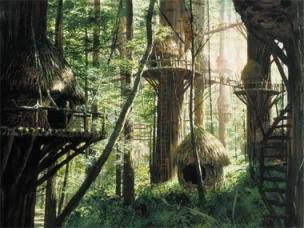
During this time, Some elves sided with the men as the only way to survive and the obvious heirs to their previous glory. Happy for the protection and friendship of the newly formed empires of men, these entered into loose alliances and maintained simple pastoral ways as deer herders dwelling in woodland villages high upon enchanted flets. These became known as the Wood Elves. The Wood Elves are on the side of the Law.

Most of the elves, however, fled into the wildernesses of the world into a forlorn life of hunting and gathering. As human hunter and gatherer societies usually consist of a few extended family groups meeting occasionally as entire tribes, elven hunter gatherers walk completely solitaire, meeting occasionally in small family groups. Their dwellings are stumps and ancient trees which only they know how to open and close. These became known as the Sylvan Elves. The Sylvan Elves take no sides any longer but their own. They are Neutral.

A few elves, however, resented the rise and ascendence of men. They refused to relinquish the former glory of the Silver Age, or even admit that it had ended. These elves dwell in enchanted castles and keeps, waylaying human travelers and imprisoning them. They try to continue to live lives of opulence and excess and to convince others of the same. These became known as the Gray Elves (either for their grave countenance upon meeting men, or perhaps due to their typical gray cloaks or, again, perhaps for the grayness of the stones of their castles -- when visible, whichever no one knows). The Gray Elves disdain human law and the ever increasing tide of human rule which they claim encroaches upon their rightful inheritance. They are therefore on the side of Chaos.

Now, with the Bronze Age Collapse, in this Age of Adventure, when parties explore the wilder lands of peril, they may be waylaid or may discover the hidden homes of any of these kinds of elves. But woe to those who fall into the traps of the Sylvan Elves, and even more so to the enchantments of the Gray Elves.

In terms of mechanics, the vast majority of the remaining elves within the Perilous Realms are the hidden and secretive Sylvan Elves. But just exactly because they are so well hidden, they are the least likely to be encountered. So, 1:6 chance that a random elven encounter in the wilderness is with one of these. If so, it means that the encounter happened at night.

The greatest minority of elves would be the Gray Elves. But just exactly because they are so militant against human rule, they are always the elves encountered when a stronghold or castle is elven. Or, if randomly encountered, 1:3 chance that it is a party of Gray Elves.

Finally, a significant minority of the remaining elves within the Perilous Realms are the friendly and lawful Wood Elves. Whenever discovering an elven village, it will be Wood Elves. And most of the time, 5:6, if there is a random elven encounter in woodland regions. Otherwise the chance of encountering a party of Wood Elves is 2:3.

In terms of playing-characters, the kind of elf you play would be based upon your choice of alignment. A backstory could quickly be spun about how you choose adventure and the company of men, etc.

This allows me to blend rather seamlessly Tolkien-style, Anderson-style and folklorish elven source material. I intend this to contribute to a rich, interesting, but still thoroughly vanilla fantasy setting -- one of the main goals of the Perilous Realms campaign!

Fight on!

Saturday, September 1, 2018

Armor Class, Movement, and fiddling with the archetypes


Why would I buy a two-handed sword if it still just does 1d6 damage?

Because, although you cannot wield a shield with it, it acts as a shield itself.


Why would I wear anything less than full armor class 2 as a fighting-man?

Because decreasing armor class increases encumbrance and thus slows movement.

AC, Encumbrance, MV table
AC
Limit
Move
9
900p
12”
8
800p
12”
7
700p
12”
6
600p
9”
5
500p
9”
4
400p
9”
3
300p
6”
2
200p
6”

We use the four M's for our combat round cycle:
Missle
Magic
Mêlée
Move

If your MV rate is better than that of an opponent, you might get an extra attack during the movement phase of the round.

Formula: difference greater than 3 = success. Difference 3, opposing check on 1d6, +1 to the party with the higher rate. Equal rates, opposing check on 1d6.


But I'll throw in a bonus side affect for you: you get to be a fighting-man that looks like Conan the Barbarian.

Recall that I allow both shields and helmets to decrease AC by 1. They just can't do so cumulatively such that you would go below your class limit.

I'll even throw in something extra for you: ring mail costs and functions the same as leather. So you can wear a big ring-mail shirt, a horned helmet and wield a two-handed sword and function at armor class 5. (Or look like the above picture: no helmet but shield and regular sword. Whatever. You get the point.) You get the benefit of attack during movement phase. You are welcome.


Why can't elves wear regular armor?

Recall that, because of the nails the crucified the King of Heaven, all iron is hallowed, stopping all (non-clerical) magic.

But elves can wear bronze armor, it costs and functions the same as chainmail. Most magical armor is ancient, thus already made of bronze.


Then why couldn't magic-users wear, say, at least leather armor?

Silly. Don't you remember that, in order to cast spells, magic-users must utter the words of power and engage the somatic gestures that resonate the spell across planes? Armor would weigh down and block the somatic resonance. Everybody knows that.

Fight on!

Saturday, May 5, 2018

Character Record


The search or the ever elusive character record continues. Above is my current character record. Here is some brief rationale and commentary:

I want it too look old school, like something printed back in the day. Hence the boxes and the old school fonts. (I have an even smaller version, using a font that looks like a type-writer.)

I hate it when I find someone's character sheet and there is no player name on it. So I made that the first thing. I'm always bummed when people have no idea how long they've had a character (including me), so: problem solved.

By character description I really mean epithet(s) and extraction, not some "background." Hence the brevity of space.

I want this record to be usable by folks who have never played and by folks who have. I want it to be usable by players that roll their own dice and also to work well for situations where I play it really old-school and I roll all dice, for everyone, behind the screen. I love playing this way and it frees the players up to figure things out and role-play.

Thus "title" is more important than level. Titles are fun and interesting and aid role-play. The levels can be jotted down in parentheses for those interested.

Likewise knowing who's side you are on is easier to make sense of then "alignment." Also, when law vs. chaos is not much more than just "shirts vs. skins," we can avoid the unending philosophical contemplations of the nature of the "alignment system."

I play race as class in my 0e games, so I just list them in the same box with a slash mark.

The first five boxes can be read out pretty straightforwardly: John's Character is Jack the Fat-lipped of the Sundown Marches; he is a Veteran Lawful Fighting-Man.

Ability Scores, sum of 3d6, each, straight down the line, no funny-business. I use Delta's abbreviation of Charisma, "X," from the Greek Chi, thus distinguishing it from the "C," for constitution.

What the heck is "apotropy"? Okay, so I know you are mad at me about this. But remember the principle from above that I want this for new players and for folks who aren't even going to be rolling dice. Okay, I hear you say, now you've lost me. But hold on. Let's look at the other boxes and come back to this one.

Reading Philotomy's Musings on the nature of hit points got me trying to call them something else. I started calling them "luck points," you know: "you're down on your luck, man; your luck is running out!" Etc. I explained this to a group of folks that included three Ph.D.s in psychology. One of them said, "oh, I get it, it's resilience, isn't it?" "Yes," I said, "resilience points." And it just kind of stuck. But for those who know or want to work with the mechanics, there is "HP," right there, still listed to the side.

I use Delta's Target-20 method for both attack rolls and saving throws (see my house rules summary). Most new folks -- and all folks when I do all the rolling behind the screen -- only need to know what kind of weapons they have. If they tell me what weapon they are using and what they are trying to do with it, I can take it from there. But for those who want the old mechanic or demand to "roll their own," then the mechanic is right there next to it, "(HD)."

Likewise, players who don't want to have to fiddle with mechanics do like to know if they have armor on or not, and if so, what. And as long as they can read the handwriting and tell me what they've got, then I know their armor class anyway. Again, you can write the armor class right there next to it in parenthesis, as suggested by the "(AC)" immediately to the right of "Armor."

Every old-school character record needs to have a box for "languages." That is how you figure out what is going on behind that door you are "listening at"!

Gold. Well there you have it. I used to call this box "Treasure," and then list "Purse g.p.," and "Bank g.p." But then I would say, "Hey, how much gold do you have left." And they would say, "Gold? gold? Where is that on here?" So now, although the game is about Monsters and Treasure, the character record just boils it down to what we are all looking for: Gold (piece value). Because, well, gold is experience. And experience is everything.

Gold is next to Armor, above it. Because starting armor comes from starting gold. And Gold is next to Equipment (which is next to Supplies), below it. Because you buy equipment and supplies with gold. Nice, right?

That is something else I was going for with this record. I wanted things also to have a logical coherence. It is pretty good, but not perfect. So experience affects level, and thus title, which in turn affects hit die, which in turn affects hit points and even saves. So all those mechanical things are clustered together on the right side.

But I also did that on purpose. If you go straight down the right-most column you have everything that most players need most of the time. You already know your characters name (right?). So you can glance down the right side and see your character's: Title (Lvl.), Experience (XP), Resilience (HP), Armor (AC), and (most importantly), GOLD!

The first thing I suggest under "Notes," is that "Last Will & Testament," urged by Men & Magic.

All those supplies listed do not indicate that the character actually has them, yet, without purchase. Nor does it suggest that you must purchase those and only those. The idea is to help out the new players with some key suggestions. I always recommend that they place the amount they purchases in parentheses next to the item listed, and then use tally marks to count them down so that they know when they need to supply up again. So, for example, Torches (6), followed by tallies until all 6 are gone. Then, if you make it back alive, buy some more torches. Rope? I hear you ask. Yes, rope. Hemp romp gets 5 uses and silk rope gets 25. I'm just tough that way.

So how about that apotropy? Well, I thought you'd never ask. Now that I've convinced you that I've done a (pretty) good job of rendering mechanical things into handy nomenclature (Resilience, Weaponry, Armor, etc.), I can tell you that that is what I am trying to do with Apotropy. I had been calling it "Resistance," but it sounded to much like electrical engineering (or freedom fighting, or whatever). Apotropaic magic is magic that wards off magic and other unlucky things. These are like talismans, amulets and charms. So this is a place for folks to jot down apotropaic objects and spells they may have in place, like a ring of protection, or whatever -- and then remind me they have it so I can factor it in when I roll their saves behind the screen! Those who know, or want to know, what is going on still have "ST," for Saving Throw(s), listed there in parentheses immediately to the right. I use a single save, but other's could easily list all five if they wanted to. So, anyway, you may not be thrilled by my word choice, but, hopefully, you get what I was trying to do: give new folks and non-rollers a box that makes some sense that can double as a saving throw box for those who want it.

(If you like this and think you might want to use it, the full-sized photo is available for download on my Character Record page.)

Friday, February 2, 2018

Rolling Characters On-The-Fly


Armor, FM:
d6+1

Weapons, FM: d6:
1 Magic Sword
2 Sword and Bow
3 Sword
4 Spear and Dagger
5 Club and Dagger
6 Club

Magic Sword on d6:
1 +3 Lightning
2-3 +2 Magic Missile
4-6 +1 Light

Armor, CL:
d6+3

Weapons, CL:
High: mace
Low: club

CL: healing potion; turn undead (reminder)

MU d3:
1 Sleep
2 Charm
3 Light

Gold: 3d6, straight-up

Note: I used the above to roll-up the middle-schooler's characters on the fly so that I could drop them straight into play. It worked. Lots of fun.

Saturday, September 23, 2017

House Rules Summary page


Hey, folks. I just put together a new "page" on my web log:

House Rules

Wherein I summarize my house rules for table play.

This house rules summary compresses into brief form the house rules I suggest in my Perilous Realms supplement.

NOTE: I freely utilize DELTA's "Target 20" approach. Thank you, Delta and your D&D Hot Spot!

I look forward to any comments.

Fight on!

Sunday, February 1, 2015

Ability Scores and "Modifiers" in Dun Kells


One of the things that some folks complain about in 0e is that "ability scores don't mean anything." Some say this to the degree that they simply drop them.

In Dun Kells, I have decided that a 3d6 check against ability is something I want to do, but not all the time. For normal exploration and combat I want role-play and rulings to determine the outcome. But sometimes players want their characters to attempt something pretty crazy, gonzo, or, well, just difficult. I want ability checks, as a referee, so that the dice can play the "oracle" for me that I can interpret. I don't want it to turn into "New School" style "feats" and "skills." I just want some probability to be added to the mix so that I, as ref, have something else to help me to interpret what is going on and the likelihood that characters are successful, and the degree to which they are successful.

I also decided, contrary to what A LOT of fellow Old School folks like, to use the B/X modifier table:

18 = +3
17-16 = +2
15-13 = +1
12-9 = n/a
8-6 = -1
5-4 = -2
3 = -3

I like this, because it allows me another way to get ability scores to "mean something" in the game. The modifiers apply to various game mechanics such that one's ability scores affect other game mechanics than simply ability checks.

So, some examples: strength modifiers directly apply to melee "to hit" and damage, dexterity modifiers directly apply to range fire "to hit," constitution modifiers to hit point rolls and restoration, etc.

I realize this makes my game a bit more "crunchy" than many Old Schoolers like. I am willing to take that. I just want the ability scores to "mean something"! And I don't think it is too much crunch, just a little arithmetic. Players might choose simply to factor it into their "to hit" schedule directly rather than adding it per roll. There are ways for them to get used to it. And I believe they can and will get used to it.

Finally, I think it adds to the "flavor," or "feel" of a character, making role-play more fun - both for me and the players. And not just in the "bonus" category. Imagine someone who, astronomically, rolls a 3 for strength, but is determined to play a "knight" (the "fighting man" of my campaign). Well, now that is going to grant some very interesting situations that the player is going to have to role-play!