Showing posts with label rules. Show all posts

Sunday, July 12, 2020

Campaigns and Dungeons & Dragons


This is the fourth post in a series of post where I explore the subtitle of Dungeons & Dragons as a means of empowering hobbyists to start their own Medieval Fantasy wargames campaigns.

The previous post was on "Rules," this post is on "Campaigns," or, wargames campaigns.

Wargames Campaigns


Napoleon didn't just fight one battle. The Napoleonic wars were not won by one battle. In actual warfare, often, many battles are pitched as part of an overarching war to attain victory. And not until many battles are fought does a victor emerge. A general, or a king, goes on a war campaign. And this campaign consists of a series of battles that are strategically designed and carefully operated in order to gain victory.


This series of connected battles, towards the end of winning the war, is called a campaign or a war campaign. Likewise, wargamers who are interested in playing out historical wars also become interested not just in playing-out one given battle but in putting a series of related, connected battles together where the outcome of one battle affects the setup of the next battle. They're going to string these battles into a campaign. And this is what is called a wargames campaign.


The key feature of a wargames campaign is that more than one battle is set up and run as a game. But these separate games are connected to each other and the conclusion of one wargame has an affect on the setup of the next wargame much like how, in a real war, multiple battles are pitched before victory is clear.

Wargames campaigns can be done at very high levels of abstraction or at a very detailed level depending on the interest, time and energy of the wargaming group. But wargames campaigns require a different set of rules than those needed to resolve battles with miniatures on a table. You need one set of rules for how to determine the outcome of one given battle on a table of miniatures. But in order to connect the outcome of that battle with the next battle you need an overarching set of rules that logically and coherently connects disparate battles together. You need a set of campaign rules.


Map Campaign


There are many different ways to set up a campaign but I'm going to explain one particular kind called a "map campaign." Map campaigns are one of the first and earliest forms of wargames campaigns. In this kind of campaign you take your wargaming table and let's say that it is four feet wide and eight feet long. And you use it on, say, a scale of one inch for 10 or even 100 yards. Then you get out a very large sheet of paper, and a ruler, and you divide along the top every four inches. Then you divide along the side, every eight inches. So you’ve divided this very large piece of paper into separate rectangles, four inches by eight inches. Then each four by eight-inch rectangle represents one battle ground on which you could set up a wargame.


Now you take this sheet of paper, that has been divided into four by eight rectangles and you either overlap that on top of an actual historical map, to scale, or you invent your own situation and imagine an area and some terrain.


You might start one army in one town, and the other army in another town, and then the referee would ask the players for their orders. The players give very detailed written orders to the referee. This is a complex situation where ideally a given player is unaware of the other players’ orders until executed. This is a case where it not only helps but might possibly be necessary to have a referee. The referee reads the orders and determines for example, whether any two armies have sighted each other.


If two opposing forces have met, then you set up your game table for a miniature wargames battle and resolve the conflict using the rules for a wargame that your group had already been using. Upon the conclusion of the conflict you note the outcome of the battle and decide what that means going forward as the campaign continues. This map, then, becomes the means for piecing together all of these different possible battles that could be pitched on your gaming table.


Dungeons & Dragons as a Map Campaign


In Dungeons & Dragons, in the third Little Brown Book, “The Underworld and Wilderness Adventures,” Gary Gygax and Dave Arneson suggest that you need a map of the immediate terrain surrounding the entrance to the underworld. That map of the overall area would have suggested to fellow wargamers something like a map campaign.


Keeping this in mind helps us to remember what the subtitle meant when it said that these were rules for a wargames campaign. The word "campaign," has taken on new connotations in the on-going growth of Role Playing Games (RPGs). But the original sense of the word was that of logically connecting wargame battles into a single campaign. The rules for the resolution of combat were one game. The rules for connecting the wargames together and including things like supply chain, economics, population, recruitment, leadership, political powers, espionage, diplomacy, and the like, were a different game or even set of games. Remembering this clears up some confusion for folks that come to the original rules only familiar with RPGs that see themselves as a single unified rule-set.


The rules for resolving an individual battle are different from the rules that connect particular battles to one another in a coherent campaign. If your group were conducting a wargames campaign, just as your group over time may have developed its own rules for resolving individual battles, so too over time your club might have developed rules for a campaign so clear and coherent and so seemingly realistic to the historical period you were trying to game, that you might think, "Hey, this is shareable too."


So sometimes wargamers would publish not just rules for resolving battles but they would also publish rules for how to set up a war games campaign. One of the most famous of these is by Donald Featherstone. Another good example is C. S. Grant’s Wargames Campaigns. One really famous set of rules for wargames campaigns relevant to the topic of Dungeons and Dragons is Tony Bath’s, "Setting Up Wargames Campaign." Tony Bath deliberately chose a fantastical medieval wargames setting for his campaigns for the simple reason of not having to worry about getting the history perfectly correct. Wargamers were used to these two aspects of their hobby, battle resolution and campaign organization, being published separately from one another.


Rules complete as rules for campaigning


This is what Gygax and Arneson were doing when they first published Dungeons & Dragons. They were not publishing a comprehensive rule-set that included both campaign rules and combat resolution rules. They were publishing what it would take to coordinate other rules together into a campaign.


The booklets themselves often refer the reader to other rules, like Chainmail, or the boardgame Outdoor Survival. Gary Gygax and Dave Arneson understood that any rule-set for resolving medieval warfare would do the trick. What Gygax and Arneson were offering were not so much the rules for running individual wargames battles, although some outlines of how to do so were suggested. They assumed that your local group had rule-sets available for resolving given wargames, so, instead, they were offering rules for how to string together a series of wargames into a campaign. The rules are not incomplete for a wargames hobbyist. They give everything needed to start one's own medieval fantasy wargames campaign as an amateur hobbyist.


We now have everything in place to make sense of the subtitle: "Rules for Fantastic Medieval Wargames Campaigns." I hope I have shown how helpful understanding the subtitle is to understanding what Gygax and Arneson were up to, and towards understanding what the original publication called "Dungeons & Dragons" has to offer -- and what it does not. I my posts inspire some readers to use the guidelines suggested in Dungeons & Dragons to launch their own, unique, medieval fantasy wargames campaign. 


Now that I have concluder this reflection on the subtitle, I am set for a two  part series on how we have come by the supertitle itself: Why "Dungeons & Dragons"? Once we have this in place even more will start to make senes about the original published rules for medieval fantasy wargames campaigns.


Fight on!

Sunday, July 5, 2020

Rules and Dungeons & Dragons


This is my third post in a series of posts where I look at the subtitle of Dungeons & Dragons as a way to allow the rules to provide a launch point for one's own wargames campaigning.

The last post was on Medieval Fantasy and Dungeons & Dragons. This post will be on what "Rules" mean in the context of the original publication.

Free Kriegsspiel and referees


One significant tradition within wargaming goes back to the use of wargaming as actual training for young officers in 18th and 19th century Europe. This tradition was called, "Kriegsspiel," which is German for wargame.


One particular branch of Kriegsspiel that developed early-on and that influenced all subsequent hobby wargaming, was called, "Free Kriegsspiel." Free Kriegsspiel recognized that the circumstances of war cannot be covered exhaustively by written rules because reality is complicated, difficult to know, and the human mind is finite. You can't possibly map every thing that would go into a possible battle into a perfect rule-set. So in Free Kriegsspiel you would get somebody who had been in so many actual, real world battles, that they knew what combat was like and what warfare was like, such as some old officer who had seen many battles.


Then you would get these young officers in a room, and you'd have a map, and you'd have pieces of the map to represent different forces. And then they would divide up into two different sides and the two different sides would issue their orders to their soldiers, and then this seasoned officer, that was acting as a referee, would judge who he thought would be the successful party in this particular battle based on his actual lived experiential knowledge of how warfare worked. So in the Free Kriegsspiel tradition you trusted a veteraned officer to make a judgment call as to whether your orders were good. And then that old seasoned officer could coach you and say, "in future don't make that decision because you'd be flanked, or you'd be outnumbered, or you'd be outrun. Etc.”


In this way, Free Kriegsspiel provided excellent training and mentorship for future officers. This in turn influenced the wargaming hobby where, even though you might have some rules, such as dice mechanics, to give the feel of randomness and probability, nonetheless, in some cases, you would want to have a referee. The referee would be somebody who was so familiar with war that he could make judgment calls based upon described actions. The referee might roll the dice if he or she felt like he or she needed more information than just orders.


The person that you'd appoint to be the referee over your game would be somebody who had real expertise in the history of war, into historical wargaming, and had accounts of so many battles and so many different types of warfare that you trusted his or her judgment call in a game. The role of referee in wargaming depends upon real knowledge of warfare.


One obvious example of where you would need a referee in wargaming would be when you have too many for the players alone to manage all the information and play well at the same time. Or, trying to agree to the meaning of certain actions and rules may take so long to judge that play gets bogged down, and something that is supposed to be entertaining is turned into a bore. Or, you might need to have a situation where certain information is secret to other players to simulate the unknowns of war, such as espionage or scouting. So there's practical gaming reasons why you'd want to have a referee. The tradition of referees in Free Kriegsspiel gives the advantage of less rules to know and interpret together with a faster-paced game.


Referees and "Dungeon Masters"


The tradition of Free Kriegspiel referees lives on in Dungeons & Dragons. Later publications by the same name would introduce the term "Dungeon Master." But the original Little Brown Books knew no such phrase. The person to facilitate the session was a referee, just as in Free Kriegspiel. And just as in Free Kriegspiel, that person was expected to be expert in all the relevant areas of knowledge necessary to make the game "realistic," or, in the case of fantasy, as true to the sources, the literature of Sword and Sorcery. In the case of the wargame hobby, this "expertise," is amateur, not professional in nature. This goes back to the original sense of the word "amateur," as someone who just does it for the love of it. There are many cases where an amateur can know more than, or have much more facility with a topic than a so called professional. And that is the kind of expertise we are looking for in this hobby.


Rulings, not rules


The "rules" of Dungeons & Dragons follow this tradition of Free Kriegsspiel. Playing Dungeons & Dragons requires a referee. The booklets themselves encourage referees and groups to interpret the rules in different directions. Referees are encouraged to build their own rules. The building of local, hobby wargaming group includes the assumption that each hobby group, just as with the wargaming hobby in general, will wind up having its own peculiar, local rule set that works for them and that reflects the campaign they have developed on their own.


In his Quick Primer for Old School Gaming, Matt Finch has coined the phrase, "Rulings, not rules," in order to try to catch, in a single pithy, easily memorable phrase, the pith of this approach. The point is that the referee is trusted to make good calls for each unique situation that arises, due to his or her expertise in medieval warfare, medieval fantasy literature, dice probabilities, traditional wargame mechanics, and the like. Over time, these rulings would become a unique set of rules for each wargame club.


For contemporary ears to hear the subtitle of this game correctly, then, it should almost be changed to "Guidines," or "Ideas," or "Suggestions," "a Framework," or "Examples," "for Medieval Fantasy Wargames Campaigns."


Next in the series: "Campaigns"


Sunday, June 28, 2020

Medieval Fantasy and Dungeons & Dragons


This is my next post in a series of posts that looks at the subtitle of Dungeons & Dragons in order more readily to launch our own hobby campaigning from the original publication.

Last post, I wrote about "Wargames." In this post I will talk about the phrase, "Fantastic Medieval," in the subtitle, or, as we would say it now, "Medieval Fantasy." "Fantastic Medieval" sounds like something medieval that we thing is just awesome: that is fantastic! But that is not what the phrase meant at the time of its publication. For contemporary ears to hear the subtitle, correctly, it should be changed to something like "Rules for Medieval Fantasy Wargames Campaigns."

Medieval Fantasy


Wargaming was and is a hobby for folks that dig the study of history. History includes the middle ages and ancient civilizations. So another area of interest that quickly developed for wargamers was medieval and ancient wargaming. It would not be long before wargamers were willing to move beyond the walls of the historical and engage the literature of fantasy.


At the time that Jeff Perren and Gary Gygax published Chainmail as a set of rules for resolving medieval wargames, Gary Gygax had already developed an interest not only in the historical western middle ages, but also medieval fantasy literature. Gygax added a fantasy supplement, to the end of the Chainmail rules for folks that were interested in adding to their wargaming hobby medieval fantasy troops like elves and hobbits, dwarves and gnomes, orcs and goblins, and monsters like giants, dragons and the like.


Gygax added to what was already the base rules of a fairly realistic historical medieval wargame, ways of resolving the possibility of a dragon showing up at one of those battles. He did this for the same reason that historical wargamers would play-out battles that already existed. Just as the historical wargamer would study actual battles from history in order to understand how to set up rules and judge games as a referee so too if you were interested in medieval fantasy literature, you might want to completely redo a battle from one of your favorite pieces of medieval fantasy literature.


The Chainmail Fantasy Supplement list, for example, the Battle of the Five Armies at the conclusion of The Hobbit by J.R.R Tolkien. So Gygax suggests that if you take the Chainmail set of rules and add to it this supplement for medieval fantasy, you can engage an actual fantasy battle as described in the relevant authoritative literature. When you feel like you'd developed enough knowledge of how fantastical battles worked out you might then try your hand at your own hypothetical medieval fantasy war game battles.


Fidelity to the literature


Just as historical wargamers worked to make sure their game was as faithful to what might have happened on an historic battlefield, so too, fidelity to medieval fantasy literature in general and Sword and Sorcery in particular, formed a significant part of this new aspect of the wargaming hobby that Dungeons & Dragons introduced.


A referee would know how to judge whether something was possible, in this medieval fantasy world because they were so familiar with the medieval fantasy literature they were gaming. A key part of Dungeons & Dragons is the love of becoming an amateur expert in medieval fantasy literature. High fantasy, low fantasy, especially sword and sorcery, urban legend, classical mythology, Arthurian legend, Carolinian cycles, Nordic sagas, all form part of the expertise needed to set up and play in a medieval fantasy role playing game.


But, in the main, the particular style of medieval fantasy literature that influenced Dungeons & Dragons was what Fritz Leiber named "Sword and Sorcery." This is important to know because Dungeons & Dragons is built better to play in this kind of fantasy world than in others. Later editions of games called "Dungeons & Dragons," have shifted from this original base towards more heroic and high fantasy. So sometimes the original game is confusing to folks coming from newer RPGs. Learning about Sword & Sorcery and reading some of its core texts helps in understanding Dungeons & Dragons and helps the amateur hobbyists to build his or her own campaign.


"The general line-up”


What I've written about so far helps us to understand certain aspects of the game. For example, the taking of sides, or what would come to be called "alignment."


When you are playing a wargame, you need to know the sides of your battle and that's exactly what's going on in the Chainmail fantasy supplement with its “General Line-up.” This gets reiterated in Dungeons & Dragons’ Men and Magic. You have the alignment table to give you sides. The big battle is between law and chaos. Some creatures are on the law side and some creatures are on the chaos side and some can go either way. Then there are some creatures that just opt out of it altogether. They're not on the side of law or chaos, they're just for themselves and these because they don't really want to wage the war between law and chaos are called neutral, like Switzerland and its diplomatic neutrality. So if you're setting up a war game table, one side is chaos and one side is law, in this medieval fantasy war game context.


These categories are derived from medieval fantasy. For example, they are implied in Tolkien's Middle Earth around the War of the Ring. But these terms, "law," and "chaos," are explicit in Sword and Sorcery literature, especially that of Poul Anderson and Michael Moorcock. So, again, we have a fidelity to the literature they were trying to game.


Race


Finally, briefly, we can understand where the use of the term "race," came from. Race was a term already used in medieval fantasy literature to distinguish human characters from other intelligent beings that were not gods or spirits. Especially there would be the fay races, such as elves and dwarves, and the fell races such as orcs, goblins and trolls.


This is not how we use the term "race" in contemporary parlance, so it can throw people off. This is not about supposed differences in human groups. If the fantasy rules were put together today, someone might have chosen "species." Although, even that is misleading in a fantasy context, where a word like "species" would sound to empirical and scientific. So this terminology has stuck and is a part of the shape of medieval fantasy wargame campaigning.


Next in the series: "Rules," free kriegspiel and refereeing.

Sunday, June 21, 2020

Wargames and Dungeons & Dragons


This is my first post in what will become a series of posts that I hope will be helpful for folks trying to understand Dungeons & Dragons as a hobby and especially the original published rules that empowered hobbyists to launch their own campaigns.

Introduction to the series

The subtitle of a published work is always the real title. Studying a subtitle, when provided, will often tell you more about what the author understands the work to be about than the main title.

The original subtitle for the first published edition of Dungeons & Dragons is:
Rules for Fantastic Medieval Wargames Campaigns.

The real title, therefore, is "Rules for Fantastic Medieval Wargames Campaigns." A lot of the misunderstandings or confusions about Dungeons and Dragons* comes from not understanding what the publication really is. In order to understand what the first "little brown books," or, LLBS were really offering, one needs to know what a wargame is, and, better, have some contact our hours of actual play. One needs to know what a wargames campaign is, which means one needs to understand war enough to understand that it is a campaign comprising a series of battles, not one battle. One needs to understand what was considered "fantastic medieval" at the time of its publication. Finally, one needs to understand how hobby wargammers understood "rules" to work and what they meant and how they used them.

Once these things fall into place, Dungeons and Dragons suddenly starts to make a lot more sense and to become much more accessible as the launch point for one's own hobby. So let's start with the central word of the true title, the word that all the others build-off of or modify, the word "wargames."


Wargaming


At the time that Dungeons & Dragons first appeared, the hobby called wargaming had gained fair popularity. The hobby consisted of casting or collecting miniature figures of soldiers of different military eras, painting miniatures, preparing large tables with scenery and terrain, etc. You would then conduct a wargame where you would, perhaps, relive an historical battle or maybe even perform a hypothetical battle, a battle that could have taken place but that actually did not.


So what is a wargame? Well, it is first of all, a game. Like most games, you have players, you have goals and victory conditions, you have pieces, you have a setup, and you have rules to the game. Wargaming is about war. So it's a game that's particularly focused on trying to play-out, to varying degrees, combat or warfare of an historical period.


Wargaming as History hobby


One of the things that wargamers really love is history. To be a good wargamer you had to know war, and the history of war. To know the history of war meant you had to research and study. One of the major parts of the hobby of wargaming is historical research. It is the research of historical facts, knowledge, information, that is part of what's fun about the hobby to historical wargamers.


Hypothetical possiblities


Now, in some historical wargaming, what you're really trying to do is set up all the conditions of an historical battle that actually happened and that you knew existed. Then a group might decide, "Well, what if other battles were fought that were never recorded in history? Or what if we just made up a battle that would be fun to pitch and see what that was like? We're going to use the same soldiers, the same groupings of soldiers and the same statistics matched to dice rolling. We'll play out what would happen in this hypothetical situation."


For example, one particular historical period that a lot of wargamers like to focus on, among many, is the Napoleonic era of warfare. There's something very attractive about Napoleonic warfare for various reasons. One is that the troop structure was quite organized. It was one of the first set of wars where lots of records still exist that were kept meticulously and mathematically. Someone can do mathematical analysis on Napoleonic battles and learn the probabilities of one army defeating another army.


Dice Mechanics


This meticulous information is really fantastic for wargamers, because what wargamers figured out pretty early on in the hobby was that the chances and vagaries of warfare could roughly be emulated by rolling dice. A single die will turn up random chances. But when you start rolling combinations of dice they roll up in probability curves. If you can find a probability curve in a combat situation, you can find a matching way of rolling dice to simulate that probability. So with all of the data that existed from Napoleonic warfare, wargames hobbyists can, fairly well, emulate the outcomes of an actual battle.


What we have discussed so far can already help us to understand some of the terminology and approaches of Dungeons & Dragons.


Alignment Table


Having some understanding of Dungeons & Dragons wargaming context helps make sense of some of the presentation of the rules that might otherwise seem confusing. For example, I used to wonder why there was an alignment table in Men and Magic separate from the monster table and stats in Monsters and Treasure. If you're playing Napoleonic wargame, you need to know which side of the table to place Napoleon and which side to place Wellington and then set-up those armies. If you're doing a map campaign, you need to know where is France and the central cities that grant resources to the French army and where is England and where are the central cities that grant resources to the English army and navy.


You need to know the sides of your battle and that's exactly what's going on in the Chainmail fantasy supplement with its “General Line-up.” This gets reiterated in Dungeons and Dragons’ Men and Magic. You have the alignment table to give you sides. The big battle is between law and chaos. Some creatures are on the law side and some creatures are on the chaos side and some can go either way. Then there are some creatures that just opt out of it altogether, like Switzerland. If you're setting up a wargame table, one side is chaos and one side is law, in this medieval fantasy war game context. So right up front, in the first book, you've got a list of the sides and who might not take a side.


Classes


Dungeons & Dragons has fairly strictly defined classes for characters because Gygax and Arneson applied this notion of classes of troop-types from their hobby of historical war gaming.


Let's look at Napoleonic warfare again. You're going to have classes of troops, types of troops, so in the classical Napoleonic context you are going to have infantry, cavalry and artillery. If you want to make it even more complex level of detail in order to try to snatch a little added realism, then you're also going to have dragoons, light infantry, heavy infantry, light cavalry, and heavy cavalry, heavy artillery, and light artillery for a greater level of scale of detail. But each of these types of troops are different classes. You know exactly what artillery can and can't do, you know exactly what infantry can and can't do, you know exactly what cavalry can and can't do. You know what their attacks are like, you know what their defenses are like, and you know what their movement rates and capacities are like. This enables you to develop your strategy by having clearly defined classes on your battle table.


Gygax and Arneson were used to this approach to things. They developed the fighting-man, the magic-user, and eventually the cleric. And these became character classes. As in Napoleonic game you would have artillery, cavalry and infantry where each of those classes of troops have clearly defined the capacities of movement, attack, and defense, so too then the fighting-man, the magic-user, and the cleric have different capacities, abilities and liabilities that define the way that they will be played and will influence the way in which they can come together as an adventuring party to be successful together.


Wargaming didn't have to just be Napoleonic, for hobbyists interested in war history. So wargamers would also try to set up situations where they could emulate, historical or hypothetical, increasingly more modern warfare like World War I or World War II era warfare. Eventually, wargamers would get interested in ancient and medieval warfare. And from there, to "fantastic medieval" warfare!


Next in the series: "Fantastic Medieval"

Fight on!

*A note about "Dungeons & Dragons": There have been many products professionally published bearing the name “Dungeons and Dragons.” At the time of the release of this post, we have what Wizards of the  Coast call the Fifth Edition. In this blog series, I will not refer to an edition number when I say, “Dungeons & Dragons.” Rather, when I say, “Dungeons & Dragons,” I will be talking about Gary Gygax and Dave Arneson’s rules for how to put together medieval fantasy wargames campaigns that were first published in 1974 by TSR. This is what some people call the original rules. Sometimes these rules are referred to as, “Original Edition Dungeons & Dragons,” "Original Dungeons & Dragons," or, "OD&D." Sometimes people will abbreviate it as, "Oe", meaning, "Original Edition." Or even "Zero-e," meaning, "Zero Edition."

Bibliographical Note: Much of this post and any posts I share about the history and historical context of D&D is based upon the book Playing at the World by Jon Peterson.

Sunday, June 7, 2020

Wishes


Okay, here is my first pass at some rules around wishes for my Perilous Realms campaign. These are inspired by the Judges Guild Ready Ref Sheets.

Wishes

First, note level of granter:

Granter
  1. Object
  2. Well/Fountain
  3. Rainbow
  4. Moon, full, midnight
  5. Star, first seen
  6. Spirit
  7. Djinn/Efreet
  8. Power
  9. Spell
  10. Item
Objects include but are not limited to:
  • Wishstone
  • Wishbone
  • Found single copper piece
  • White horse, first sight
  • Talisman
  • Statue
Major gems are special objects with their own granter value.

Grant-level:Gem-value
1:5,000
2:10,000
3:25,000
4:50,000
5:100,000
6:500,000
7:1,000,000+

Well/fountain, in general, any given character gets one wish per instance.

Spirits are elemental and otherwise neutral powers, especially, e.g., elementals themselves, and also sometimes sylvan beings of the classical variety, such as dryads or centaurs, or of the gothic variety such as pixies and unicorns.

Powers are cosmic spirits of either lawful or chaotic alignment such as gods and goddesses, angels, demons, and the like.

The Wish spell is a 7th level arcane spell that can only be found through research.

Items are magic items with wishes like rings and swords.

Next, discern level of intent:

Intent:
2 Trivial
3 Selfless
4 Altruistic
5 Mutual
6 Greedy
8 Selfish
9 Malicious
10 Give/take life

Trivial indicates that no one directly benefits and there is no possible harm.

Selfless indicates the wisher benefits from the wish in no way.

Altruistic indicates that one or more parties benefit from the wish but the wisher benefit only indirectly.

Mutual indicates mutually beneficial to wisher and one or more other parties.

Greedy indicates the wish is only for material gain, and / or that there may be one or more other parties that benefit, but only indirectly.

Selfish indicates that the wish is only beneficial to the wisher.

Malicious indicates harmful intent.

Give/take life indicates wishes to kill or restore life, including restoration from flesh turned to stone.

Next, determine likelihood of granting, together with likelihood of repercussion upon wisher and splash on any beneficiaries. Divide Granter by Intent for percent chance granted. Subtract percent chance granted from 100 for percent chance of repercussion for the wish. Roll for repercussion whether wish is granted or not. If granted, halve the chance for repercussion for percent chance of splash on others who benefit from the wish, if any.

d100:Repercusion
99+:Death
97-98:Insane
94-96:Blind
90-93:Reverse
85-89:Geas
75-84:Quest
60-74:Disease
45-59:Curse
25-44:Charm
00-24:Sleep

Roll d100 for repercussion. Roll d50 for splash back. For both repercussion and splash, add 10 for malicious or murderous intent, subtract 10 for selfless or life-granting intent. Less than zero indicates no repercussion or splash.

Charm indicates wisher or beneficiary charmed by person place or thing related to the context of the wish and/or the situation of the granting. Referee determines.

Fight on!

Sunday, December 29, 2019

Sacrifice in the Perilous Realms


Characters sacrifice consumable goods to gods and demons. Characters specify a particular recipient of sacrifice. Characters must find a suitable altar - usually at the temple of the given entity, duly offered by recognized priests consecrated to the entity. Best to sacrifice on an auspicious occasion.

Consumable goods include vegetable (resin, incense, oil, wine, grain), animal, monster and sentient beings.

Sentient beings:
Fell beings equal XP earned in a kill.
Fay beings and lawful monsters equal 1K XP per HD.
Human beings equal 2K XP per HD.
Double the above for each of the following conditions:
  • Young
  • Female
  • Innocent
  • Willing
Multiple creatures can be sacrificed over the course of the same festival.

Most auspicious: cross-quarters +2
  • Candlemas/Imbolc, February 2
  • May-Day/Beltane, May 1
  • Lammas, August 2
  • Samhain, November 1
Auspicious: quarters +1
  • Yule, December 22
  • Liberalia/Hilaria, March 22
  • Midsummer/Litha, June 22
  • Harvest-Home/Mabon, September 22
Least auspicious: full (night of the 14th) and new moons (day of the 1st)
Inauspicious: all other times -1

Entity finds sacrifice acceptable on a reaction check. Apply modifiers based upon how auspicious the occasion is (above). Apply suppliant’s charisma modifiers. Offerings particularly abominable or favorable to the entity may modify as well. Table:

2-3    Curse
4-5    Enmity (-1 to future sacrifices)
6-8    No answer
9-10    Acceptance
11+    Favor (+1 to future sacrifices)

Sacrifice grants XP = value of sacrifice in gp.
  • Instead of XP, sacrifice may grant:
  • Magic item
  • Knowledge (divination)
  • Ethereal servant
  • Undead servant
  • Monster servant
Magic item equivalent to gp value of XP. Only grants items within entity’s realm of authority.
Divination like “commune.” Clerics receive additional questions: 9-10: 1, 11+: 2.
Servants have 1HD per 1Kgp value of sacrifice, not to exceed 16HD. Servants obey for a year and a day.

Sacrificing to an entity moves a character one alignment closer to that of the entity per sacrifice. So, a lawful character who sacrifices to a chaotic entity becomes neutral. A second such sacrifice would make that neutral character chaotic. Etc.
Any blood sacrifice on the part of a baptized member of the church of law makes that character chaotic, regardless of whether or not the entity is lawful.
Any blood sacrifice on the part of a lawful cleric renders the character chaotic and the character looses clerical powers until restored by repentance through the fulfillment of a quest or until received by a chaotic order.

______

These rules explain how certain magic users and clerics gain in life-energy without much adventure. It also explains the source of many magic items and magical powers where magic-users are not present.

The above is inspired by Courtney Campbell's On Down Time & Demesnes. Thank you, Courtney!

Friday, August 9, 2019

Few have the inclination or patience to fight under rules they did not compile


. . . little attempt has been made in this book to lay down rules for specific periods of military history, assuming that the wargammer will have obtained or formulated rules for the type of warfare in which he is most interested. To this must be added the well-established and acknowledged fact that few wargamers have the inclination or patience to fight under rules that they did not compile themselves.
--Donald Featherstone, Solo Wargaming (emphasis mine)

This really incapsulates what differentiates the (original) Dungeons & Dragons category of play from the larger category, "old school," in which if falls.

Are you playing a wargames campaign that happens to be set in sword and sorcery? Or are you playing a role-playing game and following its published rules.

Fight on!

Friday, July 5, 2019

Setting-up a Medieval Fantasy Wargames Campaign


In a previous post, I made the point that Dungeons & Dragons (original) is an approach to setting up medieval fantasy wargames campaigns. Back in the day, folks within the miniature war-gaming hobby would share their rules for how to resolve individual combats. In addition to that, they would also sometimes share rules for how to string together a series of table sessions into a coherent war campaign. In these documents, they would not focus on rules for the wargames themselves -- they assumed they were writing to wargamers who already knew such rules and probably already had their own house rules as a local, hobby, gaming group. Instead, the focus was on how to make the games link to each other, reasonably, in order to game a "realistic" war campaign, and not just individual, disparate battles.

As I thought about these things while writing that post, I began to imagine what their pamphlets might have read like if Gygax and Arneson had written them in a more colloquial style that showed very clearly that they were talking to other wargamers about what had worked for them, what they had found to be fun. Because that was in fact what they were doing. It is just that it can be lost on many of us when we come backwards to the pamphlets from complete-rules-style RPG books rather than forward from their actual wargame hobby context. I offer my imaginings, below. The actual work would be a bit more detailed, but still short enough. I leave a lot that would be fleshed out as parenthetical summaries of what I imagine they would include in the actual text. Who knows, maybe someday I'll write this whole thought experiment up?

________

Dungeons & Dragons, or
How to Set-up a Medieval Fantasy Wargames Campaign

These booklets are a set of ideas for how to turn an ordinary wargames campaign into a Sword and Sorcery wargames campaign! As with any suggestions for setting up a wargames campaign, these brief booklets give some ideas and descriptions of what has worked for us in our own campaigns. Experiment with it and have fun. Always make it work for your local group.

As with any wargames campaign, you will need to assign sides. In simple fantasy, it is usually good enough just to have "good guys" and "bad guys." But, following Anderson and Moorcock, and hints at such in Tolkien, we have named our major sides "Law" and "Chaos." Monsters, fantasy figures and characters in general fall along such lines. Of course, brute beasts don't fall along any particular line and characters may choose to "opt out" and remain neutral. (Here would follow the list of fantasy creatures by line up, or what would come to be called "alignment.")

Choose rules for resolving combat and figure out a way to factor in the fantastic. We recommend Chainmail, especially with its fantasy supplement and man-to-man rules. We tried to make combat rules and fantasy creatures match up by having monsters and characters act equivalent to a certain number of figures in a typical wargame battle. We talk in terms of "hit dice," to make sense of this. Since we assume that you are already an experienced wargammer (since you are interested in reading pamphlets about setting up an entire campaign), we trust that you are familiar with this way of thinking of these things, so you get the point. But, real quick, here is an Alternative Combat resolution to consider (here they present the "Target-20" method they introduce by means of the "Alternative Combat" tables and the concept of "Armor Class" borrowed from naval wargaming).

Okay, now here is a fun new idea: what if players not only played as "generals" over armies, but actually played individual characters within the game-world? Characters can fall into different "classes," much like then different classes of troops in a typical wargame. Make sure they are different from each other, with clear cooperative properties, so that they can work well together as a Sword and Sorcery style adventuring party.

Here are some ideas for character classes: Start with the proverbial fighting-man. Next would be magic-users. Gygax doesn't much like the idea of magic-users being playing characters, since they are usually the bad-guy in Sword and Sorcery. However, some players may want to play chaos. And you could have "good" magic-users in your campaign. So you may want them to be a character class as well. Also, we had someone who wanted to play a "Van Helsing" type character, so we introduced the "cleric." They are kind of like a crusader. They can force undead to check morale (usually, as they are "undead," they would not check morale). We call this "turning." Clerics also have some of their own kind of spells that are a bit more religiously miraculous, like healing.

Don't forget standard fantasy races such as elves, dwarves and hobbits. Give them descriptions that match what you like from fantasy you have read and that you would like to incorporate into your campaign. Here is what we've done. (Here would follow race descriptions.)

Here is another cool idea: when you play as a general of armies, you usually start with a point-buy system for hiring your starting armies. Then, through play, you can gain more points to buy more troops, thus increasing your army, etc. Well, we thought of a cool way to make this work with players playing characters at a one-to-one scale. We call it "experience" and we measure it in "experience points." Just as armies have tactical goals, Sword and Sorcery characters have the goal of treasure extraction and "looting." So we have developed a way of matching the value of a treasure safely extracted by a character to a character's "experience points." Successful victories also grant some experience. These experience points then accumulate and grant the character advancement in the game-world. We use the term "level" to describe this game-world advancement. Each time a character gains a level they gain in the respective capacities and advantages of their particular class, just like armies growing more powerful in a regular wargames campaign. Here are some ideas. (Here would follow the tables for advancement, XP, HD, spells, etc.)

Now here are some ideas about how to incorporate magic-users and their spell-casting abilities into a wargame context that keeps things fair but still "wonderful." You will find your own way to work this stuff out for your campaign. (Here is where spell lists and descriptions would go.)

Oh, and to make sense of non-combat related eventualities, Arneson borrowed from Naval Wargaming the mechanic of "saving throws." Much like determining how much hull-damage a ship has taken from, say, an underwater mine, you can use saving throws for resolving how much damage a character takes from, say, falling down, drinking poison, or being hit by a magic-user's fireball! We have also found it useful for determining if a character or creature has been affected by a spell or not. As characters advance in level, eventually their chance to save increases as well.

Another thing that we discovered to be really fun is what came to be an emphasis on the more exploratory aspect of the game. Since we have allowed a 1:1 correspondence between player and in-game character, we can set up scenarios where characters explore an unknown, usually interior and often underworld environment. Think of this in terms of Stratego or Battleship, but even more complex and fascinating as the players will need to map a potentially elaborate underworld setting. This could be maze-like or labyrinthine. Or you could have secret spaces only discovered when they have circumnavigated it.

There are a lot of possibilities here. You can set up standard things from Sword and Sorcery that often fall outside the purview of standard wargames. For example, you can have tricks and traps and puzzles that the players can solve by means of their characters interacting with the environment. Really the sky is the limit here.

We have found that the combination of the 1:1 scale and an emphasis on underworld exploration has been absolutely amazing in giving our campaigns a real Sword and Sorcery feel!

Here are some ideas for monsters. We take advantage of the use of Hit Dice to represent relative fighting power and ferocity. Other natural and magical capacities can then be factored in. We describe below what we have developed for ourselves. Again, look at our examples and then work out what would work best for you in your campaign. (Here would follow the monster list and descriptions.)

Here are some ideas for treasure. Look to our examples and work out things for your campaign. (Here would be the tables for deterring treasure, magic items and their descriptions.)

Many wargames campaigns are "map campaigns," and that is what we suggest here. The scope of the game is infinite, but just for starting out we recommend a map of a local area with several opportunities for treasure hunting in dangerous and "underworld" environs, perhaps with one big dungeon nearby. This dungeon would comprise many subterranean levels that the players can easily begin exploring before branching out into the wider world.

Start with at least three levels to this main dungeon (in case they decide to go pretty deep from the start). As they explore, you can continue to add more levels to the dungeon and expand your map to include wider kingdoms and wildernesses -- even a whole fantasy world, eventually, if you want to.

Oh, and if you find your players suddenly want to strike out into the wilderness for an off-hand adventure, Arneson has found it really fun and easy to use the Outdoor Survival board (Avalon Hill). Here are some ideas for random encounters and what to do with some of the symbols on the board in order to render them a bit more like exploring in a medieval fantasy wilderness. (Here follows the suggestions for castles, random encounters, jousting, etc.)

Be sure to keep things fresh. This is fantasy so go crazy! For example, players might think that they have "cleared" an area only to see that a bunch of orcs or goblins have made their home there -- perhaps, very thankful for their newly cleared-out digs!

Most importantly, keep it fun and make it your own. Let us know what you come up with! We always improve as referees by hearing about what other referees are doing with their local clubs.

Fight on!
_________

If you have a medieval fantasy wargames campaign that sounds like something inspired by the above -- no matter what mechanics you are using for resolving encounters -- you are playing "original" Dungeons & Dragons. So, again, I will say:

Fight on!

Thursday, July 4, 2019

Understanding Original Dungeons & Dragons


I've seen some posts on reddit and other fora asking questions like: what counts as (original) D&D, how do we know that it isn't (original) D&D anymore? What are the advantages of D&D to later editions using that name? Etc.

Here is my answer: (original) D&D is an approach, not a set of rules. It is an approach to a hobby, called "wargaming." It is an approach to a particular interest of that hobby: the wargames campaign. It is an approach to giving that hobby-interest a "Sword and Sorcery" feel.

It is not a product designed to be consumed. Repeat: not a product made by experts to be consumed by an unprofessional public. It is a set of suggestions for fellow hobby-ists, who have a rich amateur knowledge and interest in their avocation. And those suggestions were sold at a price to make the effort worth it for the fellow-hobby-ists who did the work to put it out there for you.

So, don't get me wrong, obviously, in one sense, it was a product -- Gygax and Arneson did publish and sell it. But what we need to remember is that back in that day the market for such pamphlets was small and highly specialized and understood to be a way to get ideas out and shared with some minimum compensation -- no one got into publishing about miniature wargaming so that they could quit their day job! (This is something so easily do-able because of the internet and part of the DIY vibe of some of the best "OSR" stuff that is out there. We can share today in a way that the hobby-ists of 1974 couldn't have dreamed.)

Later "editions" move more and more towards "product identity" and changing the very semantics of the name "Dungeons & Dragons" from referring to three little pamphlets that suggested how to set up a medieval fantasy wargames campaign, itself intended for an audience of other wargamers, towards more of a product making money for a particular company from a non-expert set of consumers.

Thus these companies become increasingly concerned about their rights over this "product" -- and taking ownership for its development out of the hands of the consumers. This really changed the nature and vibe of things. Remember, for quite some time Gygax simply could not understand why any fellow-hobby-ist would want to by a "Dungeon Masters Kit," or "module." Why borrow someone else's creativity? The point is to have an outlet for your own! (Then he saw the cash available in it! I do not blame him for this. It was a smart, and, probably, the right business and even hobby-supporting move. I'm just giving this as an example for the subtle shift in things.)

Why do I keep putting "original" in parentheses? Just exactly because of the above. The three little brown books are not an edition. They are suggestions from hobby-ists, to fellow hobby-ists about a particular area of interest: wargames campaigning in a medieval fantasy setting. This is not an "edition," of a "game," with a unified mechanic and defined setting.

To many of us who play (original) Dungeons & Dragons, the other "editions" of Role Playing Game rules with the title "Dungeons & Dragons" look to us like many various house-rule variants of these suggestions for medieval wargames campaigns. (But, in this case, it often feels like someone else is telling us that their house rules are now the RULES, period.)

So AD&D is Gygax' tournament house rules made official.
3.5, 4, and 5 are Wizards of the Coasts house rules made official.
All the retro-clones are cool house rule variants, shared for the rest of us.

And good for them! In fact, thanks for sharing! They are all, also, D&D! But we don't have to use their house rules, we can make up our own. And we certainly don't have to view them as "official."

So, Dungeons & Dragons (original) is an approach to setting up medieval fantasy wargames campaigns. Back in the day, giants of the miniature war-gaming hobby would share their rules for how to resolve individual combats. But sometimes they would share rules for how to string together a series of combats into a coherent war campaign. In these documents, they would not focus on rules for the wargames themselves -- they assumed they were writing to wargamers who already knew such rules and probably already had their own house rules as a local, hobby, gaming group.

So, for example, they were in no way interested in a "unified mechanic." They wanted mechanics that made sense for the type of thing they were trying to resolve, at the appropriate level of scale. (Not everything scales up and down well, like, say, a fractal. More like the cube law, sometimes things need to change to work well.) This alone explains a lot of misconception about what the original little brown books were trying to do and to offer. Folks would do better, and understand original D&D far more, if they compared the three little brown books to other books on setting up wargames campaigns, rather than to later books that came to be called "role playing games."

Here are the three I would suggest anyone interested in understanding (original) Dungeons & Dragons:

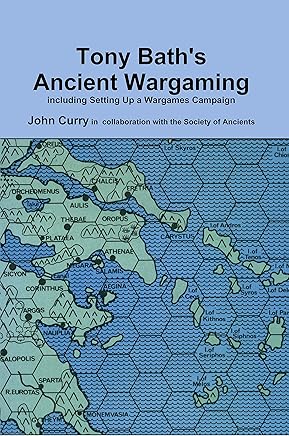
Tony Bath's Ancient Wargaming including Setting Up a Wargames Campaign:


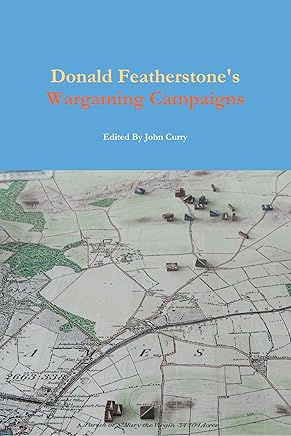
Donald Featherstone's Wargaming Campaings:


And, finally, Grant's Wargames Campaigns.

But I would especially emphasize Tony Bath's book.

Another big difference in the slow transformation from a small, wargames hobby to a large, consumer role-playing game product is the vibe of play, and what the goal of play is. And this is, in many ways, far more important for understanding the difference between "original" and later "editions" of D&D -- but that is for another post.

Before I write that post, my next post will be a kind of imaginary example of what D&D might have been worded like if it had more of the form of some of the above classical examples of wargames campaigns books.

To conclude this post, I will say, if you are involved, as a fellow hobby-ist, in a local medieval fantasy wargames campaign that, through play, has developed its own vibe, feel and corresponding house-rules, then you are playing Dungeons & Dragons, whatever other name you call it.

Fight on!

Friday, February 2, 2018

Rolling Characters On-The-Fly


Armor, FM:
d6+1

Weapons, FM: d6:
1 Magic Sword
2 Sword and Bow
3 Sword
4 Spear and Dagger
5 Club and Dagger
6 Club

Magic Sword on d6:
1 +3 Lightning
2-3 +2 Magic Missile
4-6 +1 Light

Armor, CL:
d6+3

Weapons, CL:
High: mace
Low: club

CL: healing potion; turn undead (reminder)

MU d3:
1 Sleep
2 Charm
3 Light

Gold: 3d6, straight-up

Note: I used the above to roll-up the middle-schooler's characters on the fly so that I could drop them straight into play. It worked. Lots of fun.

Saturday, September 23, 2017

House Rules Summary page


Hey, folks. I just put together a new "page" on my web log:

House Rules

Wherein I summarize my house rules for table play.

This house rules summary compresses into brief form the house rules I suggest in my Perilous Realms supplement.

NOTE: I freely utilize DELTA's "Target 20" approach. Thank you, Delta and your D&D Hot Spot!

I look forward to any comments.

Fight on!

Monday, September 4, 2017

Treasure Focused Dungeon Stocking


Scott Anderson has been engaging me over at ODD74 on stocking dungeons based upon treasure, first, rather than monsters; seeing as how that is the goal of the game - it is what gets you "points."

I have lots of people around the table when I play and we cannot play that frequently so I have altered the stocking tables. I multiplied all pieces ten-fold and I doubled the chances of gems, jewelry and magic items per level.

Treasure by Dungeon Level
 
·      Always copper
·      2:3 silver
·      If silver, 2:3 gold
 
Level treasure table
Dungeon LevelCopper* & SilverGold Pieces% Gems & Jewelry% Magic Items
11K100105
2-32K1K2010
4-510K2K4020
6-720K5K6030
8-950K10K80*40
10-1250K20K100*50
13+100K50K100*60*
*Multiply by 2d6, all else by 1d6

Over at the Ruins of Murkhill, I shared the way I describe gems and jewelry based upon the tables for determining them. Later, I added them together for convenience.
Determine and Describe Gems
 
First, determine the chance that the gem is precious or semiprecious by basic gem gp value:
d%gp ValueSizePrecious on d6
01-1010Tiny1
11-2550Small1-2
26-75100Medium1-3
76-90500Large1-4
91-001KHuge1-5
1:6*>1KGiantPrecious
*5K; 10K; 25K; 50K; 100K; 500K; etc.
 
Precious by type:
d6Type
1Diamond
2Emerald
3Opal
4Pearl
5Ruby
6Sapphire
 
Semiprecious by type:
d20Typed20Type
1Amber11Jasper
2Coral12Lapis Lazuli
3Ivory13Moon/Sunstone
4Jet14Obsidian
5Amethyst15Onyx
6Agate16Paridot
7Beryl17Quartz
8Carnelian18Tiger's Eye
9Garnet19Topaz
10Jade20Turquoise
 
If >1K gp value, the gem is always named, famous with backstory, and perhaps enchanted, cursed, charming, geased or any combination of the above. "Enchanted," indicates some magical affect for beautification and value, it does not perform any functional magic, e.g., glowing or sparkling on its own, humming, etc. 
Determine and Describe Jewelry
 
Jewelry combines metals with gems. Determine whether its setting is precious or base metal:
D%gp Value RangeChance Precious
01-20300-1800Never Precious
21-801K-6K50%
81-001K-10KAlways Precious
 
Determine metal type:
d4Precious Metald6Base Metal
1Colored Gold1Brass
2Electrum2Bronze
3Gold3Copper
4Silver4Pewter
--5Steel
--6Tin
 
Precious gems are never set in base metal. If metal is precious, there is a 50% chance it is inset with precious stones. Jewelry of 7k+ gp value will always be inset with precious stones. Role for stones using the tables for gems, above.
 
Determine type of jewelry item:
d20Typed20Type
1Anklet11Greaves
2Buckle12Medallion
3Bracelet13Necklace
4Bracer14Pendant
5Brooch15Ring, ear
6Chain, belly16Ring, finger
7Circlet17Ring, nose
8Clip, hair18Scabbard
9Codpiece19Tiara
10Crown20Trophy
 
Any jewelry of 7K+ gp value is named and famous with backstory and perhaps enchanted, cursed, charmed, geased, or any combination of the above. "Enchanted," indicates some magical affect of no practical magical merit that adds value and beauty, e.g., a precious stone set in a silver flower that opens and closes over the course of some meaningful time period, etc.
So, first come up with an amazing focal treasure for your level or lair. I think a level or lair cannot be less than 6 rooms, not counting connections. I think more than about 36 rooms becomes too difficult for both players and the referee. I would come up with some kind of key item of treasure for about every 12 rooms. So, a lair of 6 would have one key item. A level of 36 rooms would have three -- scattered about. In all these cases these items would not have any strategically useful magic (although they might have gonzo or beautifying magic - or a charm or geas that makes them difficult), but they would be culturally important and either famous or forgotten (and important once remembered).

So, flip a coin whether it is going to be a gem or an item of jewelry. If it is a gem make sure it is at least 1Kgp in value. If it is an item of jewelry, at least 7Kgp in value. Imagine it's background, fame, name and if it has some enchantment on it.

Next, determine what kind of monster is its guardian. Is the monster aware that it is guarding this treasure, or not? Is it literally guarding it, or is it wandering around madly, trying to find away to get past the same trap that your character is going to have to deal with as well? Etc.?

In future, I will come up with some way of matching monsters to treasures. This is a kind of reversal of monster lists with treasure types. I will probably largely base this upon the color of the gem (either alone or set in an item of jewelry)! Red dragons will obviously have some kind of giant red ruby or a golden crown set with rubies, etc. The adventurers will get hooks and clues about the treasure long before they can guess what monster may be that is guarding it.

I am working on scaling by dungeon level / party level / monster level. That will help me to determine the treasure to creature table. So, more on that to come.

Now that you have a treasure and a guardian you should have all the inspiration you need for a theme for that level or lair. Now (and only now) start drawing the map. Once the map is drawn, if you know the obvious place for the lair treasure to be guarded, trapped, tricked or hidden - go for it. I you know the obvious best place for (one of the key) guardians, again, go for it. For the rest of the rooms it goes like this: Take a six-sider for each room:

  • 2:3 hold treasure. Of those with treasure:
  • 2:3 have a guardian or monster. Of those without treasure:
  • 1:6 have a monster. Of those with treasure without a monster: 
  • 2:3 are trapped
  • The rest are hidden or tricked in some way, TBD by the ref
When rolling for the rooms with monsters:
  • 1:2 it is the main level/lair guardian (or type, or minion, whatever)
  • 1:3 it is a random monster (no relationship needed. The dungeon is a mythic underworld)
  • 1:6 it is a unique random one-off monstrosity
I've also worked up my own underworld stocking tables that actually allow every kind of creature listed or mentioned in the LBB possibly to show up, but this post is already long, so I will stop here.

Comment. Let me know what you think. Fight on!