Showing posts with label combat. Show all posts

Saturday, September 1, 2018

Armor Class, Movement, and fiddling with the archetypes


Why would I buy a two-handed sword if it still just does 1d6 damage?

Because, although you cannot wield a shield with it, it acts as a shield itself.


Why would I wear anything less than full armor class 2 as a fighting-man?

Because decreasing armor class increases encumbrance and thus slows movement.

AC, Encumbrance, MV table
AC
Limit
Move
9
900p
12”
8
800p
12”
7
700p
12”
6
600p
9”
5
500p
9”
4
400p
9”
3
300p
6”
2
200p
6”

We use the four M's for our combat round cycle:
Missle
Magic
Mêlée
Move

If your MV rate is better than that of an opponent, you might get an extra attack during the movement phase of the round.

Formula: difference greater than 3 = success. Difference 3, opposing check on 1d6, +1 to the party with the higher rate. Equal rates, opposing check on 1d6.


But I'll throw in a bonus side affect for you: you get to be a fighting-man that looks like Conan the Barbarian.

Recall that I allow both shields and helmets to decrease AC by 1. They just can't do so cumulatively such that you would go below your class limit.

I'll even throw in something extra for you: ring mail costs and functions the same as leather. So you can wear a big ring-mail shirt, a horned helmet and wield a two-handed sword and function at armor class 5. (Or look like the above picture: no helmet but shield and regular sword. Whatever. You get the point.) You get the benefit of attack during movement phase. You are welcome.


Why can't elves wear regular armor?

Recall that, because of the nails the crucified the King of Heaven, all iron is hallowed, stopping all (non-clerical) magic.

But elves can wear bronze armor, it costs and functions the same as chainmail. Most magical armor is ancient, thus already made of bronze.


Then why couldn't magic-users wear, say, at least leather armor?

Silly. Don't you remember that, in order to cast spells, magic-users must utter the words of power and engage the somatic gestures that resonate the spell across planes? Armor would weigh down and block the somatic resonance. Everybody knows that.

Fight on!

Saturday, September 23, 2017

House Rules Summary page


Hey, folks. I just put together a new "page" on my web log:

House Rules

Wherein I summarize my house rules for table play.

This house rules summary compresses into brief form the house rules I suggest in my Perilous Realms supplement.

NOTE: I freely utilize DELTA's "Target 20" approach. Thank you, Delta and your D&D Hot Spot!

I look forward to any comments.

Fight on!

Wednesday, November 23, 2016

Maxims of Mechanical Minimalism


I am discerning three recursive maxims that drive my D&D minimalism and define my approach to "rules-lite." Here they are:

  1. Always resolve through role-play anything that can be resolved through role-play
  2. Keep all mechanics as abstract as possible, as concrete as necessary
  3. Use abstract mechanics as openings to, rather than shut-downs of role-play
Notice how the three form a neat recursive circle. The first prioritizes role-play over mechanics. The second limits the nature and use of mechanics. The third reminds us to use mechanics to support, rather than shut-down, role play, thus leading us back to the first maxim. I must say I find this quite satisfying.

Always resolve through role-play anything that can be resolved through role-play

What I mean here by "role-play" is wargame-style playing of a particular tactical role defined by character class, race, level, etc., much like infantry, cavalry, artillery, with light, medium or heavy armor define rolls to play in napoleonic wargames. I do not mean amateur improvisational theatre. That said, just as with Diplomacy, there are good times to "ham it up" for the sake of "sealing the deal" in a tough diplomatic negotiation.

I remember running a game of original edition using my Perilous Realms house rules for some players who were familiar with later editions. One first-time-to-original player asked "do all weapons just deal 1d6 damage?" "Yes," I answered. "So why not just buy a cudgel and leave it at that? Why spend the money for a halberd or a sword?" "Cudgels can't cut anything," I replied, "halberds have a long reach. Swords cut and thrust." He could not understand what I was driving at because he had been living under the oppression of over-mechanization! I had to explain, "the different weapons allow different role-playing possibilities. You can do things with a spear you can't do with a sword, and vice versa. Does that make sense?" He was doubtful. But when the mummy came and they lowered the portcullis just in time, skewered it on a spear to keep it from retreating, hit it with oil and torched it, they then started seeing the strategic nature of the game -- something that has more to do with role-play than mechanics. A bunch of first level characters survived a random mummy encounter. I could only congratulate them.

Point of the maxim in this case: there is no need for variable damage mechanics in order to "describe" the usefulness of different weapons. The weapons themselves, used "in-world," do that for us, through good role-play.

Keep all mechanics as abstract as possible, as concrete as necessary

Mechanics serve as a kind of "oracle" that gives the game-world the feeling of independent reality. The more mechanics are used to dive into describing concrete minutiae, the more they become a straight jacket upon either referee or player decision-making. Like all oracles, they should be abstract and open to interpretation by the diviner -- in this case, the referee. The more concrete the mechanic -- like research into the exact force of the weight of a blow from a halberd on plate armor generating a complex chart of bell-curves, yada yada -- the more the game gets stuck in the morass of endless non-interpretive dice rolling -- what folks call "roll playing," rather than role-playing.

Let's take the common complaint that the original edition doesn't have a "universal mechanic." I will not dispute that here but I will point out that it has a near universal exploration mechanic:
1d6 : the lower the more beneficial, the higher the more detrimental to playing-characters
Key examples: Locate secret passage: 1-2, elves 1-4; elves sense secret door on passing by 1-2; force door: 1-2; spike slips: 5-6; traps spring: 1-2 (I suppose this means deliberately looking with a ten foot pole, otherwise it should have been 5-6, but inconsistency is one of the glories of the original edition!); listen at door, hear something: 1, elves 1-2; wandering monster per turn: 6; surprise: 1-2 (again, should have been for monster, 5-6 for party!); wilderness exploration has similar mechanics.

A pattern emerges: Roll 1d6:

  • Unlikely to benefit PCs: 1
  • Possible to benefit PCs: 1-2
  • Toss up: call high or low
  • Likely to benefit PCs: 1-4
  • Unlikely to be detrimental to PCs: 6
These represent chances of 1/6, ⅓, and ⅔, respectively (except for "toss up," which I only use when both the players and I are "meh" about the outcome of something. I never write "toss ups" into my house rules).

I only consult these exploration mechanics when I need something more than my own knowledge of the setting and the player's careful description of their actions to make a ruling about the results of their behavior. That means I don't use mechanics very often. If they describe something pretty well and their characters are pretty high level or possess talents and possibilities, then they succeed. The more beautiful, interesting and fun their plan of action and description, the more inclined I am to grant them success. It is a game. The point is fun. The point is to reward, not punish, good, fun role-play.

I learned this the hard way but I am the better for it. I had some high-powered PCs surprised by finding a high-powered ancient vampire waiting for them in a closet they opened up. He shot out about 50 bats in their faces (awesome!). When they got their wits about them, the wizard decided he would turn rock to mud, opening a whole in the ceiling of the temple right above the vampire, thus turning him to dust with sunlight. I was still stuck in the old mechanics-heavy framework. I said,  "okay, high it works, low he escapes from the light." I rolled low. I ruled he escaped from the in-coming light just in time. One of my players, a long time referee in his own right, noticed that I was disappointed in this outcome. He said to me, "are you disappointed it didn't work?" "Well, yes, " I replied. "Well hell then, man, rule that it worked, you're the ref! Let's have fun!" It was like scales falling from my eyes. We were all supposed to have fun, even me. I liked their plan. It contributed to fun -- even my own fun as the referee -- after all, although I was "playing" the vampire, I was not "on his side"! So I reversed the ruling and we all cheered. I learned something important that day. I only need mechanics when I really am unsure of the outcome of player actions. If it makes sense, or just seems fun to me, it works!

In most situations where I do use the "universal exploration mechanic," I reason it out with the players. I low-ball them. They high-ball me, and we comprise and I roll the dice in front of them. "I think you have about 1 chance on a d6 to pull that off." "No way, man, at least a toss up!" "Okay, 1 or 2, fair enough?" "Fair enough." "I rolled a 4 so it didn't work as you'd hoped, sorry guys." "That's cool. It was worth a try." "But you do manage to get about half way there." "Cool!" Etc. I do, of course, roll secretly for "listen at door," the triggering of traps, etc.

Point of the maxim in this case: abstraction allows for oracular interpretation, and that only when the referee feels the need.

Use abstract mechanics as openings to, rather than shut-downs of role-play

We keep mechanics as abstract as possible in order to encourage role-play. Keeping mechanics abstract allows room for interpretation and creative description. But sometimes we turn the abstraction into a chance to make things as boring and free of detail as possible. And that is our mistake, as players and as referees.

[NOTE with regards to the following example: I mean no severe critique of the referee or his rules. I am trying to make one small point about a use of mechanics that bugs me. I've learned so much from this referee and he is awesome. Okay, now, moving on to the example:]

I've played in a game where the referee allows magic-users to have up to two shield-bearers. These shield-bearers serve as kind of body guards. The referee describes the results of hiring such help purely in mechanical terms. He says each shield-bearer, so long as they are defending the magic-user, has his armor class increased by one, while lowering the armor class of the protected magic-user. So a magic-user would effectively have an armor class of, say, 7 while these shield-bearers would have an armor class (in plate) of 3 each. This seems reasonable. But I find it affects play in an adverse way. It takes away a chance to role-play strategically and reduces it to numbers and probabilities.

I remember explaining this clever mechanic to some trusted folks on an online forum and someone replied "why turn this into mechanics? Just role-play it. The shield-bearers protect the magic-user until the opponent can break their defense." Oh. It suddenly made perfect sense to me and I saw how mechanics could steal role-playing opportunities. So it breaks my first maxim. But it also, in play, winds up becoming an example of why I need the third maxim.

We were playing with these mechanics when we were attacked by poisonous hypnotic frog-men. The referee randomly rolled that they attacked the magic-user rather than either body-guard. He rolled an attack against armor class 7 and hit. My thought was, this mechanic forced us to assume that these were the most inept two shield-bearers ever hired. I suppose the frog men could have leaped over the shield bearers and landed on the magic-user's head. But why weren't the shield-bearers knocking the creature off their patron? It just didn't make sense to me the way that the abstraction of the mechanic then forced an interpretation of the game world rather than the other way round.

Why not allow the player and referee to role-play the shield-bearers? If the random roll shows the magic-user is under attack, imagine what the shield-bearers are trying to do to prevent it. Ask the player, "what instructions or agreements has the magic-user made with his bodyguard?" Imagine what you would do if you were the body guard. Then make up something creative -- mechanics be darned!

This extends to many other aspects of combat. We've all been subject to the unbelievable boredom of:
  • roll d20 fail to hit
  • roll d20 hit
  • roll d6 damage: 1
  • you are now hit: 6 damage
  • next round, roll initiative
  • yada yada, yawn
Now, I am not saying that strategic role-play should necessarily grant mechanical benefit. I am not saying that if a player says, "I swing down on them from the chandelier," that your response as a referee should be "+1 to hit!" I think quite the opposite. It should open up role-play, strategic role-play, possibilities. What to the goblins think of this acrobatic act? Perhaps roll for reaction. Do they cower at the bravado, laugh at the stupidity, or leap to bite the feet? Keep rolling the d20s and the d6s but describe what is going on.

I've "trained" players by having my NPCs do strategic stuff with objects nearby. As the players see that the NPCs can turn a situation around by grabbing a chair, throwing over a table as a shield for their archers, etc., they start doing the same thing. That way, the attack and damage rolls become oracles for interpretation within a combat scenario that is role-played with strategy, rather than abstracted to the state of absolute boredom.

Point of the maxim in this case: mechanics are supposed to be abstract in order to free the players and the referee to describe the concrete actions of the characters.


Okay, that's all I've got for now. I hope my little mini-essay was helpful, or at least interesting, and I welcome comments.

Fight on!

Sunday, September 18, 2016

Ringmail


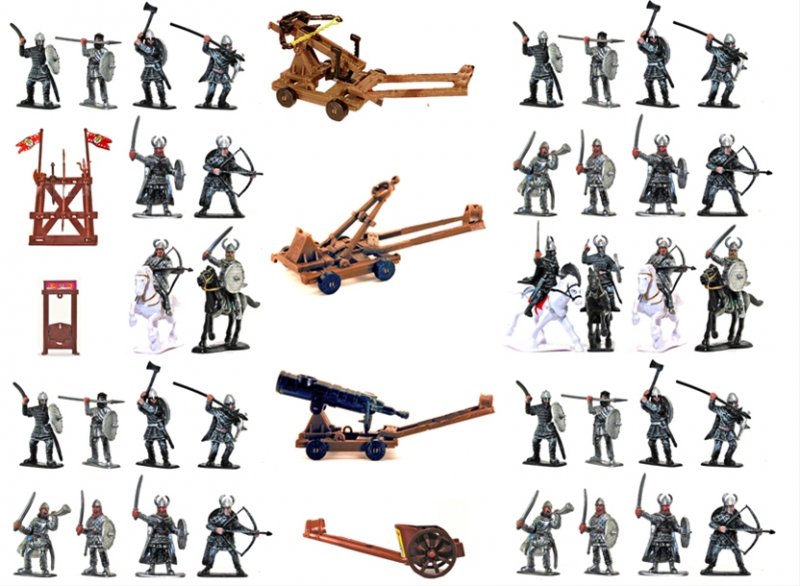
Rules for Medieval Toy Soldiers

Introduction

"Ringmail" was an improbable historical construct. So too these rules are an improbable match to anything historical. But they sure are fun!

Scale

Toy soldiers are 1:32 scale; that is 2&¼" or 54mm.

Field of Battle

Arrange a field of battle anywhere from 6' to 24' in dimensions. Determine battle line between opposing sides in roughly the middle of the field. Each side has a starting line set back from the battle line equivalent to that of their opponent's and no less than 24." Main stronghold, camp or pavilion of each side no more than 12" back from respective start-lines. Scale of play is such that terrain types and penalties make little sense. Distribute interesting obstacles for tactical use. Recommended: felt battle mat marked with 2" hexes; model trees, blue ribbon for rivers, etc.

Composition of Forces

Each side has one or two engines of war. Arrange each side with troop types falling roughly within the following ratio:

1 Archer : 3 Cavalry : 5 Infantry

Turn Sequence

  1. Engine
  2. Range
  3. Melee
  4. Move

All actions simultaneous. Alternatively, players determine initiative for movement by opposing check. First turn: move only. Second turn: move and melee (if any). Third turn adds range. Fourth and all subsequent turns: all four phases.

Movement

  • Engine 3"
  • Archers 6"
  • Infantry 12"
  • Cavalry 24"

Range & Melee

Range fire and melee resolved with modified rock-paper-scissors:

  • Archer removes cavalry (24" range)
  • Cavalry removes infantry
  • Infantry removes archer

All other melee resolved on opposing check: loser removed; both remain on ties. Note the following exceptions:

  • Cavalry and archer opposing check in melee
  • Both archers remain when attacker losses opposing check against archer not returning fire
  • Flank (side) or surprise (rear) attack of lesser to greater allows opposing check
  • E.g., infantry flanking cavalry resolved by opposing check

Engine

  • Redo misfires
  • Remove any figure hit by projectile
  • Remove engines hit by opposing engine fire
  • Take engines with two or more troops of opposing side on successful opposing check

Morale

Check a force's morale at the top of every turn after reduced beyond half its original line-up: maintain morale on 2d6 = 7+ otherwise morale lost.

End

Battle ends when one or both sides:

  • Losses morale
  • Reduced to less than a third its original line-up
  • Surrenders

Victory

Victory goes to the side that:

  • Does not loose morale
  • Is not reduced to less than a third its original line-up
  • Does not surrender

Otherwise a draw. Alternatively, other end and victory conditions may be agreed upon; e.g., attaining some goal such as capturing an object or flag, etc.

Sieges

Make walls with gates and even some wall-portions that engine fire can topple. One additional engine to the defender but defender starts with one third the troops of the besieger. Imagine any foot soldier positions along a wall or upon a parapet as capable of range fire, whether depicted with range weapon or not.

Point Values

  • Engine 5
  • Cavalry 4
  • Archer 3
  • Infantry 2

Setting up a Medieval Toy Soldier Wargames Campaign

Each side starts with 50 points to acquire starting forces. Note guidelines to composition of force, above. After each battle, save for the return of removed troops on 2d6:

  • Engine 6+
  • Cavalry 6+
  • Archer 7+
  • Infantry 8+

Victor gets 20 points, looser 10. Capture of opposing "baggage" or some other such treasure, object or goal grants 5 points. Each side of a draw gets 15 points. Unused points accumulate. Use points to acquire new forces for subsequent battles.

Fantasy Supplement

For a fantasy scenario, use larger scales for large types (e.g., tall elves, trolls, ogres, etc.) and smaller scales for diminutive types (e.g., small elves, dwarves, hobbits, pixies, etc.).

For monsters, use appropriate toys (e.g., dragons, giants, animals). Most monsters move as cavalry. Flight grants 36" of movement. Monsters resolve melee with an opposing check: monster = 2d6 to normal figure = 1d6. Some monsters also have range or engine capacities, e.g., dragon fiery breath, giants hurling rocks, etc. Monsters cost 15 points; those removed in battle save for the next on 2d6: 9+.

Mark one or more figures per side to indicate special status as a hero, wizard, or knight (i.e., "Templar" or "cleric").

Hero = best of both cavalry and archer; removed by archery
Wizard = best of both archer and infantry; removed by infantry
Knight = best of both infantry and cavalry; removed by cavalry

Heroes melee and range monsters with equal opposing check; defeat monsters by flanking or surprise. Heroes and wizards range fire as archers (wizards by magic). In any given battle wizards may cast each of the following once per battle: fireball, lightning bolt, light (good wizard) or darkness (bad wizard) during the engine turn phase. Light spells cause fell and undead creatures to check morale with a penalty. Darkness spells cause normal troops to check morale with a penalty. Resolve fireball and lightning bolt as engine fire. Lobbing a colorful marble with the thumb usually does the trick. During the engine phase knights may do one of the following per battle: restore one removed figure upon a successful save (see above); cast light (Dark Knights cast darkness); dispel undead creature. Heroes, wizards and knights cost 10 points and those removed in battle save for the next on 2d6: 5+.

A Sort of Challenge

"How much better is the amiable miniature than the Real Thing! Here is a homeopathic remedy for the imaginative strategist. Here is the premeditation, the thrill, the strain of accumulating victory or disaster -- and no smashed nor sanguinary bodies, no shattered fine buildings nor devastated country sides, no petty cruelties, none of that awful universal boredom and embitterment, that tiresome delay or stoppage or embarrassment of every gracious, bold, sweet, charming thing, that we who . . . remember a real modern war know to be the reality of belligerence." H. G. Wells, Little Wars, 1913.

Fight on!

Sunday, February 15, 2015

a game where anything can be attempted


My title to this post refers, or course, to Jon Peterson's definition of a role-playing game.

In my Dun Kells house rules, I try to make this quite explicit.

Any character can engage in combat. Knights are just the best for melee, scouts for range. Knights and dwarves get the best armor class possibilities.

Any character can attempt to cast an arcane spell. Magi are just best at it. It is safest for them. Other characters ability check intelligence for success and save against insanity. Clerics loose the favor of their patrons until they confess and do penance.

Any character can attempt to call down a patronal boon. Okay, well, almost any. Fay characters, dwarves and elves, cannot. They are not baptized so they have no heavenly patrons. Clerics do this best and it is the safest for them. Others characters ability check wisdom for success and save against "blight."

Any character may explore and attempt to use those skills associated with the "thief." Dexterity modifiers apply in most cases. "Scouts" (my lawful "thieves") get an additional bonus every three levels, starting at level four.

That seems to me to cover just about all of the kinds of actions that get parceled out as class specific. In the main they are no longer class specific. Class just makes you better, safer, or both. Players who choose a class still get to feel that they have a special role in the party and that their role progresses. But, in the main, characters can "attempt anything."

Sunday, November 24, 2013

Combat mechanics

My house rules mechanics for battle solves a lot of problems for me.

Don't get me wrong. I love d&d mechanics, but mainly because it just feels good rolling that d20 and then (if I am lucky) that d6. It is kind of like mechanical nostalgia. But it just doesn't make a whole heck of a lot of sense to me.

The folks that put that together were war gammers, scaling down down down to one to one ratio of man to figure. But they still had the mechanics of mass combat in their bones where things are chancier (fog of war!) and where you don't mind troops getting swept away turn after turn because, a.) you want the game to move and b.) you've got plenty more troops coming!

But random, linear progression for "to hit" and then random damage (allowing for low damage after a perfect hit) just doesn't make much sense in actual one to one combat. Actual human beings have a skill set and are going to succeed within that skill set following a bell curve, not a linear progression randomly meted.

Furthermore, the notion that one's defense is based entirely upon ones armor makes sense if you are a ship of the line (the real source of "armor class" was naval warfare!) but makes no sense considering that self-defense in battle is actually one of your skills!

So here is my solution:

Attacker and defender each get an attack and defense roll, respectively, on 2d. The "d" depends upon what kind of beast or PC you are. So, let's say a human fighter is 2d10 and a goblin is 2d6. Most of the time the fighter is going to hit that silly little goblin. Most of the time that goblin is not going to be able to get past a human fighter's defenses. Human fighter, on average, is going to hit at 11, and the goblin is going to defend at 7, and vice versa.

The mechanic for determining damage is then built into the throws: Successful attack minus unsuccessful defense equals damage. So, in the above scenario, the goblin takes 4 HP damage.

This gives everybody something to do at every phase of the battle. That in itself is psychologically satisfying, and my "play testers" attest to the fact!

I am leaning on a great online article "A Treatise on Dice Mechanics," for this house rule. According to the author's three goals, 1. speed and ease of use, 2. precision and 3. "correctness," that is to say, correspondence to what you are trying to "map" in the real world, I am purchasing 3 at the cost of both 1 and 2, well, at least 1. But it is worth it to me. Yes, the players and the GM have to do a little math, but not hard math. Addition and subtraction. We can handle it. The mechanic is more satisfying because both attacker and defender feel like they are playing a role, as in real combat, and because the target is no longer absolute but relative. In other words, the attacker has a moving target. That, also, is more like combat. We obtain reflexivity in combat. It is a bit more "complex," and that makes play move a bit "slower," but we have fun all the same.

The author of that really helpful online article also worries about how to morph a bell curve as we have PCs that raise in level. I do not see a problem here. With every level my "knight" class (basically "fighting man" but all my PCs are "lawful") adds another bonus to their attack and defense rolls. My "scouts" (alignment neutral "thieves") add a bonus every other level up. Wizards every four levels. So the bell curve of relative skill remains the same, but one's "sweet spot" continues to improve. Much like the development of skills in real life.

Yeay bell curves and a mechanic that maps more to "reality" (whatever that means in a fantasy game!)!