Showing posts with label rules-lite. Show all posts

Sunday, July 5, 2020

Rules and Dungeons & Dragons


This is my third post in a series of posts where I look at the subtitle of Dungeons & Dragons as a way to allow the rules to provide a launch point for one's own wargames campaigning.

The last post was on Medieval Fantasy and Dungeons & Dragons. This post will be on what "Rules" mean in the context of the original publication.

Free Kriegsspiel and referees


One significant tradition within wargaming goes back to the use of wargaming as actual training for young officers in 18th and 19th century Europe. This tradition was called, "Kriegsspiel," which is German for wargame.


One particular branch of Kriegsspiel that developed early-on and that influenced all subsequent hobby wargaming, was called, "Free Kriegsspiel." Free Kriegsspiel recognized that the circumstances of war cannot be covered exhaustively by written rules because reality is complicated, difficult to know, and the human mind is finite. You can't possibly map every thing that would go into a possible battle into a perfect rule-set. So in Free Kriegsspiel you would get somebody who had been in so many actual, real world battles, that they knew what combat was like and what warfare was like, such as some old officer who had seen many battles.


Then you would get these young officers in a room, and you'd have a map, and you'd have pieces of the map to represent different forces. And then they would divide up into two different sides and the two different sides would issue their orders to their soldiers, and then this seasoned officer, that was acting as a referee, would judge who he thought would be the successful party in this particular battle based on his actual lived experiential knowledge of how warfare worked. So in the Free Kriegsspiel tradition you trusted a veteraned officer to make a judgment call as to whether your orders were good. And then that old seasoned officer could coach you and say, "in future don't make that decision because you'd be flanked, or you'd be outnumbered, or you'd be outrun. Etc.”


In this way, Free Kriegsspiel provided excellent training and mentorship for future officers. This in turn influenced the wargaming hobby where, even though you might have some rules, such as dice mechanics, to give the feel of randomness and probability, nonetheless, in some cases, you would want to have a referee. The referee would be somebody who was so familiar with war that he could make judgment calls based upon described actions. The referee might roll the dice if he or she felt like he or she needed more information than just orders.


The person that you'd appoint to be the referee over your game would be somebody who had real expertise in the history of war, into historical wargaming, and had accounts of so many battles and so many different types of warfare that you trusted his or her judgment call in a game. The role of referee in wargaming depends upon real knowledge of warfare.


One obvious example of where you would need a referee in wargaming would be when you have too many for the players alone to manage all the information and play well at the same time. Or, trying to agree to the meaning of certain actions and rules may take so long to judge that play gets bogged down, and something that is supposed to be entertaining is turned into a bore. Or, you might need to have a situation where certain information is secret to other players to simulate the unknowns of war, such as espionage or scouting. So there's practical gaming reasons why you'd want to have a referee. The tradition of referees in Free Kriegsspiel gives the advantage of less rules to know and interpret together with a faster-paced game.


Referees and "Dungeon Masters"


The tradition of Free Kriegspiel referees lives on in Dungeons & Dragons. Later publications by the same name would introduce the term "Dungeon Master." But the original Little Brown Books knew no such phrase. The person to facilitate the session was a referee, just as in Free Kriegspiel. And just as in Free Kriegspiel, that person was expected to be expert in all the relevant areas of knowledge necessary to make the game "realistic," or, in the case of fantasy, as true to the sources, the literature of Sword and Sorcery. In the case of the wargame hobby, this "expertise," is amateur, not professional in nature. This goes back to the original sense of the word "amateur," as someone who just does it for the love of it. There are many cases where an amateur can know more than, or have much more facility with a topic than a so called professional. And that is the kind of expertise we are looking for in this hobby.


Rulings, not rules


The "rules" of Dungeons & Dragons follow this tradition of Free Kriegsspiel. Playing Dungeons & Dragons requires a referee. The booklets themselves encourage referees and groups to interpret the rules in different directions. Referees are encouraged to build their own rules. The building of local, hobby wargaming group includes the assumption that each hobby group, just as with the wargaming hobby in general, will wind up having its own peculiar, local rule set that works for them and that reflects the campaign they have developed on their own.


In his Quick Primer for Old School Gaming, Matt Finch has coined the phrase, "Rulings, not rules," in order to try to catch, in a single pithy, easily memorable phrase, the pith of this approach. The point is that the referee is trusted to make good calls for each unique situation that arises, due to his or her expertise in medieval warfare, medieval fantasy literature, dice probabilities, traditional wargame mechanics, and the like. Over time, these rulings would become a unique set of rules for each wargame club.


For contemporary ears to hear the subtitle of this game correctly, then, it should almost be changed to "Guidines," or "Ideas," or "Suggestions," "a Framework," or "Examples," "for Medieval Fantasy Wargames Campaigns."


Next in the series: "Campaigns"


Sunday, June 7, 2020

Wishes


Okay, here is my first pass at some rules around wishes for my Perilous Realms campaign. These are inspired by the Judges Guild Ready Ref Sheets.

Wishes

First, note level of granter:

Granter
  1. Object
  2. Well/Fountain
  3. Rainbow
  4. Moon, full, midnight
  5. Star, first seen
  6. Spirit
  7. Djinn/Efreet
  8. Power
  9. Spell
  10. Item
Objects include but are not limited to:
  • Wishstone
  • Wishbone
  • Found single copper piece
  • White horse, first sight
  • Talisman
  • Statue
Major gems are special objects with their own granter value.

Grant-level:Gem-value
1:5,000
2:10,000
3:25,000
4:50,000
5:100,000
6:500,000
7:1,000,000+

Well/fountain, in general, any given character gets one wish per instance.

Spirits are elemental and otherwise neutral powers, especially, e.g., elementals themselves, and also sometimes sylvan beings of the classical variety, such as dryads or centaurs, or of the gothic variety such as pixies and unicorns.

Powers are cosmic spirits of either lawful or chaotic alignment such as gods and goddesses, angels, demons, and the like.

The Wish spell is a 7th level arcane spell that can only be found through research.

Items are magic items with wishes like rings and swords.

Next, discern level of intent:

Intent:
2 Trivial
3 Selfless
4 Altruistic
5 Mutual
6 Greedy
8 Selfish
9 Malicious
10 Give/take life

Trivial indicates that no one directly benefits and there is no possible harm.

Selfless indicates the wisher benefits from the wish in no way.

Altruistic indicates that one or more parties benefit from the wish but the wisher benefit only indirectly.

Mutual indicates mutually beneficial to wisher and one or more other parties.

Greedy indicates the wish is only for material gain, and / or that there may be one or more other parties that benefit, but only indirectly.

Selfish indicates that the wish is only beneficial to the wisher.

Malicious indicates harmful intent.

Give/take life indicates wishes to kill or restore life, including restoration from flesh turned to stone.

Next, determine likelihood of granting, together with likelihood of repercussion upon wisher and splash on any beneficiaries. Divide Granter by Intent for percent chance granted. Subtract percent chance granted from 100 for percent chance of repercussion for the wish. Roll for repercussion whether wish is granted or not. If granted, halve the chance for repercussion for percent chance of splash on others who benefit from the wish, if any.

d100:Repercusion
99+:Death
97-98:Insane
94-96:Blind
90-93:Reverse
85-89:Geas
75-84:Quest
60-74:Disease
45-59:Curse
25-44:Charm
00-24:Sleep

Roll d100 for repercussion. Roll d50 for splash back. For both repercussion and splash, add 10 for malicious or murderous intent, subtract 10 for selfless or life-granting intent. Less than zero indicates no repercussion or splash.

Charm indicates wisher or beneficiary charmed by person place or thing related to the context of the wish and/or the situation of the granting. Referee determines.

Fight on!

Saturday, October 13, 2018

OSR Questionnaire


When I first became aware of the OSR, I was excited about it and learned as much as I could. After discovering Dungeons & Dragons (original) and the communities that support it, I no loner feel like I am "a part of" the OSR in a straightforward way.

It seems at first the OSR was about a return to the original, wargame style of play at the time of the birth of D&D as a hobby. Part of this included a return to a more DIY approach, both in terms of setting (not relying upon someone else's published, professional, setting) and "rulings not rules" (realizing that the local referee, group and game play itself was more important for developing both the rules and the shared setting than strict adherence to a professionally developed set of rules and settings).

In other words, the OSR represented to me a return to D&D as a hobby, rather than a consumer product. The hobby approach empowers creativity. The consumer approach makes passive clients. As a hobby it comes with a hobbying community of idea-sharing and mutual support. The internet facilitates such a hobby community in a large and broad way.

Much of what I have seen the OSR become since I got back into gaming in 2013 is a proliferation of small-scale or semi-professional game-resource publication. There is a lot of really good stuff out there. But, just exactly because of my more hobby-based, localist approach, I do not find myself using other people's modules very often, however professionally slick or "old school."

However, much of the stuff published as "OSR" falls into the current cultural zeitgeist that "creative" indicates, or is equivalent to, being edgy, troubled, dark, or "morally ambiguous." A lot of talk out there is about how we need to eschew "tropes" of fantasy in order to be "truly creative." In some cases it seems that the goal is to be as edgy as possible while still playing in a new school, story-game style. "Mapping sucks." "Challenge people with a moral dilemma." Etc. I find none of this attractive.

The following questionnaire comes from a big OSR personality named Zak. I do not follow his work much, honestly. But I stumbled across the questionnaire from other folk's blog posts and google+ posts where they filled it in in interesting ways. That is a good gift to the community, so, thank you, Zak. So if you are still reading, here goes:

1. One article or blog entry that exemplifies the best of the Old School Renaissance for me:

Philotomy's Musings

2. My favorite piece of OSR wisdom/advice/snark:

My own pithy zen-like saying in the spirit of Matt Finch's "Primer":

Amateur hobby, not professional product.

Medieval fantasy wargames campaigning is a hobby, so dive in for amateur fun. Stop expecting "professional production quality," and go for the joy and creativity that comes from a community of amateurs sharing ideas and swapping stories -- hobbyists who do it for the fun of it, not for profit. Don't passively receive wargames campaigning as some product rendered to you as a mere consumer of what "experts" say you are supposed to like or agree upon as standard. Instead, Fight on!

3. Best OSR module/supplement:

Tomb of the Sea Kings

4. My favorite house rule (by someone else):

"Crits" & "Fumbles": "Natural 20" does full (not double) damage. Don't do fumbles. Fumbles punish everyone with unfun. Both rulings come from Philotomy (see above).

5. How I found out about the OSR:

In 2013 I was surfing the web and remembered D&D then I plunged into what was going on and found my way to the OSR and, through them, to the original rules for medieval fantasy wargames campaigns.

6. My favorite OSR online resource/toy:

Mr. Josh Bear's ODD Referee Tool. I use it every session.

7. Best place to talk to other OSR gamers:

Because of what I mean by "OSR," as a return to old school, war-gaming style of play, together with, but not limited to a DYI attitude:

Finarvyn's ODD74 proboard, and
The Knights & Knaves Alehouse forum.

These are old-school internet formats that actually encourage conversation and not disappearing content:
This is the weapon of a Jedi Knight. Not as clumsy or random as a blaster; an elegant weapon for a more civilized age.
8. Other places I might be found hanging out talking games:

My own blog (you are here). I just don't post very often or very consistently. Sorry about that. (I hope that it is due to the fact that most of my hobby energy goes to actually gaming weekly.)

I also hang out and talk about games with real-live people that I know. Once a year I get to go to the North Texas Role-playing Game Convention and I get to talk to even more real live people about the game.

I followed folks on google+ but just used it to share my blog posts. It is now going the way of the dodo. We will see what happens with the migration to MeWe.

9. My awesome, pithy OSR take nobody appreciates enough:

It is not my own, but Delta's Target 20 combat and save resolution, combined with my own house-ruled hit-dice approach for distinguishing classes from one another. This has recently been "historically justified" by none other than Jon Peterson himself!

10. My favorite non-OSR RPG:

Diplomacy.

11. Why I like OSR stuff:

The OSR stuff that I like, when I like it, is stuff that has come out of someone's loving, amateur DYI hobby that is full of archetypal fantasy, full of interesting puzzles to solve, and immediately usable at the table (= good, easily readable, well-keyed maps).

12. Two other cool OSR things you should know about that I haven’t named yet:

Wayne Rossi's The Original D&D Setting. Just so good.
Paul Gorman's Magic Swords.

13. If I could read but one other RPG blog but my own it would be:

Please, don't read mine if you are only going to read two RPG blogs! I don't have nearly enough content. So, I get to name two. Since I have already mentioned Delta's D&D Hotspot, Jon Peterson's Playing at the World blog, and Wayne Rossi's Semper Initiativus Unum blog, above, then I get two more:

Jeff's Game Blog.
Hack & Slash.

Dyson Logos' Dodecahedron should get an honorable mention. His mapping skill and artistry is only improving. Unfortunately, for me, the actual gameable content of the maps has become increasingly blah and unusable over time. Dig back into his earlier stuff. Less pretty (perhaps, I still think it is great), but far more usable for old school play: lots of overlapping rooms and corridors, secret hatches, passageways, doors, traps. Just more interesting and inspiring for my style of play.

Finally, Bryce Lynch's Ten Foot Pole should receive another honorable mention. I agree with his module criteria about 80%, and that is about as much as any mature adult can expect to agree with another mature adult if they are not members of a cult. My main points of disagreement are where he tends towards "realism" and "ecology," whereas I enjoy a more "funhouse" approach.

14. A game thing I made that I like quite a lot is:

My own cumulative setting and house rules. I mean not just The Perilous Realms supplement I published or the simplified version I have as a page on my blog, but all of the cumulative rulings I've tracked due to actual play in the campaign. I have it all compiled in a readable but loving imitation of the Judge's Guild Ready Ref Sheets. I call it "Campaign Aids and Inspirations." It is where I put all my generative charts, tables, and decision trees. I haven't shared that document and I may never. The point is for you to develop your own settings and rulings.

15. I'm currently running/playing:

The Perilous Realms, a medieval fantasy wargames campaign. I use my own campaign world based upon an anachronistic mash up of our own medieval and ancient past. Each particular wilderness is the Outdoor Survival board set in such a way that the river flows to the nearest major body of water. The particular wilderness right now I call the Hollow Lands. They lie underneath the Mazandarin Sea, the nearest major city being Hecatompylos along the Silk Route. I use my own house rules built upon Dungeons & Dragons (the original rules for fantastic medieval wargames campaigns).

16. I don't care whether you use ascending or descending AC because:

If I am at your table, I trust you will tell me if my attack was successful. If you are at my table, I will tell you if your attack was successful. Thank you, Dave Arneson.

17. The OSRest picture I could post on short notice:

Please see above.

Fight on!

Saturday, September 23, 2017

House Rules Summary page


Hey, folks. I just put together a new "page" on my web log:

House Rules

Wherein I summarize my house rules for table play.

This house rules summary compresses into brief form the house rules I suggest in my Perilous Realms supplement.

NOTE: I freely utilize DELTA's "Target 20" approach. Thank you, Delta and your D&D Hot Spot!

I look forward to any comments.

Fight on!

Monday, September 4, 2017

Treasure Focused Dungeon Stocking


Scott Anderson has been engaging me over at ODD74 on stocking dungeons based upon treasure, first, rather than monsters; seeing as how that is the goal of the game - it is what gets you "points."

I have lots of people around the table when I play and we cannot play that frequently so I have altered the stocking tables. I multiplied all pieces ten-fold and I doubled the chances of gems, jewelry and magic items per level.

Treasure by Dungeon Level
 
·      Always copper
·      2:3 silver
·      If silver, 2:3 gold
 
Level treasure table
Dungeon LevelCopper* & SilverGold Pieces% Gems & Jewelry% Magic Items
11K100105
2-32K1K2010
4-510K2K4020
6-720K5K6030
8-950K10K80*40
10-1250K20K100*50
13+100K50K100*60*
*Multiply by 2d6, all else by 1d6

Over at the Ruins of Murkhill, I shared the way I describe gems and jewelry based upon the tables for determining them. Later, I added them together for convenience.
Determine and Describe Gems
 
First, determine the chance that the gem is precious or semiprecious by basic gem gp value:
d%gp ValueSizePrecious on d6
01-1010Tiny1
11-2550Small1-2
26-75100Medium1-3
76-90500Large1-4
91-001KHuge1-5
1:6*>1KGiantPrecious
*5K; 10K; 25K; 50K; 100K; 500K; etc.
 
Precious by type:
d6Type
1Diamond
2Emerald
3Opal
4Pearl
5Ruby
6Sapphire
 
Semiprecious by type:
d20Typed20Type
1Amber11Jasper
2Coral12Lapis Lazuli
3Ivory13Moon/Sunstone
4Jet14Obsidian
5Amethyst15Onyx
6Agate16Paridot
7Beryl17Quartz
8Carnelian18Tiger's Eye
9Garnet19Topaz
10Jade20Turquoise
 
If >1K gp value, the gem is always named, famous with backstory, and perhaps enchanted, cursed, charming, geased or any combination of the above. "Enchanted," indicates some magical affect for beautification and value, it does not perform any functional magic, e.g., glowing or sparkling on its own, humming, etc. 
Determine and Describe Jewelry
 
Jewelry combines metals with gems. Determine whether its setting is precious or base metal:
D%gp Value RangeChance Precious
01-20300-1800Never Precious
21-801K-6K50%
81-001K-10KAlways Precious
 
Determine metal type:
d4Precious Metald6Base Metal
1Colored Gold1Brass
2Electrum2Bronze
3Gold3Copper
4Silver4Pewter
--5Steel
--6Tin
 
Precious gems are never set in base metal. If metal is precious, there is a 50% chance it is inset with precious stones. Jewelry of 7k+ gp value will always be inset with precious stones. Role for stones using the tables for gems, above.
 
Determine type of jewelry item:
d20Typed20Type
1Anklet11Greaves
2Buckle12Medallion
3Bracelet13Necklace
4Bracer14Pendant
5Brooch15Ring, ear
6Chain, belly16Ring, finger
7Circlet17Ring, nose
8Clip, hair18Scabbard
9Codpiece19Tiara
10Crown20Trophy
 
Any jewelry of 7K+ gp value is named and famous with backstory and perhaps enchanted, cursed, charmed, geased, or any combination of the above. "Enchanted," indicates some magical affect of no practical magical merit that adds value and beauty, e.g., a precious stone set in a silver flower that opens and closes over the course of some meaningful time period, etc.
So, first come up with an amazing focal treasure for your level or lair. I think a level or lair cannot be less than 6 rooms, not counting connections. I think more than about 36 rooms becomes too difficult for both players and the referee. I would come up with some kind of key item of treasure for about every 12 rooms. So, a lair of 6 would have one key item. A level of 36 rooms would have three -- scattered about. In all these cases these items would not have any strategically useful magic (although they might have gonzo or beautifying magic - or a charm or geas that makes them difficult), but they would be culturally important and either famous or forgotten (and important once remembered).

So, flip a coin whether it is going to be a gem or an item of jewelry. If it is a gem make sure it is at least 1Kgp in value. If it is an item of jewelry, at least 7Kgp in value. Imagine it's background, fame, name and if it has some enchantment on it.

Next, determine what kind of monster is its guardian. Is the monster aware that it is guarding this treasure, or not? Is it literally guarding it, or is it wandering around madly, trying to find away to get past the same trap that your character is going to have to deal with as well? Etc.?

In future, I will come up with some way of matching monsters to treasures. This is a kind of reversal of monster lists with treasure types. I will probably largely base this upon the color of the gem (either alone or set in an item of jewelry)! Red dragons will obviously have some kind of giant red ruby or a golden crown set with rubies, etc. The adventurers will get hooks and clues about the treasure long before they can guess what monster may be that is guarding it.

I am working on scaling by dungeon level / party level / monster level. That will help me to determine the treasure to creature table. So, more on that to come.

Now that you have a treasure and a guardian you should have all the inspiration you need for a theme for that level or lair. Now (and only now) start drawing the map. Once the map is drawn, if you know the obvious place for the lair treasure to be guarded, trapped, tricked or hidden - go for it. I you know the obvious best place for (one of the key) guardians, again, go for it. For the rest of the rooms it goes like this: Take a six-sider for each room:

  • 2:3 hold treasure. Of those with treasure:
  • 2:3 have a guardian or monster. Of those without treasure:
  • 1:6 have a monster. Of those with treasure without a monster: 
  • 2:3 are trapped
  • The rest are hidden or tricked in some way, TBD by the ref
When rolling for the rooms with monsters:
  • 1:2 it is the main level/lair guardian (or type, or minion, whatever)
  • 1:3 it is a random monster (no relationship needed. The dungeon is a mythic underworld)
  • 1:6 it is a unique random one-off monstrosity
I've also worked up my own underworld stocking tables that actually allow every kind of creature listed or mentioned in the LBB possibly to show up, but this post is already long, so I will stop here.

Comment. Let me know what you think. Fight on!

Sunday, January 8, 2017

D&D 5e as viewed by one 0e referee


I will keep this brief, as hundreds of others more important than I have written their own reviews. I will also keep it free from any polemic or really even criticism. I am only going to share my own first impressions of the 5e core rule books as an 0e referee.

I bought the core rule books from my FLGS and enjoyed perusing them.

First of all, it seems to me that what most folks have said is true, this feels much more "old school" than either 3e or 4e to me. There is an emphasis on dungeons, and rulings over rules-lawyering. That feels good to me. The magic items are great and they have brought to prominence ones I recognize from 0e itself. Double plus good to Mike Mearls and team for all that.

I could see myself playing 5e, under the right referee, and having a lot of fun.

That said, I will not referee 5e. And that for really only one reason: it is not rules light enough for me. Now, that is no deep criticism. I won't touch AD&D, 1e, for the exact same reason: too many *%$! rules. Rules light versus rules heavy has nothing to do with old or new school. Hence my post is about an 0e referee looking at 5e NOT an "old school" referee looking at "new school." Those categories don't help in this situation.

Although I think these rules could be used to play in a sandbox kind of way, the "fluff," or descriptive material in both the DMG and PH emphasize that the game is about making a story. The rules don't necessarily force a referee to railroad. But the emphasis on story together with what most of the supplements look like means that that particular trend seems to continue. If that characterizes the "vibe" of 5e, I will not prefer to join those tables.

Finally, they make it very clear that they are trying to make rules for, and present the rules (especially, for example, in their presentation and illustration) in such a way as to support heroic fantasy role play. They mention sword and sorcery and low fantasy as an option the rules support, but not the main focus of the rules. Now, double plus to WotC for making this clear and saying so. The art is crazily heroic fantasy. There is absolutely nothing pulp about it. It therefore does not have a "vibe" that attracts me. I love heroic fantasy. I could even play in a campaign of heroic fantasy. But D&D is sword and sorcery role play to me, forever, full stop.

So, to conclude, these books are sleek, beautiful, with amazing art work. The rules are written clearly and presented beautifully. I could play as a character in a campaign run in a sandbox, sword and sorcery way. But I will never referee these rules for three reasons:

  • Too many rules
  • Story-focused (vs. sandbox)
  • Heroic vs. low fantasy focused
So there are my two-coppers. Thanks for reading!

Wednesday, November 23, 2016

Maxims of Mechanical Minimalism


I am discerning three recursive maxims that drive my D&D minimalism and define my approach to "rules-lite." Here they are:

  1. Always resolve through role-play anything that can be resolved through role-play
  2. Keep all mechanics as abstract as possible, as concrete as necessary
  3. Use abstract mechanics as openings to, rather than shut-downs of role-play
Notice how the three form a neat recursive circle. The first prioritizes role-play over mechanics. The second limits the nature and use of mechanics. The third reminds us to use mechanics to support, rather than shut-down, role play, thus leading us back to the first maxim. I must say I find this quite satisfying.

Always resolve through role-play anything that can be resolved through role-play

What I mean here by "role-play" is wargame-style playing of a particular tactical role defined by character class, race, level, etc., much like infantry, cavalry, artillery, with light, medium or heavy armor define rolls to play in napoleonic wargames. I do not mean amateur improvisational theatre. That said, just as with Diplomacy, there are good times to "ham it up" for the sake of "sealing the deal" in a tough diplomatic negotiation.

I remember running a game of original edition using my Perilous Realms house rules for some players who were familiar with later editions. One first-time-to-original player asked "do all weapons just deal 1d6 damage?" "Yes," I answered. "So why not just buy a cudgel and leave it at that? Why spend the money for a halberd or a sword?" "Cudgels can't cut anything," I replied, "halberds have a long reach. Swords cut and thrust." He could not understand what I was driving at because he had been living under the oppression of over-mechanization! I had to explain, "the different weapons allow different role-playing possibilities. You can do things with a spear you can't do with a sword, and vice versa. Does that make sense?" He was doubtful. But when the mummy came and they lowered the portcullis just in time, skewered it on a spear to keep it from retreating, hit it with oil and torched it, they then started seeing the strategic nature of the game -- something that has more to do with role-play than mechanics. A bunch of first level characters survived a random mummy encounter. I could only congratulate them.

Point of the maxim in this case: there is no need for variable damage mechanics in order to "describe" the usefulness of different weapons. The weapons themselves, used "in-world," do that for us, through good role-play.

Keep all mechanics as abstract as possible, as concrete as necessary

Mechanics serve as a kind of "oracle" that gives the game-world the feeling of independent reality. The more mechanics are used to dive into describing concrete minutiae, the more they become a straight jacket upon either referee or player decision-making. Like all oracles, they should be abstract and open to interpretation by the diviner -- in this case, the referee. The more concrete the mechanic -- like research into the exact force of the weight of a blow from a halberd on plate armor generating a complex chart of bell-curves, yada yada -- the more the game gets stuck in the morass of endless non-interpretive dice rolling -- what folks call "roll playing," rather than role-playing.

Let's take the common complaint that the original edition doesn't have a "universal mechanic." I will not dispute that here but I will point out that it has a near universal exploration mechanic:
1d6 : the lower the more beneficial, the higher the more detrimental to playing-characters
Key examples: Locate secret passage: 1-2, elves 1-4; elves sense secret door on passing by 1-2; force door: 1-2; spike slips: 5-6; traps spring: 1-2 (I suppose this means deliberately looking with a ten foot pole, otherwise it should have been 5-6, but inconsistency is one of the glories of the original edition!); listen at door, hear something: 1, elves 1-2; wandering monster per turn: 6; surprise: 1-2 (again, should have been for monster, 5-6 for party!); wilderness exploration has similar mechanics.

A pattern emerges: Roll 1d6:

  • Unlikely to benefit PCs: 1
  • Possible to benefit PCs: 1-2
  • Toss up: call high or low
  • Likely to benefit PCs: 1-4
  • Unlikely to be detrimental to PCs: 6
These represent chances of 1/6, ⅓, and ⅔, respectively (except for "toss up," which I only use when both the players and I are "meh" about the outcome of something. I never write "toss ups" into my house rules).

I only consult these exploration mechanics when I need something more than my own knowledge of the setting and the player's careful description of their actions to make a ruling about the results of their behavior. That means I don't use mechanics very often. If they describe something pretty well and their characters are pretty high level or possess talents and possibilities, then they succeed. The more beautiful, interesting and fun their plan of action and description, the more inclined I am to grant them success. It is a game. The point is fun. The point is to reward, not punish, good, fun role-play.

I learned this the hard way but I am the better for it. I had some high-powered PCs surprised by finding a high-powered ancient vampire waiting for them in a closet they opened up. He shot out about 50 bats in their faces (awesome!). When they got their wits about them, the wizard decided he would turn rock to mud, opening a whole in the ceiling of the temple right above the vampire, thus turning him to dust with sunlight. I was still stuck in the old mechanics-heavy framework. I said,  "okay, high it works, low he escapes from the light." I rolled low. I ruled he escaped from the in-coming light just in time. One of my players, a long time referee in his own right, noticed that I was disappointed in this outcome. He said to me, "are you disappointed it didn't work?" "Well, yes, " I replied. "Well hell then, man, rule that it worked, you're the ref! Let's have fun!" It was like scales falling from my eyes. We were all supposed to have fun, even me. I liked their plan. It contributed to fun -- even my own fun as the referee -- after all, although I was "playing" the vampire, I was not "on his side"! So I reversed the ruling and we all cheered. I learned something important that day. I only need mechanics when I really am unsure of the outcome of player actions. If it makes sense, or just seems fun to me, it works!

In most situations where I do use the "universal exploration mechanic," I reason it out with the players. I low-ball them. They high-ball me, and we comprise and I roll the dice in front of them. "I think you have about 1 chance on a d6 to pull that off." "No way, man, at least a toss up!" "Okay, 1 or 2, fair enough?" "Fair enough." "I rolled a 4 so it didn't work as you'd hoped, sorry guys." "That's cool. It was worth a try." "But you do manage to get about half way there." "Cool!" Etc. I do, of course, roll secretly for "listen at door," the triggering of traps, etc.

Point of the maxim in this case: abstraction allows for oracular interpretation, and that only when the referee feels the need.

Use abstract mechanics as openings to, rather than shut-downs of role-play

We keep mechanics as abstract as possible in order to encourage role-play. Keeping mechanics abstract allows room for interpretation and creative description. But sometimes we turn the abstraction into a chance to make things as boring and free of detail as possible. And that is our mistake, as players and as referees.

[NOTE with regards to the following example: I mean no severe critique of the referee or his rules. I am trying to make one small point about a use of mechanics that bugs me. I've learned so much from this referee and he is awesome. Okay, now, moving on to the example:]

I've played in a game where the referee allows magic-users to have up to two shield-bearers. These shield-bearers serve as kind of body guards. The referee describes the results of hiring such help purely in mechanical terms. He says each shield-bearer, so long as they are defending the magic-user, has his armor class increased by one, while lowering the armor class of the protected magic-user. So a magic-user would effectively have an armor class of, say, 7 while these shield-bearers would have an armor class (in plate) of 3 each. This seems reasonable. But I find it affects play in an adverse way. It takes away a chance to role-play strategically and reduces it to numbers and probabilities.

I remember explaining this clever mechanic to some trusted folks on an online forum and someone replied "why turn this into mechanics? Just role-play it. The shield-bearers protect the magic-user until the opponent can break their defense." Oh. It suddenly made perfect sense to me and I saw how mechanics could steal role-playing opportunities. So it breaks my first maxim. But it also, in play, winds up becoming an example of why I need the third maxim.

We were playing with these mechanics when we were attacked by poisonous hypnotic frog-men. The referee randomly rolled that they attacked the magic-user rather than either body-guard. He rolled an attack against armor class 7 and hit. My thought was, this mechanic forced us to assume that these were the most inept two shield-bearers ever hired. I suppose the frog men could have leaped over the shield bearers and landed on the magic-user's head. But why weren't the shield-bearers knocking the creature off their patron? It just didn't make sense to me the way that the abstraction of the mechanic then forced an interpretation of the game world rather than the other way round.

Why not allow the player and referee to role-play the shield-bearers? If the random roll shows the magic-user is under attack, imagine what the shield-bearers are trying to do to prevent it. Ask the player, "what instructions or agreements has the magic-user made with his bodyguard?" Imagine what you would do if you were the body guard. Then make up something creative -- mechanics be darned!

This extends to many other aspects of combat. We've all been subject to the unbelievable boredom of:
  • roll d20 fail to hit
  • roll d20 hit
  • roll d6 damage: 1
  • you are now hit: 6 damage
  • next round, roll initiative
  • yada yada, yawn
Now, I am not saying that strategic role-play should necessarily grant mechanical benefit. I am not saying that if a player says, "I swing down on them from the chandelier," that your response as a referee should be "+1 to hit!" I think quite the opposite. It should open up role-play, strategic role-play, possibilities. What to the goblins think of this acrobatic act? Perhaps roll for reaction. Do they cower at the bravado, laugh at the stupidity, or leap to bite the feet? Keep rolling the d20s and the d6s but describe what is going on.

I've "trained" players by having my NPCs do strategic stuff with objects nearby. As the players see that the NPCs can turn a situation around by grabbing a chair, throwing over a table as a shield for their archers, etc., they start doing the same thing. That way, the attack and damage rolls become oracles for interpretation within a combat scenario that is role-played with strategy, rather than abstracted to the state of absolute boredom.

Point of the maxim in this case: mechanics are supposed to be abstract in order to free the players and the referee to describe the concrete actions of the characters.


Okay, that's all I've got for now. I hope my little mini-essay was helpful, or at least interesting, and I welcome comments.

Fight on!

Sunday, September 18, 2016

Ringmail


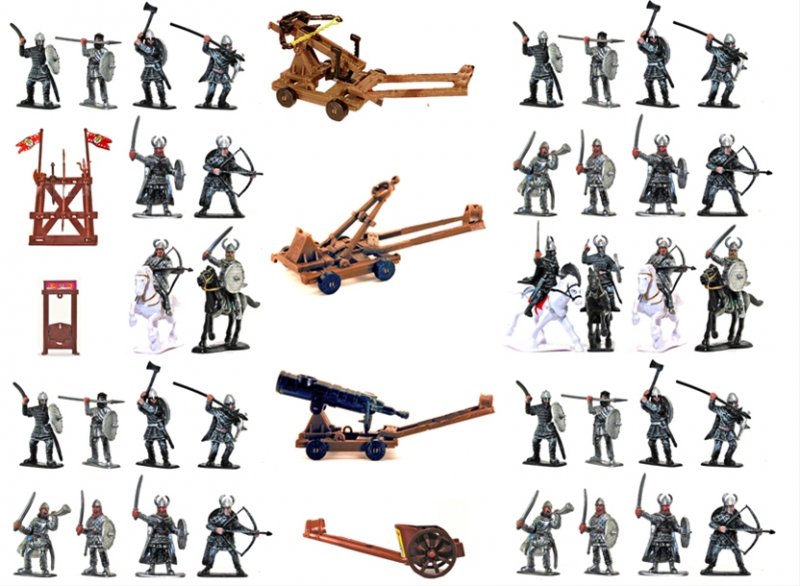
Rules for Medieval Toy Soldiers

Introduction

"Ringmail" was an improbable historical construct. So too these rules are an improbable match to anything historical. But they sure are fun!

Scale

Toy soldiers are 1:32 scale; that is 2&¼" or 54mm.

Field of Battle

Arrange a field of battle anywhere from 6' to 24' in dimensions. Determine battle line between opposing sides in roughly the middle of the field. Each side has a starting line set back from the battle line equivalent to that of their opponent's and no less than 24." Main stronghold, camp or pavilion of each side no more than 12" back from respective start-lines. Scale of play is such that terrain types and penalties make little sense. Distribute interesting obstacles for tactical use. Recommended: felt battle mat marked with 2" hexes; model trees, blue ribbon for rivers, etc.

Composition of Forces

Each side has one or two engines of war. Arrange each side with troop types falling roughly within the following ratio:

1 Archer : 3 Cavalry : 5 Infantry

Turn Sequence

  1. Engine
  2. Range
  3. Melee
  4. Move

All actions simultaneous. Alternatively, players determine initiative for movement by opposing check. First turn: move only. Second turn: move and melee (if any). Third turn adds range. Fourth and all subsequent turns: all four phases.

Movement

  • Engine 3"
  • Archers 6"
  • Infantry 12"
  • Cavalry 24"

Range & Melee

Range fire and melee resolved with modified rock-paper-scissors:

  • Archer removes cavalry (24" range)
  • Cavalry removes infantry
  • Infantry removes archer

All other melee resolved on opposing check: loser removed; both remain on ties. Note the following exceptions:

  • Cavalry and archer opposing check in melee
  • Both archers remain when attacker losses opposing check against archer not returning fire
  • Flank (side) or surprise (rear) attack of lesser to greater allows opposing check
  • E.g., infantry flanking cavalry resolved by opposing check

Engine

  • Redo misfires
  • Remove any figure hit by projectile
  • Remove engines hit by opposing engine fire
  • Take engines with two or more troops of opposing side on successful opposing check

Morale

Check a force's morale at the top of every turn after reduced beyond half its original line-up: maintain morale on 2d6 = 7+ otherwise morale lost.

End

Battle ends when one or both sides:

  • Losses morale
  • Reduced to less than a third its original line-up
  • Surrenders

Victory

Victory goes to the side that:

  • Does not loose morale
  • Is not reduced to less than a third its original line-up
  • Does not surrender

Otherwise a draw. Alternatively, other end and victory conditions may be agreed upon; e.g., attaining some goal such as capturing an object or flag, etc.

Sieges

Make walls with gates and even some wall-portions that engine fire can topple. One additional engine to the defender but defender starts with one third the troops of the besieger. Imagine any foot soldier positions along a wall or upon a parapet as capable of range fire, whether depicted with range weapon or not.

Point Values

  • Engine 5
  • Cavalry 4
  • Archer 3
  • Infantry 2

Setting up a Medieval Toy Soldier Wargames Campaign

Each side starts with 50 points to acquire starting forces. Note guidelines to composition of force, above. After each battle, save for the return of removed troops on 2d6:

  • Engine 6+
  • Cavalry 6+
  • Archer 7+
  • Infantry 8+

Victor gets 20 points, looser 10. Capture of opposing "baggage" or some other such treasure, object or goal grants 5 points. Each side of a draw gets 15 points. Unused points accumulate. Use points to acquire new forces for subsequent battles.

Fantasy Supplement

For a fantasy scenario, use larger scales for large types (e.g., tall elves, trolls, ogres, etc.) and smaller scales for diminutive types (e.g., small elves, dwarves, hobbits, pixies, etc.).

For monsters, use appropriate toys (e.g., dragons, giants, animals). Most monsters move as cavalry. Flight grants 36" of movement. Monsters resolve melee with an opposing check: monster = 2d6 to normal figure = 1d6. Some monsters also have range or engine capacities, e.g., dragon fiery breath, giants hurling rocks, etc. Monsters cost 15 points; those removed in battle save for the next on 2d6: 9+.

Mark one or more figures per side to indicate special status as a hero, wizard, or knight (i.e., "Templar" or "cleric").

Hero = best of both cavalry and archer; removed by archery
Wizard = best of both archer and infantry; removed by infantry
Knight = best of both infantry and cavalry; removed by cavalry

Heroes melee and range monsters with equal opposing check; defeat monsters by flanking or surprise. Heroes and wizards range fire as archers (wizards by magic). In any given battle wizards may cast each of the following once per battle: fireball, lightning bolt, light (good wizard) or darkness (bad wizard) during the engine turn phase. Light spells cause fell and undead creatures to check morale with a penalty. Darkness spells cause normal troops to check morale with a penalty. Resolve fireball and lightning bolt as engine fire. Lobbing a colorful marble with the thumb usually does the trick. During the engine phase knights may do one of the following per battle: restore one removed figure upon a successful save (see above); cast light (Dark Knights cast darkness); dispel undead creature. Heroes, wizards and knights cost 10 points and those removed in battle save for the next on 2d6: 5+.

A Sort of Challenge

"How much better is the amiable miniature than the Real Thing! Here is a homeopathic remedy for the imaginative strategist. Here is the premeditation, the thrill, the strain of accumulating victory or disaster -- and no smashed nor sanguinary bodies, no shattered fine buildings nor devastated country sides, no petty cruelties, none of that awful universal boredom and embitterment, that tiresome delay or stoppage or embarrassment of every gracious, bold, sweet, charming thing, that we who . . . remember a real modern war know to be the reality of belligerence." H. G. Wells, Little Wars, 1913.

Fight on!