Showing posts with label games. Show all posts

Thursday, August 6, 2020

Dungeon, exploration and the title: "Dungeons & Dragons"


This is the second post in a two-part series of posts on the title of Dungeons & Dragons as a means to empower hobbyists to start their own medieval fantasy wargames campaigns.


The last post was on level of scale and the incorporation of role play. This post is on how the one-to-one level of scale empowered character exploration -- giving birth to the supertitle, "Dungeons & Dragons."


Dave Arneson’s Blackmoor


Before the publication of Dungeons & Dragons, its co-author, Dave Arneson, was already a wargamer involved with his group of friends in running wargames campaigns. He and came up with a wargames campaign for his friends that was a full-blown medieval fantasy wargames campaign that came to be called Blackmoor. Arneson had already encouraged his players to look at their relationship to the wargame in a different way. Inspired by things like Diplomacy, and by Baunstein and other such campaigns before, Arneson encouraged wargames-style role-playing as a significant aspect of the birth of Dungeons and Dragons.


The First Dungeon


Dave Arneson stumbled upon a scenario over the course of his Blackmoor campaign where his players’ characters, while laying siege to the castle of one of their enemies, decided that they would mine, that is to say, dig under the walls to try to break the siege. When Arneson moved the scale down to the level of skirmish so that each figure on the table was one to one in scale, then you have not just a soldier in front of you, but you have what is going to be called a character, and you're going to be playing not as the general of an army, but as that one character in a medieval fantasy setting.


This gave Dave Arneson an idea. And what he decided to do has made history. He set up a situation where once the players’ characters had successfully dug under the walls of the castle, they would suddenly find themselves tunneled right into the crazy labyrinthine dungeons underneath the tyrannical lord's castle. 

Instead of just coming up in the castle yard, they found themselves down in the dungeons. And instead of the normal dungeons of history that just had normal prisoners, Dave Arneson populated this dungeon with the fantasy denizens of the underworld: monsters and creatures that the characters had to steer clear from so that they could come up, find the bad guy, take him out, and win the day.


Exploring the Unknown


Arneson conducted this scenario such that the players’ characters did not know exactly where they were until they had explored the dungeon and created their own map of the dungeon. They could keep track of where they'd been, where monsters were to avoid. They were playing in such a way that they were not simply laying out a battlefield and playing a pitched battle with miniature figures on a one to one scale, but instead they were imagining exploring down in the darkness of a deep dungeon and they had to create a map of what they'd discovered as they were going along.


This is not unlike other games that were popular at the time and still are, such as Battleship and Stratego. Both Battleship and Stratego are simple games where something is concealed from the player, and through play you slowly begin to reveal what's concealed, and those revelations and guesses made on those revelations help lead the player to victory. So this was already a concept that existed in gaming, and Arneson was able to grab it and use it at a much more complex level of scale where instead of it simply discovering whether you've sunk someone's battleship, or whether you've found someone's flag in a battlefield, now you got a whole labyrinthine dungeon underneath an evil tyrannical castle.


Dave Arneson's players found this so exciting and fun that they said, "Hey, we've really got to do this again sometime." We now see the birth of the first dungeon for what would come to be called Dungeons and Dragons.


Everything in place for the Title: Dungeons & Dragons


Arneson had stumbled upon the joys of dungeon exploration with his players. Dragons are the quintessential monster of medieval fantasy. At the time in the wargaming hobby community, there were a lot of “something & something” titles. Fill-in-the-blank and fill-in-the-blank titles were popular at this time of hobby wargaming. So there is a story that says that Gygax as sitting at his kitchen table with his daughter and a list of words. He would go through the list, adding two words together with an “and” in between. When the combo “Dungeons & Dragons” finally came up, his daughter said, “that’s it, that is the one.” And it has stuck ever since. At least that is the story!


So now with this post in this series, and with the posts of the previous series on the subtitle, we have in place what a wargame is. We have in place the tradition of Free Kriegspiel. We have in place what a wargames campaign is. We've talked about how things move down to the skirmish level or one to one scale of play. We've talked about role playing in early war gaming, such as the game of Diplomacy. We've talked about how Arneson added the discovery of hidden things through careful play, such as we find in games like Battleship and Stratego. When all of these things come together, then Dave Arneson together with Gary Gygax were able to put together the first published rules for setting up and conducting a medieval fantasy wargames campaign: Dungeons and Dragons.


Summary so-far


So to sum things up, Dungeons & Dragons arises when we have a referee (Free Kriegsspiel) with an extensive knowledge of both wargaming (hobby) and medieval fantasy literature (fidelity to outside source) who moderates a generally skirmish scale (level of scale) medieval fantasy wargames (wargaming) campaign (campaign-play) that connects wargame sessions involving exploration of unknown spaces and areas (exploration) through skillful role-play (role-play). I would add, anyone playing a game with these elements in place, because they are playing a fantastic medieval wargames campaign, they are therefore playing "Dungeons & Dragons," as originally presented by the authors, whatever that particular group happen to call it, and whatever is currently being published with that name printed on the cover!


Fight on!


These two series of posts are now tied up. Now I can launch a follow-up series of posts where I will look at a couple of miscellaneous things that haven't quite fit into a previous post but that now begin to make sense in light of what we have discussed so far: things like Experience Points and gold, etc.

Tuesday, July 28, 2020

Scale, Role-play, and Dungeons & Dragons


I recently published a four post series reflecting on the subtitle of Dungeons & Dragons to help make sense of the original publication. Here are those links:


Wargames and Dungeons & Dragons

Medieval Fantasy and Dungeons & Dragons

Rules and Dungeons & Dragons

Campaigns and Dungeons & Dragons


With those reflections in place, I can now move on to reflect on the development of the supertitle itself: "Dungeons & Dragons"! In doing so I hope to empower hobbyists to start their own medieval fantasy wargames campaigns.


This will be the first post in a short two-part series of posts. This post will be on level of scale and how the move to one-to-one scale empowered things such as the abstraction of hit-points and the ability to role-play.


Scale


Wargaming allows for play at different levels of scale. So on a given war gaming table, an inch might represent 10 feet, 10 yards, 100 yards, etc. One miniature soldier might represent as many as, say, 10 soldiers, 20 soldiers, 100 soldiers, depending on the level of scale that you'd set up in the beginning. For most historical miniature wargaming, the level of scale is what is called tactical. So tactical warfare is one given battle between two armies where two generals or colonels can direct the activity fairly obviously over the course of about one battle day.


This makes a lot of sense in, say, Napoleonic warfare, which is again, one of the reasons why Napoleonic warfare is so attractive to historical wargamers. But there are other levels of scale. If you jump up to a higher level of scale, you can have strategic wargaming. This is where you might start getting into what you call hex and counter wargaming, where you've got a map divided into many different hexagons, and those hexes might represent 5 miles, 6 miles, 25 miles of distance across. Instead of miniatures representing soldiers, or 10 soldiers, or 100 soldiers, you have a more abstract piece that represents an entire legion, battalion, or perhaps even an entire army.


At the highest level of abstraction you have board games like Axis and Allies, or Risk. Some miniature wargamers question whether those should count as wargames, because they're at such a high level of abstraction that they're not very far away from a game like chess or checkers. But the typical scale of war gaming for miniature wargamers is tactical. You can abstract it to a higher level like strategic. But you can also move down to a tighter level of scale.


Skirmish


You can go down to a level of scale called skirmish warfare. This is where you're really talking about individual soldiers, head to head with each other. In this case, each one of your miniature figures actually represents one soldier. So the ratio or the scale becomes one to one. Every miniature figure is exactly one soldier.


Chainmail, for example, has a section dedicated to skirmish or man to man combat for the resolution of this level of medieval wargaming. So its fantasy supplement had to address this level of scale as well: how would fantastical creatures and armies match up in not just tactical, but also skirmish level warfare.


Hit points as abstract


One-to-one level of scale helps make sense of the roots of some of Dungeons & Dragons core mechanics, such as, for example, Hit Points. The rules of combat resolution have to be different at such a tight level of scale. The statistics, the way that you match results of combat up to dice, the things that a referee would need to judge all change when you get to that smaller, tighter level of scale.


In a tactical level wargame, when two enemy troops come in contact with each other, generally, if one side is successful and the other fails, the side that fails is removed. If you have those rules exactly at a skirmish level, playing only one character, then every time you went into combat, your character might die the first time he or she was hit. This hit-equals-removal way of playing that works at a tactical level doesn’t directly map to a skirmish, one-character-per-player level of scale. So instead Gygax and Arneson developed hit points. Hit points are the number of points your character can take from successful hits before the character is finally removed. Hit points are an abstraction for the relative resilience of your character and so, in general, as your character increases in level, your character is going to increase in this resilience, represented by hit points.


Role-play


One-to-one level of scale also helps us make sense of what the original players understood "role play" to be. Role-play existed before Dungeons and Dragons. Role playing is something that's done for example, at professional development training sessions, in training for therapists and counselors, or in other contexts where a mentor is trying to teach a student. A concrete situation with a client, or a patient, or even a more dangerous scenario, where you would say, "here is the situation. We're going to pretend that this situation is real, and we want you to role play what you think you would do in this situation."


One of the chief examples of role-play in wargaming would be the famous game, Diplomacy. Diplomacy is a wargame at the highest possible level of abstraction that could still really count as a wargame. You have a map of Europe, right on the edge of World War I, and you represent one of the major European powers at that time, such as Italy, Germany, Great Britain, Russia and the like. You are going to play the military forces of this particular national power. And in each turn, you can move your armies or navies, and you can attempt to take over other regions. But the most important part of this game is in its very name itself, which is Diplomacy. In Diplomacy, in every game turn, there's a phase at which you are allowed to enter into diplomatic negotiations and form diplomatic relationships with other players. You might form alliances against other players such that it is almost impossible to win the game of Diplomacy if you are not talking to other players, forming alliances, breaking alliances, and the like.


In Diplomacy, you as the player would ask yourself, “given this situation, and given the capacities that this nation has to achieve victory in this war game, how would I, as its leader or ambassador act? I want to play out what I would do to survive and achieve victory in this role within this situation.” Thoughtful role-play becomes a way to invest in the success of the game. Role-play in Diplomacy is a skillful means of engaging the game.


Role-play can work at any level of wargames scale, but it seems to draw-out at the more extreme levels of scale: strategic on the one end, with games like Diplomacy, and skirmish at the other end, with what is going to become Dungeons and Dragons. When you're playing a skirmish scale wargame, and where, instead of playing an officer over a squad you are playing only one figure on a wargames table, then you have an opportunity to role play that figure.


Understanding the wargaming roots of Dungeons & Dragons helps to make sense of the kind of confusion about what is going on in play between what is sometimes called "old school" styles of play and more recent Role-playing Games that emphasize the building of a story. What is clear is that role-play meant discerning what you would do in a given wargames situation if you were actually in this war and you actually had the capacities granted you by the game. Role-play meant playing the role of a leader in a war campaign. It did not, at the time, mean something like playing a part in a play or story - although plenty of players loved to ham it up, even from the beginning, if what I have heard is correct.


Next in this short series: Dungeon, exploration, and the title: "Dungeons & Dragons"!

Sunday, July 12, 2020

Campaigns and Dungeons & Dragons


This is the fourth post in a series of post where I explore the subtitle of Dungeons & Dragons as a means of empowering hobbyists to start their own Medieval Fantasy wargames campaigns.

The previous post was on "Rules," this post is on "Campaigns," or, wargames campaigns.

Wargames Campaigns


Napoleon didn't just fight one battle. The Napoleonic wars were not won by one battle. In actual warfare, often, many battles are pitched as part of an overarching war to attain victory. And not until many battles are fought does a victor emerge. A general, or a king, goes on a war campaign. And this campaign consists of a series of battles that are strategically designed and carefully operated in order to gain victory.


This series of connected battles, towards the end of winning the war, is called a campaign or a war campaign. Likewise, wargamers who are interested in playing out historical wars also become interested not just in playing-out one given battle but in putting a series of related, connected battles together where the outcome of one battle affects the setup of the next battle. They're going to string these battles into a campaign. And this is what is called a wargames campaign.


The key feature of a wargames campaign is that more than one battle is set up and run as a game. But these separate games are connected to each other and the conclusion of one wargame has an affect on the setup of the next wargame much like how, in a real war, multiple battles are pitched before victory is clear.

Wargames campaigns can be done at very high levels of abstraction or at a very detailed level depending on the interest, time and energy of the wargaming group. But wargames campaigns require a different set of rules than those needed to resolve battles with miniatures on a table. You need one set of rules for how to determine the outcome of one given battle on a table of miniatures. But in order to connect the outcome of that battle with the next battle you need an overarching set of rules that logically and coherently connects disparate battles together. You need a set of campaign rules.


Map Campaign


There are many different ways to set up a campaign but I'm going to explain one particular kind called a "map campaign." Map campaigns are one of the first and earliest forms of wargames campaigns. In this kind of campaign you take your wargaming table and let's say that it is four feet wide and eight feet long. And you use it on, say, a scale of one inch for 10 or even 100 yards. Then you get out a very large sheet of paper, and a ruler, and you divide along the top every four inches. Then you divide along the side, every eight inches. So you’ve divided this very large piece of paper into separate rectangles, four inches by eight inches. Then each four by eight-inch rectangle represents one battle ground on which you could set up a wargame.


Now you take this sheet of paper, that has been divided into four by eight rectangles and you either overlap that on top of an actual historical map, to scale, or you invent your own situation and imagine an area and some terrain.


You might start one army in one town, and the other army in another town, and then the referee would ask the players for their orders. The players give very detailed written orders to the referee. This is a complex situation where ideally a given player is unaware of the other players’ orders until executed. This is a case where it not only helps but might possibly be necessary to have a referee. The referee reads the orders and determines for example, whether any two armies have sighted each other.


If two opposing forces have met, then you set up your game table for a miniature wargames battle and resolve the conflict using the rules for a wargame that your group had already been using. Upon the conclusion of the conflict you note the outcome of the battle and decide what that means going forward as the campaign continues. This map, then, becomes the means for piecing together all of these different possible battles that could be pitched on your gaming table.


Dungeons & Dragons as a Map Campaign


In Dungeons & Dragons, in the third Little Brown Book, “The Underworld and Wilderness Adventures,” Gary Gygax and Dave Arneson suggest that you need a map of the immediate terrain surrounding the entrance to the underworld. That map of the overall area would have suggested to fellow wargamers something like a map campaign.


Keeping this in mind helps us to remember what the subtitle meant when it said that these were rules for a wargames campaign. The word "campaign," has taken on new connotations in the on-going growth of Role Playing Games (RPGs). But the original sense of the word was that of logically connecting wargame battles into a single campaign. The rules for the resolution of combat were one game. The rules for connecting the wargames together and including things like supply chain, economics, population, recruitment, leadership, political powers, espionage, diplomacy, and the like, were a different game or even set of games. Remembering this clears up some confusion for folks that come to the original rules only familiar with RPGs that see themselves as a single unified rule-set.


The rules for resolving an individual battle are different from the rules that connect particular battles to one another in a coherent campaign. If your group were conducting a wargames campaign, just as your group over time may have developed its own rules for resolving individual battles, so too over time your club might have developed rules for a campaign so clear and coherent and so seemingly realistic to the historical period you were trying to game, that you might think, "Hey, this is shareable too."


So sometimes wargamers would publish not just rules for resolving battles but they would also publish rules for how to set up a war games campaign. One of the most famous of these is by Donald Featherstone. Another good example is C. S. Grant’s Wargames Campaigns. One really famous set of rules for wargames campaigns relevant to the topic of Dungeons and Dragons is Tony Bath’s, "Setting Up Wargames Campaign." Tony Bath deliberately chose a fantastical medieval wargames setting for his campaigns for the simple reason of not having to worry about getting the history perfectly correct. Wargamers were used to these two aspects of their hobby, battle resolution and campaign organization, being published separately from one another.


Rules complete as rules for campaigning


This is what Gygax and Arneson were doing when they first published Dungeons & Dragons. They were not publishing a comprehensive rule-set that included both campaign rules and combat resolution rules. They were publishing what it would take to coordinate other rules together into a campaign.


The booklets themselves often refer the reader to other rules, like Chainmail, or the boardgame Outdoor Survival. Gary Gygax and Dave Arneson understood that any rule-set for resolving medieval warfare would do the trick. What Gygax and Arneson were offering were not so much the rules for running individual wargames battles, although some outlines of how to do so were suggested. They assumed that your local group had rule-sets available for resolving given wargames, so, instead, they were offering rules for how to string together a series of wargames into a campaign. The rules are not incomplete for a wargames hobbyist. They give everything needed to start one's own medieval fantasy wargames campaign as an amateur hobbyist.


We now have everything in place to make sense of the subtitle: "Rules for Fantastic Medieval Wargames Campaigns." I hope I have shown how helpful understanding the subtitle is to understanding what Gygax and Arneson were up to, and towards understanding what the original publication called "Dungeons & Dragons" has to offer -- and what it does not. I my posts inspire some readers to use the guidelines suggested in Dungeons & Dragons to launch their own, unique, medieval fantasy wargames campaign. 


Now that I have concluder this reflection on the subtitle, I am set for a two  part series on how we have come by the supertitle itself: Why "Dungeons & Dragons"? Once we have this in place even more will start to make senes about the original published rules for medieval fantasy wargames campaigns.


Fight on!

Sunday, June 28, 2020

Medieval Fantasy and Dungeons & Dragons


This is my next post in a series of posts that looks at the subtitle of Dungeons & Dragons in order more readily to launch our own hobby campaigning from the original publication.

Last post, I wrote about "Wargames." In this post I will talk about the phrase, "Fantastic Medieval," in the subtitle, or, as we would say it now, "Medieval Fantasy." "Fantastic Medieval" sounds like something medieval that we thing is just awesome: that is fantastic! But that is not what the phrase meant at the time of its publication. For contemporary ears to hear the subtitle, correctly, it should be changed to something like "Rules for Medieval Fantasy Wargames Campaigns."

Medieval Fantasy


Wargaming was and is a hobby for folks that dig the study of history. History includes the middle ages and ancient civilizations. So another area of interest that quickly developed for wargamers was medieval and ancient wargaming. It would not be long before wargamers were willing to move beyond the walls of the historical and engage the literature of fantasy.


At the time that Jeff Perren and Gary Gygax published Chainmail as a set of rules for resolving medieval wargames, Gary Gygax had already developed an interest not only in the historical western middle ages, but also medieval fantasy literature. Gygax added a fantasy supplement, to the end of the Chainmail rules for folks that were interested in adding to their wargaming hobby medieval fantasy troops like elves and hobbits, dwarves and gnomes, orcs and goblins, and monsters like giants, dragons and the like.


Gygax added to what was already the base rules of a fairly realistic historical medieval wargame, ways of resolving the possibility of a dragon showing up at one of those battles. He did this for the same reason that historical wargamers would play-out battles that already existed. Just as the historical wargamer would study actual battles from history in order to understand how to set up rules and judge games as a referee so too if you were interested in medieval fantasy literature, you might want to completely redo a battle from one of your favorite pieces of medieval fantasy literature.


The Chainmail Fantasy Supplement list, for example, the Battle of the Five Armies at the conclusion of The Hobbit by J.R.R Tolkien. So Gygax suggests that if you take the Chainmail set of rules and add to it this supplement for medieval fantasy, you can engage an actual fantasy battle as described in the relevant authoritative literature. When you feel like you'd developed enough knowledge of how fantastical battles worked out you might then try your hand at your own hypothetical medieval fantasy war game battles.


Fidelity to the literature


Just as historical wargamers worked to make sure their game was as faithful to what might have happened on an historic battlefield, so too, fidelity to medieval fantasy literature in general and Sword and Sorcery in particular, formed a significant part of this new aspect of the wargaming hobby that Dungeons & Dragons introduced.


A referee would know how to judge whether something was possible, in this medieval fantasy world because they were so familiar with the medieval fantasy literature they were gaming. A key part of Dungeons & Dragons is the love of becoming an amateur expert in medieval fantasy literature. High fantasy, low fantasy, especially sword and sorcery, urban legend, classical mythology, Arthurian legend, Carolinian cycles, Nordic sagas, all form part of the expertise needed to set up and play in a medieval fantasy role playing game.


But, in the main, the particular style of medieval fantasy literature that influenced Dungeons & Dragons was what Fritz Leiber named "Sword and Sorcery." This is important to know because Dungeons & Dragons is built better to play in this kind of fantasy world than in others. Later editions of games called "Dungeons & Dragons," have shifted from this original base towards more heroic and high fantasy. So sometimes the original game is confusing to folks coming from newer RPGs. Learning about Sword & Sorcery and reading some of its core texts helps in understanding Dungeons & Dragons and helps the amateur hobbyists to build his or her own campaign.


"The general line-up”


What I've written about so far helps us to understand certain aspects of the game. For example, the taking of sides, or what would come to be called "alignment."


When you are playing a wargame, you need to know the sides of your battle and that's exactly what's going on in the Chainmail fantasy supplement with its “General Line-up.” This gets reiterated in Dungeons & Dragons’ Men and Magic. You have the alignment table to give you sides. The big battle is between law and chaos. Some creatures are on the law side and some creatures are on the chaos side and some can go either way. Then there are some creatures that just opt out of it altogether. They're not on the side of law or chaos, they're just for themselves and these because they don't really want to wage the war between law and chaos are called neutral, like Switzerland and its diplomatic neutrality. So if you're setting up a war game table, one side is chaos and one side is law, in this medieval fantasy war game context.


These categories are derived from medieval fantasy. For example, they are implied in Tolkien's Middle Earth around the War of the Ring. But these terms, "law," and "chaos," are explicit in Sword and Sorcery literature, especially that of Poul Anderson and Michael Moorcock. So, again, we have a fidelity to the literature they were trying to game.


Race


Finally, briefly, we can understand where the use of the term "race," came from. Race was a term already used in medieval fantasy literature to distinguish human characters from other intelligent beings that were not gods or spirits. Especially there would be the fay races, such as elves and dwarves, and the fell races such as orcs, goblins and trolls.


This is not how we use the term "race" in contemporary parlance, so it can throw people off. This is not about supposed differences in human groups. If the fantasy rules were put together today, someone might have chosen "species." Although, even that is misleading in a fantasy context, where a word like "species" would sound to empirical and scientific. So this terminology has stuck and is a part of the shape of medieval fantasy wargame campaigning.


Next in the series: "Rules," free kriegspiel and refereeing.

Sunday, June 21, 2020

Wargames and Dungeons & Dragons


This is my first post in what will become a series of posts that I hope will be helpful for folks trying to understand Dungeons & Dragons as a hobby and especially the original published rules that empowered hobbyists to launch their own campaigns.

Introduction to the series

The subtitle of a published work is always the real title. Studying a subtitle, when provided, will often tell you more about what the author understands the work to be about than the main title.

The original subtitle for the first published edition of Dungeons & Dragons is:
Rules for Fantastic Medieval Wargames Campaigns.

The real title, therefore, is "Rules for Fantastic Medieval Wargames Campaigns." A lot of the misunderstandings or confusions about Dungeons and Dragons* comes from not understanding what the publication really is. In order to understand what the first "little brown books," or, LLBS were really offering, one needs to know what a wargame is, and, better, have some contact our hours of actual play. One needs to know what a wargames campaign is, which means one needs to understand war enough to understand that it is a campaign comprising a series of battles, not one battle. One needs to understand what was considered "fantastic medieval" at the time of its publication. Finally, one needs to understand how hobby wargammers understood "rules" to work and what they meant and how they used them.

Once these things fall into place, Dungeons and Dragons suddenly starts to make a lot more sense and to become much more accessible as the launch point for one's own hobby. So let's start with the central word of the true title, the word that all the others build-off of or modify, the word "wargames."


Wargaming


At the time that Dungeons & Dragons first appeared, the hobby called wargaming had gained fair popularity. The hobby consisted of casting or collecting miniature figures of soldiers of different military eras, painting miniatures, preparing large tables with scenery and terrain, etc. You would then conduct a wargame where you would, perhaps, relive an historical battle or maybe even perform a hypothetical battle, a battle that could have taken place but that actually did not.


So what is a wargame? Well, it is first of all, a game. Like most games, you have players, you have goals and victory conditions, you have pieces, you have a setup, and you have rules to the game. Wargaming is about war. So it's a game that's particularly focused on trying to play-out, to varying degrees, combat or warfare of an historical period.


Wargaming as History hobby


One of the things that wargamers really love is history. To be a good wargamer you had to know war, and the history of war. To know the history of war meant you had to research and study. One of the major parts of the hobby of wargaming is historical research. It is the research of historical facts, knowledge, information, that is part of what's fun about the hobby to historical wargamers.


Hypothetical possiblities


Now, in some historical wargaming, what you're really trying to do is set up all the conditions of an historical battle that actually happened and that you knew existed. Then a group might decide, "Well, what if other battles were fought that were never recorded in history? Or what if we just made up a battle that would be fun to pitch and see what that was like? We're going to use the same soldiers, the same groupings of soldiers and the same statistics matched to dice rolling. We'll play out what would happen in this hypothetical situation."


For example, one particular historical period that a lot of wargamers like to focus on, among many, is the Napoleonic era of warfare. There's something very attractive about Napoleonic warfare for various reasons. One is that the troop structure was quite organized. It was one of the first set of wars where lots of records still exist that were kept meticulously and mathematically. Someone can do mathematical analysis on Napoleonic battles and learn the probabilities of one army defeating another army.


Dice Mechanics


This meticulous information is really fantastic for wargamers, because what wargamers figured out pretty early on in the hobby was that the chances and vagaries of warfare could roughly be emulated by rolling dice. A single die will turn up random chances. But when you start rolling combinations of dice they roll up in probability curves. If you can find a probability curve in a combat situation, you can find a matching way of rolling dice to simulate that probability. So with all of the data that existed from Napoleonic warfare, wargames hobbyists can, fairly well, emulate the outcomes of an actual battle.


What we have discussed so far can already help us to understand some of the terminology and approaches of Dungeons & Dragons.


Alignment Table


Having some understanding of Dungeons & Dragons wargaming context helps make sense of some of the presentation of the rules that might otherwise seem confusing. For example, I used to wonder why there was an alignment table in Men and Magic separate from the monster table and stats in Monsters and Treasure. If you're playing Napoleonic wargame, you need to know which side of the table to place Napoleon and which side to place Wellington and then set-up those armies. If you're doing a map campaign, you need to know where is France and the central cities that grant resources to the French army and where is England and where are the central cities that grant resources to the English army and navy.


You need to know the sides of your battle and that's exactly what's going on in the Chainmail fantasy supplement with its “General Line-up.” This gets reiterated in Dungeons and Dragons’ Men and Magic. You have the alignment table to give you sides. The big battle is between law and chaos. Some creatures are on the law side and some creatures are on the chaos side and some can go either way. Then there are some creatures that just opt out of it altogether, like Switzerland. If you're setting up a wargame table, one side is chaos and one side is law, in this medieval fantasy war game context. So right up front, in the first book, you've got a list of the sides and who might not take a side.


Classes


Dungeons & Dragons has fairly strictly defined classes for characters because Gygax and Arneson applied this notion of classes of troop-types from their hobby of historical war gaming.


Let's look at Napoleonic warfare again. You're going to have classes of troops, types of troops, so in the classical Napoleonic context you are going to have infantry, cavalry and artillery. If you want to make it even more complex level of detail in order to try to snatch a little added realism, then you're also going to have dragoons, light infantry, heavy infantry, light cavalry, and heavy cavalry, heavy artillery, and light artillery for a greater level of scale of detail. But each of these types of troops are different classes. You know exactly what artillery can and can't do, you know exactly what infantry can and can't do, you know exactly what cavalry can and can't do. You know what their attacks are like, you know what their defenses are like, and you know what their movement rates and capacities are like. This enables you to develop your strategy by having clearly defined classes on your battle table.


Gygax and Arneson were used to this approach to things. They developed the fighting-man, the magic-user, and eventually the cleric. And these became character classes. As in Napoleonic game you would have artillery, cavalry and infantry where each of those classes of troops have clearly defined the capacities of movement, attack, and defense, so too then the fighting-man, the magic-user, and the cleric have different capacities, abilities and liabilities that define the way that they will be played and will influence the way in which they can come together as an adventuring party to be successful together.


Wargaming didn't have to just be Napoleonic, for hobbyists interested in war history. So wargamers would also try to set up situations where they could emulate, historical or hypothetical, increasingly more modern warfare like World War I or World War II era warfare. Eventually, wargamers would get interested in ancient and medieval warfare. And from there, to "fantastic medieval" warfare!


Next in the series: "Fantastic Medieval"

Fight on!

*A note about "Dungeons & Dragons": There have been many products professionally published bearing the name “Dungeons and Dragons.” At the time of the release of this post, we have what Wizards of the  Coast call the Fifth Edition. In this blog series, I will not refer to an edition number when I say, “Dungeons & Dragons.” Rather, when I say, “Dungeons & Dragons,” I will be talking about Gary Gygax and Dave Arneson’s rules for how to put together medieval fantasy wargames campaigns that were first published in 1974 by TSR. This is what some people call the original rules. Sometimes these rules are referred to as, “Original Edition Dungeons & Dragons,” "Original Dungeons & Dragons," or, "OD&D." Sometimes people will abbreviate it as, "Oe", meaning, "Original Edition." Or even "Zero-e," meaning, "Zero Edition."

Bibliographical Note: Much of this post and any posts I share about the history and historical context of D&D is based upon the book Playing at the World by Jon Peterson.

Friday, August 9, 2019

Few have the inclination or patience to fight under rules they did not compile


. . . little attempt has been made in this book to lay down rules for specific periods of military history, assuming that the wargammer will have obtained or formulated rules for the type of warfare in which he is most interested. To this must be added the well-established and acknowledged fact that few wargamers have the inclination or patience to fight under rules that they did not compile themselves.
--Donald Featherstone, Solo Wargaming (emphasis mine)

This really incapsulates what differentiates the (original) Dungeons & Dragons category of play from the larger category, "old school," in which if falls.

Are you playing a wargames campaign that happens to be set in sword and sorcery? Or are you playing a role-playing game and following its published rules.

Fight on!

Friday, July 5, 2019

Setting-up a Medieval Fantasy Wargames Campaign


In a previous post, I made the point that Dungeons & Dragons (original) is an approach to setting up medieval fantasy wargames campaigns. Back in the day, folks within the miniature war-gaming hobby would share their rules for how to resolve individual combats. In addition to that, they would also sometimes share rules for how to string together a series of table sessions into a coherent war campaign. In these documents, they would not focus on rules for the wargames themselves -- they assumed they were writing to wargamers who already knew such rules and probably already had their own house rules as a local, hobby, gaming group. Instead, the focus was on how to make the games link to each other, reasonably, in order to game a "realistic" war campaign, and not just individual, disparate battles.

As I thought about these things while writing that post, I began to imagine what their pamphlets might have read like if Gygax and Arneson had written them in a more colloquial style that showed very clearly that they were talking to other wargamers about what had worked for them, what they had found to be fun. Because that was in fact what they were doing. It is just that it can be lost on many of us when we come backwards to the pamphlets from complete-rules-style RPG books rather than forward from their actual wargame hobby context. I offer my imaginings, below. The actual work would be a bit more detailed, but still short enough. I leave a lot that would be fleshed out as parenthetical summaries of what I imagine they would include in the actual text. Who knows, maybe someday I'll write this whole thought experiment up?

________

Dungeons & Dragons, or
How to Set-up a Medieval Fantasy Wargames Campaign

These booklets are a set of ideas for how to turn an ordinary wargames campaign into a Sword and Sorcery wargames campaign! As with any suggestions for setting up a wargames campaign, these brief booklets give some ideas and descriptions of what has worked for us in our own campaigns. Experiment with it and have fun. Always make it work for your local group.

As with any wargames campaign, you will need to assign sides. In simple fantasy, it is usually good enough just to have "good guys" and "bad guys." But, following Anderson and Moorcock, and hints at such in Tolkien, we have named our major sides "Law" and "Chaos." Monsters, fantasy figures and characters in general fall along such lines. Of course, brute beasts don't fall along any particular line and characters may choose to "opt out" and remain neutral. (Here would follow the list of fantasy creatures by line up, or what would come to be called "alignment.")

Choose rules for resolving combat and figure out a way to factor in the fantastic. We recommend Chainmail, especially with its fantasy supplement and man-to-man rules. We tried to make combat rules and fantasy creatures match up by having monsters and characters act equivalent to a certain number of figures in a typical wargame battle. We talk in terms of "hit dice," to make sense of this. Since we assume that you are already an experienced wargammer (since you are interested in reading pamphlets about setting up an entire campaign), we trust that you are familiar with this way of thinking of these things, so you get the point. But, real quick, here is an Alternative Combat resolution to consider (here they present the "Target-20" method they introduce by means of the "Alternative Combat" tables and the concept of "Armor Class" borrowed from naval wargaming).

Okay, now here is a fun new idea: what if players not only played as "generals" over armies, but actually played individual characters within the game-world? Characters can fall into different "classes," much like then different classes of troops in a typical wargame. Make sure they are different from each other, with clear cooperative properties, so that they can work well together as a Sword and Sorcery style adventuring party.

Here are some ideas for character classes: Start with the proverbial fighting-man. Next would be magic-users. Gygax doesn't much like the idea of magic-users being playing characters, since they are usually the bad-guy in Sword and Sorcery. However, some players may want to play chaos. And you could have "good" magic-users in your campaign. So you may want them to be a character class as well. Also, we had someone who wanted to play a "Van Helsing" type character, so we introduced the "cleric." They are kind of like a crusader. They can force undead to check morale (usually, as they are "undead," they would not check morale). We call this "turning." Clerics also have some of their own kind of spells that are a bit more religiously miraculous, like healing.

Don't forget standard fantasy races such as elves, dwarves and hobbits. Give them descriptions that match what you like from fantasy you have read and that you would like to incorporate into your campaign. Here is what we've done. (Here would follow race descriptions.)

Here is another cool idea: when you play as a general of armies, you usually start with a point-buy system for hiring your starting armies. Then, through play, you can gain more points to buy more troops, thus increasing your army, etc. Well, we thought of a cool way to make this work with players playing characters at a one-to-one scale. We call it "experience" and we measure it in "experience points." Just as armies have tactical goals, Sword and Sorcery characters have the goal of treasure extraction and "looting." So we have developed a way of matching the value of a treasure safely extracted by a character to a character's "experience points." Successful victories also grant some experience. These experience points then accumulate and grant the character advancement in the game-world. We use the term "level" to describe this game-world advancement. Each time a character gains a level they gain in the respective capacities and advantages of their particular class, just like armies growing more powerful in a regular wargames campaign. Here are some ideas. (Here would follow the tables for advancement, XP, HD, spells, etc.)

Now here are some ideas about how to incorporate magic-users and their spell-casting abilities into a wargame context that keeps things fair but still "wonderful." You will find your own way to work this stuff out for your campaign. (Here is where spell lists and descriptions would go.)

Oh, and to make sense of non-combat related eventualities, Arneson borrowed from Naval Wargaming the mechanic of "saving throws." Much like determining how much hull-damage a ship has taken from, say, an underwater mine, you can use saving throws for resolving how much damage a character takes from, say, falling down, drinking poison, or being hit by a magic-user's fireball! We have also found it useful for determining if a character or creature has been affected by a spell or not. As characters advance in level, eventually their chance to save increases as well.

Another thing that we discovered to be really fun is what came to be an emphasis on the more exploratory aspect of the game. Since we have allowed a 1:1 correspondence between player and in-game character, we can set up scenarios where characters explore an unknown, usually interior and often underworld environment. Think of this in terms of Stratego or Battleship, but even more complex and fascinating as the players will need to map a potentially elaborate underworld setting. This could be maze-like or labyrinthine. Or you could have secret spaces only discovered when they have circumnavigated it.

There are a lot of possibilities here. You can set up standard things from Sword and Sorcery that often fall outside the purview of standard wargames. For example, you can have tricks and traps and puzzles that the players can solve by means of their characters interacting with the environment. Really the sky is the limit here.

We have found that the combination of the 1:1 scale and an emphasis on underworld exploration has been absolutely amazing in giving our campaigns a real Sword and Sorcery feel!

Here are some ideas for monsters. We take advantage of the use of Hit Dice to represent relative fighting power and ferocity. Other natural and magical capacities can then be factored in. We describe below what we have developed for ourselves. Again, look at our examples and then work out what would work best for you in your campaign. (Here would follow the monster list and descriptions.)

Here are some ideas for treasure. Look to our examples and work out things for your campaign. (Here would be the tables for deterring treasure, magic items and their descriptions.)

Many wargames campaigns are "map campaigns," and that is what we suggest here. The scope of the game is infinite, but just for starting out we recommend a map of a local area with several opportunities for treasure hunting in dangerous and "underworld" environs, perhaps with one big dungeon nearby. This dungeon would comprise many subterranean levels that the players can easily begin exploring before branching out into the wider world.

Start with at least three levels to this main dungeon (in case they decide to go pretty deep from the start). As they explore, you can continue to add more levels to the dungeon and expand your map to include wider kingdoms and wildernesses -- even a whole fantasy world, eventually, if you want to.

Oh, and if you find your players suddenly want to strike out into the wilderness for an off-hand adventure, Arneson has found it really fun and easy to use the Outdoor Survival board (Avalon Hill). Here are some ideas for random encounters and what to do with some of the symbols on the board in order to render them a bit more like exploring in a medieval fantasy wilderness. (Here follows the suggestions for castles, random encounters, jousting, etc.)

Be sure to keep things fresh. This is fantasy so go crazy! For example, players might think that they have "cleared" an area only to see that a bunch of orcs or goblins have made their home there -- perhaps, very thankful for their newly cleared-out digs!

Most importantly, keep it fun and make it your own. Let us know what you come up with! We always improve as referees by hearing about what other referees are doing with their local clubs.

Fight on!
_________

If you have a medieval fantasy wargames campaign that sounds like something inspired by the above -- no matter what mechanics you are using for resolving encounters -- you are playing "original" Dungeons & Dragons. So, again, I will say:

Fight on!

Sunday, January 8, 2017

D&D 5e as viewed by one 0e referee


I will keep this brief, as hundreds of others more important than I have written their own reviews. I will also keep it free from any polemic or really even criticism. I am only going to share my own first impressions of the 5e core rule books as an 0e referee.

I bought the core rule books from my FLGS and enjoyed perusing them.

First of all, it seems to me that what most folks have said is true, this feels much more "old school" than either 3e or 4e to me. There is an emphasis on dungeons, and rulings over rules-lawyering. That feels good to me. The magic items are great and they have brought to prominence ones I recognize from 0e itself. Double plus good to Mike Mearls and team for all that.

I could see myself playing 5e, under the right referee, and having a lot of fun.

That said, I will not referee 5e. And that for really only one reason: it is not rules light enough for me. Now, that is no deep criticism. I won't touch AD&D, 1e, for the exact same reason: too many *%$! rules. Rules light versus rules heavy has nothing to do with old or new school. Hence my post is about an 0e referee looking at 5e NOT an "old school" referee looking at "new school." Those categories don't help in this situation.

Although I think these rules could be used to play in a sandbox kind of way, the "fluff," or descriptive material in both the DMG and PH emphasize that the game is about making a story. The rules don't necessarily force a referee to railroad. But the emphasis on story together with what most of the supplements look like means that that particular trend seems to continue. If that characterizes the "vibe" of 5e, I will not prefer to join those tables.

Finally, they make it very clear that they are trying to make rules for, and present the rules (especially, for example, in their presentation and illustration) in such a way as to support heroic fantasy role play. They mention sword and sorcery and low fantasy as an option the rules support, but not the main focus of the rules. Now, double plus to WotC for making this clear and saying so. The art is crazily heroic fantasy. There is absolutely nothing pulp about it. It therefore does not have a "vibe" that attracts me. I love heroic fantasy. I could even play in a campaign of heroic fantasy. But D&D is sword and sorcery role play to me, forever, full stop.

So, to conclude, these books are sleek, beautiful, with amazing art work. The rules are written clearly and presented beautifully. I could play as a character in a campaign run in a sandbox, sword and sorcery way. But I will never referee these rules for three reasons:

  • Too many rules
  • Story-focused (vs. sandbox)
  • Heroic vs. low fantasy focused
So there are my two-coppers. Thanks for reading!

Wednesday, November 23, 2016

Maxims of Mechanical Minimalism


I am discerning three recursive maxims that drive my D&D minimalism and define my approach to "rules-lite." Here they are:

  1. Always resolve through role-play anything that can be resolved through role-play
  2. Keep all mechanics as abstract as possible, as concrete as necessary
  3. Use abstract mechanics as openings to, rather than shut-downs of role-play
Notice how the three form a neat recursive circle. The first prioritizes role-play over mechanics. The second limits the nature and use of mechanics. The third reminds us to use mechanics to support, rather than shut-down, role play, thus leading us back to the first maxim. I must say I find this quite satisfying.

Always resolve through role-play anything that can be resolved through role-play

What I mean here by "role-play" is wargame-style playing of a particular tactical role defined by character class, race, level, etc., much like infantry, cavalry, artillery, with light, medium or heavy armor define rolls to play in napoleonic wargames. I do not mean amateur improvisational theatre. That said, just as with Diplomacy, there are good times to "ham it up" for the sake of "sealing the deal" in a tough diplomatic negotiation.

I remember running a game of original edition using my Perilous Realms house rules for some players who were familiar with later editions. One first-time-to-original player asked "do all weapons just deal 1d6 damage?" "Yes," I answered. "So why not just buy a cudgel and leave it at that? Why spend the money for a halberd or a sword?" "Cudgels can't cut anything," I replied, "halberds have a long reach. Swords cut and thrust." He could not understand what I was driving at because he had been living under the oppression of over-mechanization! I had to explain, "the different weapons allow different role-playing possibilities. You can do things with a spear you can't do with a sword, and vice versa. Does that make sense?" He was doubtful. But when the mummy came and they lowered the portcullis just in time, skewered it on a spear to keep it from retreating, hit it with oil and torched it, they then started seeing the strategic nature of the game -- something that has more to do with role-play than mechanics. A bunch of first level characters survived a random mummy encounter. I could only congratulate them.

Point of the maxim in this case: there is no need for variable damage mechanics in order to "describe" the usefulness of different weapons. The weapons themselves, used "in-world," do that for us, through good role-play.

Keep all mechanics as abstract as possible, as concrete as necessary

Mechanics serve as a kind of "oracle" that gives the game-world the feeling of independent reality. The more mechanics are used to dive into describing concrete minutiae, the more they become a straight jacket upon either referee or player decision-making. Like all oracles, they should be abstract and open to interpretation by the diviner -- in this case, the referee. The more concrete the mechanic -- like research into the exact force of the weight of a blow from a halberd on plate armor generating a complex chart of bell-curves, yada yada -- the more the game gets stuck in the morass of endless non-interpretive dice rolling -- what folks call "roll playing," rather than role-playing.

Let's take the common complaint that the original edition doesn't have a "universal mechanic." I will not dispute that here but I will point out that it has a near universal exploration mechanic:
1d6 : the lower the more beneficial, the higher the more detrimental to playing-characters
Key examples: Locate secret passage: 1-2, elves 1-4; elves sense secret door on passing by 1-2; force door: 1-2; spike slips: 5-6; traps spring: 1-2 (I suppose this means deliberately looking with a ten foot pole, otherwise it should have been 5-6, but inconsistency is one of the glories of the original edition!); listen at door, hear something: 1, elves 1-2; wandering monster per turn: 6; surprise: 1-2 (again, should have been for monster, 5-6 for party!); wilderness exploration has similar mechanics.

A pattern emerges: Roll 1d6:

  • Unlikely to benefit PCs: 1
  • Possible to benefit PCs: 1-2
  • Toss up: call high or low
  • Likely to benefit PCs: 1-4
  • Unlikely to be detrimental to PCs: 6
These represent chances of 1/6, ⅓, and ⅔, respectively (except for "toss up," which I only use when both the players and I are "meh" about the outcome of something. I never write "toss ups" into my house rules).

I only consult these exploration mechanics when I need something more than my own knowledge of the setting and the player's careful description of their actions to make a ruling about the results of their behavior. That means I don't use mechanics very often. If they describe something pretty well and their characters are pretty high level or possess talents and possibilities, then they succeed. The more beautiful, interesting and fun their plan of action and description, the more inclined I am to grant them success. It is a game. The point is fun. The point is to reward, not punish, good, fun role-play.

I learned this the hard way but I am the better for it. I had some high-powered PCs surprised by finding a high-powered ancient vampire waiting for them in a closet they opened up. He shot out about 50 bats in their faces (awesome!). When they got their wits about them, the wizard decided he would turn rock to mud, opening a whole in the ceiling of the temple right above the vampire, thus turning him to dust with sunlight. I was still stuck in the old mechanics-heavy framework. I said,  "okay, high it works, low he escapes from the light." I rolled low. I ruled he escaped from the in-coming light just in time. One of my players, a long time referee in his own right, noticed that I was disappointed in this outcome. He said to me, "are you disappointed it didn't work?" "Well, yes, " I replied. "Well hell then, man, rule that it worked, you're the ref! Let's have fun!" It was like scales falling from my eyes. We were all supposed to have fun, even me. I liked their plan. It contributed to fun -- even my own fun as the referee -- after all, although I was "playing" the vampire, I was not "on his side"! So I reversed the ruling and we all cheered. I learned something important that day. I only need mechanics when I really am unsure of the outcome of player actions. If it makes sense, or just seems fun to me, it works!

In most situations where I do use the "universal exploration mechanic," I reason it out with the players. I low-ball them. They high-ball me, and we comprise and I roll the dice in front of them. "I think you have about 1 chance on a d6 to pull that off." "No way, man, at least a toss up!" "Okay, 1 or 2, fair enough?" "Fair enough." "I rolled a 4 so it didn't work as you'd hoped, sorry guys." "That's cool. It was worth a try." "But you do manage to get about half way there." "Cool!" Etc. I do, of course, roll secretly for "listen at door," the triggering of traps, etc.

Point of the maxim in this case: abstraction allows for oracular interpretation, and that only when the referee feels the need.

Use abstract mechanics as openings to, rather than shut-downs of role-play

We keep mechanics as abstract as possible in order to encourage role-play. Keeping mechanics abstract allows room for interpretation and creative description. But sometimes we turn the abstraction into a chance to make things as boring and free of detail as possible. And that is our mistake, as players and as referees.

[NOTE with regards to the following example: I mean no severe critique of the referee or his rules. I am trying to make one small point about a use of mechanics that bugs me. I've learned so much from this referee and he is awesome. Okay, now, moving on to the example:]

I've played in a game where the referee allows magic-users to have up to two shield-bearers. These shield-bearers serve as kind of body guards. The referee describes the results of hiring such help purely in mechanical terms. He says each shield-bearer, so long as they are defending the magic-user, has his armor class increased by one, while lowering the armor class of the protected magic-user. So a magic-user would effectively have an armor class of, say, 7 while these shield-bearers would have an armor class (in plate) of 3 each. This seems reasonable. But I find it affects play in an adverse way. It takes away a chance to role-play strategically and reduces it to numbers and probabilities.

I remember explaining this clever mechanic to some trusted folks on an online forum and someone replied "why turn this into mechanics? Just role-play it. The shield-bearers protect the magic-user until the opponent can break their defense." Oh. It suddenly made perfect sense to me and I saw how mechanics could steal role-playing opportunities. So it breaks my first maxim. But it also, in play, winds up becoming an example of why I need the third maxim.

We were playing with these mechanics when we were attacked by poisonous hypnotic frog-men. The referee randomly rolled that they attacked the magic-user rather than either body-guard. He rolled an attack against armor class 7 and hit. My thought was, this mechanic forced us to assume that these were the most inept two shield-bearers ever hired. I suppose the frog men could have leaped over the shield bearers and landed on the magic-user's head. But why weren't the shield-bearers knocking the creature off their patron? It just didn't make sense to me the way that the abstraction of the mechanic then forced an interpretation of the game world rather than the other way round.

Why not allow the player and referee to role-play the shield-bearers? If the random roll shows the magic-user is under attack, imagine what the shield-bearers are trying to do to prevent it. Ask the player, "what instructions or agreements has the magic-user made with his bodyguard?" Imagine what you would do if you were the body guard. Then make up something creative -- mechanics be darned!

This extends to many other aspects of combat. We've all been subject to the unbelievable boredom of:
  • roll d20 fail to hit
  • roll d20 hit
  • roll d6 damage: 1
  • you are now hit: 6 damage
  • next round, roll initiative
  • yada yada, yawn
Now, I am not saying that strategic role-play should necessarily grant mechanical benefit. I am not saying that if a player says, "I swing down on them from the chandelier," that your response as a referee should be "+1 to hit!" I think quite the opposite. It should open up role-play, strategic role-play, possibilities. What to the goblins think of this acrobatic act? Perhaps roll for reaction. Do they cower at the bravado, laugh at the stupidity, or leap to bite the feet? Keep rolling the d20s and the d6s but describe what is going on.

I've "trained" players by having my NPCs do strategic stuff with objects nearby. As the players see that the NPCs can turn a situation around by grabbing a chair, throwing over a table as a shield for their archers, etc., they start doing the same thing. That way, the attack and damage rolls become oracles for interpretation within a combat scenario that is role-played with strategy, rather than abstracted to the state of absolute boredom.

Point of the maxim in this case: mechanics are supposed to be abstract in order to free the players and the referee to describe the concrete actions of the characters.


Okay, that's all I've got for now. I hope my little mini-essay was helpful, or at least interesting, and I welcome comments.

Fight on!

Sunday, September 18, 2016

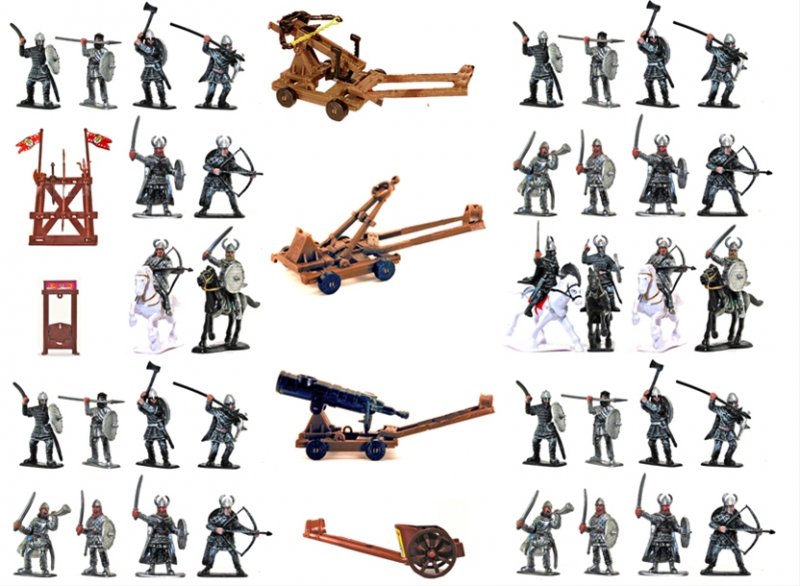
Ringmail


Rules for Medieval Toy Soldiers

Introduction

"Ringmail" was an improbable historical construct. So too these rules are an improbable match to anything historical. But they sure are fun!

Scale

Toy soldiers are 1:32 scale; that is 2&¼" or 54mm.

Field of Battle

Arrange a field of battle anywhere from 6' to 24' in dimensions. Determine battle line between opposing sides in roughly the middle of the field. Each side has a starting line set back from the battle line equivalent to that of their opponent's and no less than 24." Main stronghold, camp or pavilion of each side no more than 12" back from respective start-lines. Scale of play is such that terrain types and penalties make little sense. Distribute interesting obstacles for tactical use. Recommended: felt battle mat marked with 2" hexes; model trees, blue ribbon for rivers, etc.

Composition of Forces

Each side has one or two engines of war. Arrange each side with troop types falling roughly within the following ratio:

1 Archer : 3 Cavalry : 5 Infantry

Turn Sequence

  1. Engine
  2. Range
  3. Melee
  4. Move

All actions simultaneous. Alternatively, players determine initiative for movement by opposing check. First turn: move only. Second turn: move and melee (if any). Third turn adds range. Fourth and all subsequent turns: all four phases.

Movement

  • Engine 3"
  • Archers 6"
  • Infantry 12"
  • Cavalry 24"

Range & Melee

Range fire and melee resolved with modified rock-paper-scissors:

  • Archer removes cavalry (24" range)
  • Cavalry removes infantry
  • Infantry removes archer

All other melee resolved on opposing check: loser removed; both remain on ties. Note the following exceptions:

  • Cavalry and archer opposing check in melee
  • Both archers remain when attacker losses opposing check against archer not returning fire
  • Flank (side) or surprise (rear) attack of lesser to greater allows opposing check
  • E.g., infantry flanking cavalry resolved by opposing check

Engine

  • Redo misfires
  • Remove any figure hit by projectile
  • Remove engines hit by opposing engine fire
  • Take engines with two or more troops of opposing side on successful opposing check

Morale

Check a force's morale at the top of every turn after reduced beyond half its original line-up: maintain morale on 2d6 = 7+ otherwise morale lost.

End

Battle ends when one or both sides:

  • Losses morale
  • Reduced to less than a third its original line-up
  • Surrenders

Victory

Victory goes to the side that:

  • Does not loose morale
  • Is not reduced to less than a third its original line-up
  • Does not surrender

Otherwise a draw. Alternatively, other end and victory conditions may be agreed upon; e.g., attaining some goal such as capturing an object or flag, etc.

Sieges

Make walls with gates and even some wall-portions that engine fire can topple. One additional engine to the defender but defender starts with one third the troops of the besieger. Imagine any foot soldier positions along a wall or upon a parapet as capable of range fire, whether depicted with range weapon or not.

Point Values

  • Engine 5
  • Cavalry 4
  • Archer 3
  • Infantry 2

Setting up a Medieval Toy Soldier Wargames Campaign

Each side starts with 50 points to acquire starting forces. Note guidelines to composition of force, above. After each battle, save for the return of removed troops on 2d6:

  • Engine 6+
  • Cavalry 6+
  • Archer 7+
  • Infantry 8+

Victor gets 20 points, looser 10. Capture of opposing "baggage" or some other such treasure, object or goal grants 5 points. Each side of a draw gets 15 points. Unused points accumulate. Use points to acquire new forces for subsequent battles.

Fantasy Supplement

For a fantasy scenario, use larger scales for large types (e.g., tall elves, trolls, ogres, etc.) and smaller scales for diminutive types (e.g., small elves, dwarves, hobbits, pixies, etc.).

For monsters, use appropriate toys (e.g., dragons, giants, animals). Most monsters move as cavalry. Flight grants 36" of movement. Monsters resolve melee with an opposing check: monster = 2d6 to normal figure = 1d6. Some monsters also have range or engine capacities, e.g., dragon fiery breath, giants hurling rocks, etc. Monsters cost 15 points; those removed in battle save for the next on 2d6: 9+.

Mark one or more figures per side to indicate special status as a hero, wizard, or knight (i.e., "Templar" or "cleric").

Hero = best of both cavalry and archer; removed by archery
Wizard = best of both archer and infantry; removed by infantry
Knight = best of both infantry and cavalry; removed by cavalry

Heroes melee and range monsters with equal opposing check; defeat monsters by flanking or surprise. Heroes and wizards range fire as archers (wizards by magic). In any given battle wizards may cast each of the following once per battle: fireball, lightning bolt, light (good wizard) or darkness (bad wizard) during the engine turn phase. Light spells cause fell and undead creatures to check morale with a penalty. Darkness spells cause normal troops to check morale with a penalty. Resolve fireball and lightning bolt as engine fire. Lobbing a colorful marble with the thumb usually does the trick. During the engine phase knights may do one of the following per battle: restore one removed figure upon a successful save (see above); cast light (Dark Knights cast darkness); dispel undead creature. Heroes, wizards and knights cost 10 points and those removed in battle save for the next on 2d6: 5+.

A Sort of Challenge

"How much better is the amiable miniature than the Real Thing! Here is a homeopathic remedy for the imaginative strategist. Here is the premeditation, the thrill, the strain of accumulating victory or disaster -- and no smashed nor sanguinary bodies, no shattered fine buildings nor devastated country sides, no petty cruelties, none of that awful universal boredom and embitterment, that tiresome delay or stoppage or embarrassment of every gracious, bold, sweet, charming thing, that we who . . . remember a real modern war know to be the reality of belligerence." H. G. Wells, Little Wars, 1913.

Fight on!