Showing posts with label class. Show all posts

Sunday, June 21, 2020

Wargames and Dungeons & Dragons


This is my first post in what will become a series of posts that I hope will be helpful for folks trying to understand Dungeons & Dragons as a hobby and especially the original published rules that empowered hobbyists to launch their own campaigns.

Introduction to the series

The subtitle of a published work is always the real title. Studying a subtitle, when provided, will often tell you more about what the author understands the work to be about than the main title.

The original subtitle for the first published edition of Dungeons & Dragons is:
Rules for Fantastic Medieval Wargames Campaigns.

The real title, therefore, is "Rules for Fantastic Medieval Wargames Campaigns." A lot of the misunderstandings or confusions about Dungeons and Dragons* comes from not understanding what the publication really is. In order to understand what the first "little brown books," or, LLBS were really offering, one needs to know what a wargame is, and, better, have some contact our hours of actual play. One needs to know what a wargames campaign is, which means one needs to understand war enough to understand that it is a campaign comprising a series of battles, not one battle. One needs to understand what was considered "fantastic medieval" at the time of its publication. Finally, one needs to understand how hobby wargammers understood "rules" to work and what they meant and how they used them.

Once these things fall into place, Dungeons and Dragons suddenly starts to make a lot more sense and to become much more accessible as the launch point for one's own hobby. So let's start with the central word of the true title, the word that all the others build-off of or modify, the word "wargames."


Wargaming


At the time that Dungeons & Dragons first appeared, the hobby called wargaming had gained fair popularity. The hobby consisted of casting or collecting miniature figures of soldiers of different military eras, painting miniatures, preparing large tables with scenery and terrain, etc. You would then conduct a wargame where you would, perhaps, relive an historical battle or maybe even perform a hypothetical battle, a battle that could have taken place but that actually did not.


So what is a wargame? Well, it is first of all, a game. Like most games, you have players, you have goals and victory conditions, you have pieces, you have a setup, and you have rules to the game. Wargaming is about war. So it's a game that's particularly focused on trying to play-out, to varying degrees, combat or warfare of an historical period.


Wargaming as History hobby


One of the things that wargamers really love is history. To be a good wargamer you had to know war, and the history of war. To know the history of war meant you had to research and study. One of the major parts of the hobby of wargaming is historical research. It is the research of historical facts, knowledge, information, that is part of what's fun about the hobby to historical wargamers.


Hypothetical possiblities


Now, in some historical wargaming, what you're really trying to do is set up all the conditions of an historical battle that actually happened and that you knew existed. Then a group might decide, "Well, what if other battles were fought that were never recorded in history? Or what if we just made up a battle that would be fun to pitch and see what that was like? We're going to use the same soldiers, the same groupings of soldiers and the same statistics matched to dice rolling. We'll play out what would happen in this hypothetical situation."


For example, one particular historical period that a lot of wargamers like to focus on, among many, is the Napoleonic era of warfare. There's something very attractive about Napoleonic warfare for various reasons. One is that the troop structure was quite organized. It was one of the first set of wars where lots of records still exist that were kept meticulously and mathematically. Someone can do mathematical analysis on Napoleonic battles and learn the probabilities of one army defeating another army.


Dice Mechanics


This meticulous information is really fantastic for wargamers, because what wargamers figured out pretty early on in the hobby was that the chances and vagaries of warfare could roughly be emulated by rolling dice. A single die will turn up random chances. But when you start rolling combinations of dice they roll up in probability curves. If you can find a probability curve in a combat situation, you can find a matching way of rolling dice to simulate that probability. So with all of the data that existed from Napoleonic warfare, wargames hobbyists can, fairly well, emulate the outcomes of an actual battle.


What we have discussed so far can already help us to understand some of the terminology and approaches of Dungeons & Dragons.


Alignment Table


Having some understanding of Dungeons & Dragons wargaming context helps make sense of some of the presentation of the rules that might otherwise seem confusing. For example, I used to wonder why there was an alignment table in Men and Magic separate from the monster table and stats in Monsters and Treasure. If you're playing Napoleonic wargame, you need to know which side of the table to place Napoleon and which side to place Wellington and then set-up those armies. If you're doing a map campaign, you need to know where is France and the central cities that grant resources to the French army and where is England and where are the central cities that grant resources to the English army and navy.


You need to know the sides of your battle and that's exactly what's going on in the Chainmail fantasy supplement with its “General Line-up.” This gets reiterated in Dungeons and Dragons’ Men and Magic. You have the alignment table to give you sides. The big battle is between law and chaos. Some creatures are on the law side and some creatures are on the chaos side and some can go either way. Then there are some creatures that just opt out of it altogether, like Switzerland. If you're setting up a wargame table, one side is chaos and one side is law, in this medieval fantasy war game context. So right up front, in the first book, you've got a list of the sides and who might not take a side.


Classes


Dungeons & Dragons has fairly strictly defined classes for characters because Gygax and Arneson applied this notion of classes of troop-types from their hobby of historical war gaming.


Let's look at Napoleonic warfare again. You're going to have classes of troops, types of troops, so in the classical Napoleonic context you are going to have infantry, cavalry and artillery. If you want to make it even more complex level of detail in order to try to snatch a little added realism, then you're also going to have dragoons, light infantry, heavy infantry, light cavalry, and heavy cavalry, heavy artillery, and light artillery for a greater level of scale of detail. But each of these types of troops are different classes. You know exactly what artillery can and can't do, you know exactly what infantry can and can't do, you know exactly what cavalry can and can't do. You know what their attacks are like, you know what their defenses are like, and you know what their movement rates and capacities are like. This enables you to develop your strategy by having clearly defined classes on your battle table.


Gygax and Arneson were used to this approach to things. They developed the fighting-man, the magic-user, and eventually the cleric. And these became character classes. As in Napoleonic game you would have artillery, cavalry and infantry where each of those classes of troops have clearly defined the capacities of movement, attack, and defense, so too then the fighting-man, the magic-user, and the cleric have different capacities, abilities and liabilities that define the way that they will be played and will influence the way in which they can come together as an adventuring party to be successful together.


Wargaming didn't have to just be Napoleonic, for hobbyists interested in war history. So wargamers would also try to set up situations where they could emulate, historical or hypothetical, increasingly more modern warfare like World War I or World War II era warfare. Eventually, wargamers would get interested in ancient and medieval warfare. And from there, to "fantastic medieval" warfare!

Next in the series: "Fantastic Medieval"

Fight on!

*A note about "Dungeons & Dragons": There have been many products professionally published bearing the name “Dungeons and Dragons.” At the time of the release of this post, we have what Wizards of the  Coast call the Fifth Edition. In this blog series, I will not refer to an edition number when I say, “Dungeons & Dragons.” Rather, when I say, “Dungeons & Dragons,” I will be talking about Gary Gygax and Dave Arneson’s rules for how to put together medieval fantasy wargames campaigns that were first published in 1974 by TSR. This is what some people call the original rules. Sometimes these rules are referred to as, “Original Edition Dungeons & Dragons,” "Original Dungeons & Dragons," or, "OD&D." Sometimes people will abbreviate it as, "Oe", meaning, "Original Edition." Or even "Zero-e," meaning, "Zero Edition."

Bibliographical Note: Much of this post and any posts I share about the history and historical context of D&D is based upon the book Playing at the World by Jon Peterson.

Thursday, June 27, 2019

Elves of the Perilous Realms


Born in the Golden Age, rulers of the Silver Age, the elves of the Perilous Realms, though diminishing, are nevertheless a force to be reckoned with. The elves were born under the gracious rule of the triumphant celestial Powers after their imprisonment of the chthonic Powers in the depths of the earth.

With the fall of the Golden Age, due to the broken watch of the Powers, the fell races rushed in, autochthonically, as part of the re-ascendence of the chthonic Powers. (From ever on the fell regenerate themselves through abiogenesis, but more on that later. We must know some of the fell to tell the tale of the elves.)

The elves experienced the loss of the safety of their Powerful rulers and fell into the disarray of fell attacks. Thus the elves organized themselves and in the name of the Powers they still loved and thus they fought off the fell and established rule throughout the Perilous Realms. This was the dawn of the Silver Age.

But they did not simply conquer the fell, they also enslaved them. Cultures, languages and bloodlines intermingled. It was at this time that men were born into the world. Just as the elves had basked in the rulership of the Powers, so now, in their youth, men rested in the benevolent rule of the elves. So long as they were their loyal subjects and grateful vassals, the elves enjoyed the company of men.

But the time came for the fall of the Silver Age as the elves fell into opulence and decadence. Thus we come to the second dark age. At this time the undead first appear and lycanthropy escapes from twisted alchemical laboratories. Men find themselves in an analogous position to their elven lords. Just as they lost the protection of the Powers, so too now men found themselves without the glorious Silver Age civilizations.

And, just as the elves had fought back and won their own empire, so too men formed the empires of the Bronze Age. As men increased, even the elves that did not retire to the uttermost West began to diminish in both magic and in number.

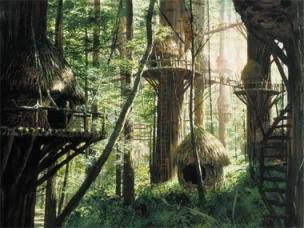
During this time, Some elves sided with the men as the only way to survive and the obvious heirs to their previous glory. Happy for the protection and friendship of the newly formed empires of men, these entered into loose alliances and maintained simple pastoral ways as deer herders dwelling in woodland villages high upon enchanted flets. These became known as the Wood Elves. The Wood Elves are on the side of the Law.

Most of the elves, however, fled into the wildernesses of the world into a forlorn life of hunting and gathering. As human hunter and gatherer societies usually consist of a few extended family groups meeting occasionally as entire tribes, elven hunter gatherers walk completely solitaire, meeting occasionally in small family groups. Their dwellings are stumps and ancient trees which only they know how to open and close. These became known as the Sylvan Elves. The Sylvan Elves take no sides any longer but their own. They are Neutral.

A few elves, however, resented the rise and ascendence of men. They refused to relinquish the former glory of the Silver Age, or even admit that it had ended. These elves dwell in enchanted castles and keeps, waylaying human travelers and imprisoning them. They try to continue to live lives of opulence and excess and to convince others of the same. These became known as the Gray Elves (either for their grave countenance upon meeting men, or perhaps due to their typical gray cloaks or, again, perhaps for the grayness of the stones of their castles -- when visible, whichever no one knows). The Gray Elves disdain human law and the ever increasing tide of human rule which they claim encroaches upon their rightful inheritance. They are therefore on the side of Chaos.

Now, with the Bronze Age Collapse, in this Age of Adventure, when parties explore the wilder lands of peril, they may be waylaid or may discover the hidden homes of any of these kinds of elves. But woe to those who fall into the traps of the Sylvan Elves, and even more so to the enchantments of the Gray Elves.

In terms of mechanics, the vast majority of the remaining elves within the Perilous Realms are the hidden and secretive Sylvan Elves. But just exactly because they are so well hidden, they are the least likely to be encountered. So, 1:6 chance that a random elven encounter in the wilderness is with one of these. If so, it means that the encounter happened at night.

The greatest minority of elves would be the Gray Elves. But just exactly because they are so militant against human rule, they are always the elves encountered when a stronghold or castle is elven. Or, if randomly encountered, 1:3 chance that it is a party of Gray Elves.

Finally, a significant minority of the remaining elves within the Perilous Realms are the friendly and lawful Wood Elves. Whenever discovering an elven village, it will be Wood Elves. And most of the time, 5:6, if there is a random elven encounter in woodland regions. Otherwise the chance of encountering a party of Wood Elves is 2:3.

In terms of playing-characters, the kind of elf you play would be based upon your choice of alignment. A backstory could quickly be spun about how you choose adventure and the company of men, etc.

This allows me to blend rather seamlessly Tolkien-style, Anderson-style and folklorish elven source material. I intend this to contribute to a rich, interesting, but still thoroughly vanilla fantasy setting -- one of the main goals of the Perilous Realms campaign!

Fight on!