Showing posts with label elves. Show all posts

Sunday, June 28, 2020

Medieval Fantasy and Dungeons & Dragons


This is my next post in a series of posts that looks at the subtitle of Dungeons & Dragons in order more readily to launch our own hobby campaigning from the original publication.

Last post, I wrote about "Wargames." In this post I will talk about the phrase, "Fantastic Medieval," in the subtitle, or, as we would say it now, "Medieval Fantasy." "Fantastic Medieval" sounds like something medieval that we thing is just awesome: that is fantastic! But that is not what the phrase meant at the time of its publication. For contemporary ears to hear the subtitle, correctly, it should be changed to something like "Rules for Medieval Fantasy Wargames Campaigns."

Medieval Fantasy


Wargaming was and is a hobby for folks that dig the study of history. History includes the middle ages and ancient civilizations. So another area of interest that quickly developed for wargamers was medieval and ancient wargaming. It would not be long before wargamers were willing to move beyond the walls of the historical and engage the literature of fantasy.


At the time that Jeff Perren and Gary Gygax published Chainmail as a set of rules for resolving medieval wargames, Gary Gygax had already developed an interest not only in the historical western middle ages, but also medieval fantasy literature. Gygax added a fantasy supplement, to the end of the Chainmail rules for folks that were interested in adding to their wargaming hobby medieval fantasy troops like elves and hobbits, dwarves and gnomes, orcs and goblins, and monsters like giants, dragons and the like.


Gygax added to what was already the base rules of a fairly realistic historical medieval wargame, ways of resolving the possibility of a dragon showing up at one of those battles. He did this for the same reason that historical wargamers would play-out battles that already existed. Just as the historical wargamer would study actual battles from history in order to understand how to set up rules and judge games as a referee so too if you were interested in medieval fantasy literature, you might want to completely redo a battle from one of your favorite pieces of medieval fantasy literature.


The Chainmail Fantasy Supplement list, for example, the Battle of the Five Armies at the conclusion of The Hobbit by J.R.R Tolkien. So Gygax suggests that if you take the Chainmail set of rules and add to it this supplement for medieval fantasy, you can engage an actual fantasy battle as described in the relevant authoritative literature. When you feel like you'd developed enough knowledge of how fantastical battles worked out you might then try your hand at your own hypothetical medieval fantasy war game battles.


Fidelity to the literature


Just as historical wargamers worked to make sure their game was as faithful to what might have happened on an historic battlefield, so too, fidelity to medieval fantasy literature in general and Sword and Sorcery in particular, formed a significant part of this new aspect of the wargaming hobby that Dungeons & Dragons introduced.


A referee would know how to judge whether something was possible, in this medieval fantasy world because they were so familiar with the medieval fantasy literature they were gaming. A key part of Dungeons & Dragons is the love of becoming an amateur expert in medieval fantasy literature. High fantasy, low fantasy, especially sword and sorcery, urban legend, classical mythology, Arthurian legend, Carolinian cycles, Nordic sagas, all form part of the expertise needed to set up and play in a medieval fantasy role playing game.


But, in the main, the particular style of medieval fantasy literature that influenced Dungeons & Dragons was what Fritz Leiber named "Sword and Sorcery." This is important to know because Dungeons & Dragons is built better to play in this kind of fantasy world than in others. Later editions of games called "Dungeons & Dragons," have shifted from this original base towards more heroic and high fantasy. So sometimes the original game is confusing to folks coming from newer RPGs. Learning about Sword & Sorcery and reading some of its core texts helps in understanding Dungeons & Dragons and helps the amateur hobbyists to build his or her own campaign.


"The general line-up”


What I've written about so far helps us to understand certain aspects of the game. For example, the taking of sides, or what would come to be called "alignment."


When you are playing a wargame, you need to know the sides of your battle and that's exactly what's going on in the Chainmail fantasy supplement with its “General Line-up.” This gets reiterated in Dungeons & Dragons’ Men and Magic. You have the alignment table to give you sides. The big battle is between law and chaos. Some creatures are on the law side and some creatures are on the chaos side and some can go either way. Then there are some creatures that just opt out of it altogether. They're not on the side of law or chaos, they're just for themselves and these because they don't really want to wage the war between law and chaos are called neutral, like Switzerland and its diplomatic neutrality. So if you're setting up a war game table, one side is chaos and one side is law, in this medieval fantasy war game context.


These categories are derived from medieval fantasy. For example, they are implied in Tolkien's Middle Earth around the War of the Ring. But these terms, "law," and "chaos," are explicit in Sword and Sorcery literature, especially that of Poul Anderson and Michael Moorcock. So, again, we have a fidelity to the literature they were trying to game.


Race


Finally, briefly, we can understand where the use of the term "race," came from. Race was a term already used in medieval fantasy literature to distinguish human characters from other intelligent beings that were not gods or spirits. Especially there would be the fay races, such as elves and dwarves, and the fell races such as orcs, goblins and trolls.


This is not how we use the term "race" in contemporary parlance, so it can throw people off. This is not about supposed differences in human groups. If the fantasy rules were put together today, someone might have chosen "species." Although, even that is misleading in a fantasy context, where a word like "species" would sound to empirical and scientific. So this terminology has stuck and is a part of the shape of medieval fantasy wargame campaigning.


Next in the series: "Rules," free kriegspiel and refereeing.

Tuesday, November 5, 2019

Pig Languages for Zany Fantasy Settings


I devised the following Pig Fantasy Languages for my Wildlands of Yawon Con Campaign I am developing. (Ran it at our Camp Allen Mini Con and will run it again at the NTRPGCon.)

In this sub-setting of the Perilous Realms there is common plus 8 other languages.

1. Ancient (human)
2. Barbarian (human)
3. Elvish
4. Dwarfish
5. Fell (orcs, goblins, etc.)
6. Chthonic
7. Elemental
8. Celestial

No “Alignment languages.” I've replaced them with Chthonic, Elemental and Celestial, respectively.

With regards to some of the instructions below, note that sometimes I move entire first syllables, and not just first letters, to the end, to make the word sound more like a real language or to avoid every word starting with a vowel.

I found Pig Elvish, first, with a google search. Can’t tell who first came up with it so I can’t give proper credit. Sorry! From Pig Elvish and good old Pig Latin I have imagined the rest.
Enjoy!

Pig Ancient (Human)
Igpay Atinlay

Pig Barbarian
Drop articles
Drop pronouns
No auxiliary verbs
Reduplicate first syllables of nouns
1 syllable words and verbs: append “um”
Orthography: ALL CAPS

Pig Elvish
1st letter to the end
3 letters or view: append “en”
4 letters or more: append random vowel
Change all Ks to Cs
Add umlauts to end and accent at will

Pig Dwarfish
1st letter to the end
3 letters or fewer: append “(z)ad”
4 letters or more: append “(‘)ka”
Change all Cs to Kh
Add apostrophes at will

Pig Orcish
As Pig Barbarian, above, and
appending and prefixing "(n)ash,” “(g)osh,” or “(g)ash” at will
Change all Cs to Ch, all Gs to Gh, Ks to Kh
Add apostrophes to separate excessive consonants

Pig Chthonic
1st letter to end
3 letters or fewer: prefix “(n)az”
4 letters or more: infix “(gh)ül”
Cs to Ch; Ks to Kh, Gs to Gh
Umlauts at will
Add apostrophes wherever necessary or fun

Pig Elemental
As Chthonic but
Prefix “(bo)ra”
Infix “rüm”
No other letter changes

Pig Celestial
As Chthonic but:
Prefix “La”
Infix “oo,” or “ü”
Use apostrophes to separate excessive vowels

Fight on!

(Image from link to: http://www.incidentalcomics.com/2012/08/pig-latin.html)

Thursday, June 27, 2019

Elves of the Perilous Realms


Born in the Golden Age, rulers of the Silver Age, the elves of the Perilous Realms, though diminishing, are nevertheless a force to be reckoned with. The elves were born under the gracious rule of the triumphant celestial Powers after their imprisonment of the chthonic Powers in the depths of the earth.

With the fall of the Golden Age, due to the broken watch of the Powers, the fell races rushed in, autochthonically, as part of the re-ascendence of the chthonic Powers. (From ever on the fell regenerate themselves through abiogenesis, but more on that later. We must know some of the fell to tell the tale of the elves.)

The elves experienced the loss of the safety of their Powerful rulers and fell into the disarray of fell attacks. Thus the elves organized themselves and in the name of the Powers they still loved and thus they fought off the fell and established rule throughout the Perilous Realms. This was the dawn of the Silver Age.

But they did not simply conquer the fell, they also enslaved them. Cultures, languages and bloodlines intermingled. It was at this time that men were born into the world. Just as the elves had basked in the rulership of the Powers, so now, in their youth, men rested in the benevolent rule of the elves. So long as they were their loyal subjects and grateful vassals, the elves enjoyed the company of men.

But the time came for the fall of the Silver Age as the elves fell into opulence and decadence. Thus we come to the second dark age. At this time the undead first appear and lycanthropy escapes from twisted alchemical laboratories. Men find themselves in an analogous position to their elven lords. Just as they lost the protection of the Powers, so too now men found themselves without the glorious Silver Age civilizations.

And, just as the elves had fought back and won their own empire, so too men formed the empires of the Bronze Age. As men increased, even the elves that did not retire to the uttermost West began to diminish in both magic and in number.

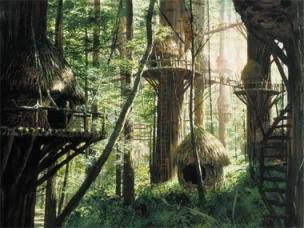
During this time, Some elves sided with the men as the only way to survive and the obvious heirs to their previous glory. Happy for the protection and friendship of the newly formed empires of men, these entered into loose alliances and maintained simple pastoral ways as deer herders dwelling in woodland villages high upon enchanted flets. These became known as the Wood Elves. The Wood Elves are on the side of the Law.

Most of the elves, however, fled into the wildernesses of the world into a forlorn life of hunting and gathering. As human hunter and gatherer societies usually consist of a few extended family groups meeting occasionally as entire tribes, elven hunter gatherers walk completely solitaire, meeting occasionally in small family groups. Their dwellings are stumps and ancient trees which only they know how to open and close. These became known as the Sylvan Elves. The Sylvan Elves take no sides any longer but their own. They are Neutral.

A few elves, however, resented the rise and ascendence of men. They refused to relinquish the former glory of the Silver Age, or even admit that it had ended. These elves dwell in enchanted castles and keeps, waylaying human travelers and imprisoning them. They try to continue to live lives of opulence and excess and to convince others of the same. These became known as the Gray Elves (either for their grave countenance upon meeting men, or perhaps due to their typical gray cloaks or, again, perhaps for the grayness of the stones of their castles -- when visible, whichever no one knows). The Gray Elves disdain human law and the ever increasing tide of human rule which they claim encroaches upon their rightful inheritance. They are therefore on the side of Chaos.

Now, with the Bronze Age Collapse, in this Age of Adventure, when parties explore the wilder lands of peril, they may be waylaid or may discover the hidden homes of any of these kinds of elves. But woe to those who fall into the traps of the Sylvan Elves, and even more so to the enchantments of the Gray Elves.

In terms of mechanics, the vast majority of the remaining elves within the Perilous Realms are the hidden and secretive Sylvan Elves. But just exactly because they are so well hidden, they are the least likely to be encountered. So, 1:6 chance that a random elven encounter in the wilderness is with one of these. If so, it means that the encounter happened at night.

The greatest minority of elves would be the Gray Elves. But just exactly because they are so militant against human rule, they are always the elves encountered when a stronghold or castle is elven. Or, if randomly encountered, 1:3 chance that it is a party of Gray Elves.

Finally, a significant minority of the remaining elves within the Perilous Realms are the friendly and lawful Wood Elves. Whenever discovering an elven village, it will be Wood Elves. And most of the time, 5:6, if there is a random elven encounter in woodland regions. Otherwise the chance of encountering a party of Wood Elves is 2:3.

In terms of playing-characters, the kind of elf you play would be based upon your choice of alignment. A backstory could quickly be spun about how you choose adventure and the company of men, etc.

This allows me to blend rather seamlessly Tolkien-style, Anderson-style and folklorish elven source material. I intend this to contribute to a rich, interesting, but still thoroughly vanilla fantasy setting -- one of the main goals of the Perilous Realms campaign!

Fight on!