Thursday, June 27, 2019

Elves of the Perilous Realms


Born in the Golden Age, rulers of the Silver Age, the elves of the Perilous Realms, though diminishing, are nevertheless a force to be reckoned with. The elves were born under the gracious rule of the triumphant celestial Powers after their imprisonment of the chthonic Powers in the depths of the earth.

With the fall of the Golden Age, due to the broken watch of the Powers, the fell races rushed in, autochthonically, as part of the re-ascendence of the chthonic Powers. (From ever on the fell regenerate themselves through abiogenesis, but more on that later. We must know some of the fell to tell the tale of the elves.)

The elves experienced the loss of the safety of their Powerful rulers and fell into the disarray of fell attacks. Thus the elves organized themselves and in the name of the Powers they still loved and thus they fought off the fell and established rule throughout the Perilous Realms. This was the dawn of the Silver Age.

But they did not simply conquer the fell, they also enslaved them. Cultures, languages and bloodlines intermingled. It was at this time that men were born into the world. Just as the elves had basked in the rulership of the Powers, so now, in their youth, men rested in the benevolent rule of the elves. So long as they were their loyal subjects and grateful vassals, the elves enjoyed the company of men.

But the time came for the fall of the Silver Age as the elves fell into opulence and decadence. Thus we come to the second dark age. At this time the undead first appear and lycanthropy escapes from twisted alchemical laboratories. Men find themselves in an analogous position to their elven lords. Just as they lost the protection of the Powers, so too now men found themselves without the glorious Silver Age civilizations.

And, just as the elves had fought back and won their own empire, so too men formed the empires of the Bronze Age. As men increased, even the elves that did not retire to the uttermost West began to diminish in both magic and in number.

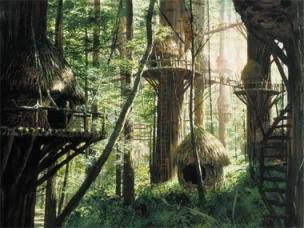
During this time, Some elves sided with the men as the only way to survive and the obvious heirs to their previous glory. Happy for the protection and friendship of the newly formed empires of men, these entered into loose alliances and maintained simple pastoral ways as deer herders dwelling in woodland villages high upon enchanted flets. These became known as the Wood Elves. The Wood Elves are on the side of the Law.

Most of the elves, however, fled into the wildernesses of the world into a forlorn life of hunting and gathering. As human hunter and gatherer societies usually consist of a few extended family groups meeting occasionally as entire tribes, elven hunter gatherers walk completely solitaire, meeting occasionally in small family groups. Their dwellings are stumps and ancient trees which only they know how to open and close. These became known as the Sylvan Elves. The Sylvan Elves take no sides any longer but their own. They are Neutral.

A few elves, however, resented the rise and ascendence of men. They refused to relinquish the former glory of the Silver Age, or even admit that it had ended. These elves dwell in enchanted castles and keeps, waylaying human travelers and imprisoning them. They try to continue to live lives of opulence and excess and to convince others of the same. These became known as the Gray Elves (either for their grave countenance upon meeting men, or perhaps due to their typical gray cloaks or, again, perhaps for the grayness of the stones of their castles -- when visible, whichever no one knows). The Gray Elves disdain human law and the ever increasing tide of human rule which they claim encroaches upon their rightful inheritance. They are therefore on the side of Chaos.

Now, with the Bronze Age Collapse, in this Age of Adventure, when parties explore the wilder lands of peril, they may be waylaid or may discover the hidden homes of any of these kinds of elves. But woe to those who fall into the traps of the Sylvan Elves, and even more so to the enchantments of the Gray Elves.

In terms of mechanics, the vast majority of the remaining elves within the Perilous Realms are the hidden and secretive Sylvan Elves. But just exactly because they are so well hidden, they are the least likely to be encountered. So, 1:6 chance that a random elven encounter in the wilderness is with one of these. If so, it means that the encounter happened at night.

The greatest minority of elves would be the Gray Elves. But just exactly because they are so militant against human rule, they are always the elves encountered when a stronghold or castle is elven. Or, if randomly encountered, 1:3 chance that it is a party of Gray Elves.

Finally, a significant minority of the remaining elves within the Perilous Realms are the friendly and lawful Wood Elves. Whenever discovering an elven village, it will be Wood Elves. And most of the time, 5:6, if there is a random elven encounter in woodland regions. Otherwise the chance of encountering a party of Wood Elves is 2:3.

In terms of playing-characters, the kind of elf you play would be based upon your choice of alignment. A backstory could quickly be spun about how you choose adventure and the company of men, etc.

This allows me to blend rather seamlessly Tolkien-style, Anderson-style and folklorish elven source material. I intend this to contribute to a rich, interesting, but still thoroughly vanilla fantasy setting -- one of the main goals of the Perilous Realms campaign!

Fight on!

Monday, April 22, 2019

Ages of the Perilous Realms


I am more a rules-imaginer than a setting-imaginer. But I'm getting more into exploring my campaign setting than ever before.

There are multiple overlapping ages of rise and collapse of mighty civilizations that define the Perilous Realms and the kinds of ruins, underworlds, treasures, magic items and artifacts that may be found. Here is the myth, or legend of the various apocalypses and dark ages that led to the current state of the Perilous Realms, my campaign setting.

The Diamond Aeon

In this age, the archetypal powers were young and playful children of the Most High.
They knew their place, and, although childishly mischievous at times, obeyed the will of their Father.
They reigned over the cosmos like living stars.
In the end, the archetypal powers come of age, and conflict ensues.
They rebel against their Father and are thrown into the chaos of war.

In terms of the way we think of things now, we are talking about billions of years ago. Thus this loosely corresponds to “big bang” through cooling down of the universe. In Tolkienesque terms, this is like the Valaquenta. The key to this fall narrative is REBELLION. So whenever we see rebellion in the campaign setting it links somehow to the Powers.

The Golden Age

Law and chaos draw their lines for the first time.
The Celestials seek to establish the joy of the Diamond Aeon through Law, and often fall into rigid legalism.
The Chthonic powers seek to empower the unbridled joy of the Diamond Aeon through following the passions of the underworld and often fall into the cruelty and whim.
Many powers opt out and hide as spirits of nature and life ("neutral" elemental powers).
The war shapes much of the terrain of the Perilous Realms.
Ultimately, the Celestials drive the Chthonics under earth and imprison them there, only to serve for fertility and virility.
The Celestials establish a Golden Era of light and genius upon the earth — with unparalleled cyclopean edifices and artifacts!
At this time, the fay races are born into the wonder of direct contact with their fascinated rulers.
But the Celestials become too confident in their victory, and their watches fall into indiscipline.
In the end, the earth cannot contain the chaos that errupts.
The final war leads to total apocalypse and a dark age ensues.
 
In terms of the way we think of things now, we are talking about millions of years ago. Thus this loosely corresponds to a kind of smashing together of the mesozoic and its great meteoric (heavenly) and volcanic (chthonic) apocalypse together with the monolithic stone age. This nicely gives us cavemen with dinosaurs! This era gives a chance to engage the Lovecraft Mythos. The key to this fall narrative is COMPLACENCY.

Interlude: The Age of Darkness

The fell races are born and run free but unorganized.

The Silver Age

Out of the shadows of the Age of Darkness, the Fay races form an alliance, consulting what Powers still remain in their weakness and sorrow.
With the advice of their cosmic elders, the fay together stem the tide of the spawning hoard.
The elves rise to power over all other fay.
They establish a Silver Era under the light of their matron, Mother Moon.
They enslave the fell races, especially the orcs, to do their bidding — and on their backs they build mighty cities, towers, and palaces unrivaled by any save the powers themselves.
But the orcs and their fellow fell never forget their enslavement.
At this time, Men arrive, the fay know not from where — nor do the men! They are in awe of the elves.
But the elves in their assumption of opulence grow fatuous, weak, superficial, degenerate — and their civilizations fall into decadence.
Thus they become easy targets for fell rebellion — if they are not dragged down by their own petty divisions and meaningless wars of trumped up honor.
The collapse of the elves is a slow and painful decline, leading, ultimately, to a second dark age.

In terms of how we think now, we are talking about several millennia ago. Thus this roughly corresponds to the great pre-historic civilizations of myth. This era allows me to smash together Tolkien's and Anderson's elves. The key to this fall narrative is DECADENCE.

Interlude: The Second Dark Age

Pacts with the chthonic power, Necros render the first Undead. Alchemical and medicinal warfare fabricate the disease of lycanthropy. Monsters proliferate.

The Bronze Age

The bronze age is the first age of Men.
In the memory of the elven empires of old, and in devotion to, and under the patronage of what remains of the mighty Powers, men erect fabulous temples. Around these temples, cities grow up — Ur, Babel, Byblos, Shangri-La, Hamunaptra, Aqaba, Thebes, Indus, Eddo, Techlan, Cyprus.
These temple-cities become the center of mighty and diverse empires in trade with one another of both goods and philosophies.
At some point, men cannot remember how or why these great empires all suddenly (with decades of one another) fell into complete collapse.
It is not likely that the collapse came about either because of internal disputes or because of external wars, although these played a part, but from the evidence it seems the “gods” (Powers) no longer favored them and removed their blessings of abundance.
This is the great Bronze Age Collapse.
The human population was decimated and the survivors fled to hills and mountains to survive.
The “Ancients” left behind powerful ruins, tombs, sepulchers and crypts — of frightful aspect to the fragile humans who remained.

In terms of how we think now this represents several centuries ago. Thus this is a fantasy version of the actual Bronze Age Collapse. This allows us to engage classical mythology and legend. The key to this fall narrative is divine ABANDONMENT.

Now: The Age of Adventure

Now is the age of adventure!
Now law and chaos reenter their struggle for vast civilizations of lawful glory or unbridled passions and dominion.
Now mighty fighting-men and Amazons rise up to pit their thews against the dying of the light!
Now over-confident users of magics seek their own through initiations into the mysteries of the arcane.
Now the church proclaims a gospel of universal order under a king of heaven and sends out crusaders (“clerics”) to establish Law: by word or by fist.
Now fearless — or foolish — adventurers commit to mighty peregrinations into forgotten wildernesses and yawning openings of the mythic underworld.

In terms of how we think now, this represents about the last millennium. The Perilous Realms campaign begins in an imaginary year 990. In a sense, this is a Third Dark Age. It roughly corresponds to a mash up of the Iron Age and both the Western and Eastern Middle Ages. This age engages Leiber's universe of Nehwon. The key narrative here, is, of course, WAR and ADVENTURE.

All of these previous beings remain: powers, fay, fell, lycanthropes, undead of the bronze age— each slightly weaker than before. Each remembers and grieves the loss of their once great status. But now they are lost in wildernesses and trapped in nightmares of the underworld.

Adventurers may stumble upon all of these different layers of civilization, languages and artifacts:
Powers: celestials, elementals, chthonicoi and their physical manifestation as giants and sylvan monsters
Fay: elves, dwarves, gnomes, and, after a fashion, even the hobbits
Fell: kobolds, goblins, orcs, hobgoblins, gnolls; and
Ancient men: Aegyptian, Anatolian, Levantine, Etruscan, Mycenean, Assyrian, Hittite, Wotan, Indus, Nod, Jomon, and more.
Their stories give clues to one another and nest within one another.

Fight on!

Monday, March 4, 2019

More on the General Line-up


Alignment came from wargames. It was about knowing what side of the battlefield to place the troops. There were the good guys (law), the bad guys (chaos) and those who wanted to try to keep out (neutral).

What does this mean?

Here is how I understand it now.

Alignment is descriptive, not prescriptive. Alignment changes based upon behavior. Example: if a chaotic person does something to serve law once, she becomes neutral. If a neutral person does something to advance law she becomes lawful. And vice versa.

  1. Law = Human law is good for everyone
  2. Neutrality = Human law is good for human beings
  3. Chaos = Human law isn't any good for anyone
Law

Human law is good for everyone. It is good for every human settlement. It is good for elves and dwarves and hobbits too - whether they know it yet or not. It is good for fell creatures such as orcs - which usually means they are dead orcs.

This is because human law is consonant with the laws of heaven or the cosmos. Thus human law is universal and should be performed and judged the same across all geographic regions, with some wiggle room for local variation and culture.

In actual practice, there are many schools of law, all arguing with each other as to who has gotten it right, but still basically recognizing each other. So, for example, there are the philosophers of the Forbidden City who proclaim that the law of heaven and of men is the same and we must find its Way. Then there is the Church of Law who believe the King of Heaven has revealed the one true law. They alone have Crusaders (clerics) actively spreading universal human law as they understand it.

Neutrality

Human law is good for human beings. Every human settlement should have laws in place for the good of its people. It is not good for human beings to live lawlessly. Human laws, however, ought not to be expected to apply to creatures that are not human.

This is because human law is something that arises naturally from human beings through accumulated custom. Custom is unavoidable and ought to be respected for the life it brings to human groups. And although laws are natural and not entirely arbitrary, nevertheless they do not enjoy anything like a one-to-one correspondence with the laws of the cosmos.  So one ought not to expect different human groups to have similar customs and laws.

There are many local cults and philosophical schools who adhere to something like the above. They are not willing to fight for anything they perceive to be purely local and customary. They will fight for human life. Needless to say, there are no churches or crusaders for neutrality.

Chaos

Human law isn't any good for anybody. Human settlements must be liberated from such oppressive local customs and traditions. Elves and dwarves and hobbits - even fell races such as orcs - actually live closer to a truly liberated existence.

This is because human law is merely by convention and therefore purely arbitrary. Laws are imposed by the strong on the weak. Laws arise among human beings out of fear of living truly free like animals following their instincts, or fay or fell races following their intuitions. Basic moral sentiments such as loyalty, disgust, respect, affection, retribution and reward are all that are necessary to live a truly human life.

Most of the cults and philosophical schools who adhere to something like the above find that they must maintain relative secrecy for their own protection. They will fight for freedom of sentiment for themselves and on behalf of others when they perceive they have an overwhelming advantage - a real chance for success - for they know the wrath of Law that will rain down upon them should they fail. Among the multitudinous cults there are many who fashion themselves "churches." These sometimes recognize each other and are willing to work together for practical reasons. They all attempt to infiltrate the Church of Law to over throw its tyranny from within. These churches have anti-crusaders (anti-clerics), sometimes openly so, sometimes acting under-cover as Crusaders (clerics), actively spreading freedom of sentiment as they understand it.

How they understand each other

This of opposite alignments see the other as deluded and dangerous.
Neutral folks find Law and Chaos fanatical, over-worried and perhaps a bit hokey.
Chaos and Law find Neutral folks wishy-washy, noncommittal and perhaps obstructive.

Conclusion

I hope this is clearly different than the way that alignment is sometimes described. Please note that none of these folks are deliberately immoral, but all can fall into some form of immorality. Chaos can be moral simply freely following basic human sentiments and passions like affection, loyalty and disgust. Chaos can be immoral when any of those affections become extreme and cruel. Law can be moral by bringing safety and peace to free races. Law can be immoral when that law is imposed with fear, micromanagement and oppression. Neutrality can be moral by respecting both sentiment and local mores. Neutrality can be immoral through complacency, claiming they ought not to get involved so as not to meddle in, or impose upon others, merely local custom.

Saturday, October 13, 2018

OSR Questionnaire


When I first became aware of the OSR, I was excited about it and learned as much as I could. After discovering Dungeons & Dragons (original) and the communities that support it, I no loner feel like I am "a part of" the OSR in a straightforward way.

It seems at first the OSR was about a return to the original, wargame style of play at the time of the birth of D&D as a hobby. Part of this included a return to a more DIY approach, both in terms of setting (not relying upon someone else's published, professional, setting) and "rulings not rules" (realizing that the local referee, group and game play itself was more important for developing both the rules and the shared setting than strict adherence to a professionally developed set of rules and settings).

In other words, the OSR represented to me a return to D&D as a hobby, rather than a consumer product. The hobby approach empowers creativity. The consumer approach makes passive clients. As a hobby it comes with a hobbying community of idea-sharing and mutual support. The internet facilitates such a hobby community in a large and broad way.

Much of what I have seen the OSR become since I got back into gaming in 2013 is a proliferation of small-scale or semi-professional game-resource publication. There is a lot of really good stuff out there. But, just exactly because of my more hobby-based, localist approach, I do not find myself using other people's modules very often, however professionally slick or "old school."

However, much of the stuff published as "OSR" falls into the current cultural zeitgeist that "creative" indicates, or is equivalent to, being edgy, troubled, dark, or "morally ambiguous." A lot of talk out there is about how we need to eschew "tropes" of fantasy in order to be "truly creative." In some cases it seems that the goal is to be as edgy as possible while still playing in a new school, story-game style. "Mapping sucks." "Challenge people with a moral dilemma." Etc. I find none of this attractive.

The following questionnaire comes from a big OSR personality named Zak. I do not follow his work much, honestly. But I stumbled across the questionnaire from other folk's blog posts and google+ posts where they filled it in in interesting ways. That is a good gift to the community, so, thank you, Zak. So if you are still reading, here goes:

1. One article or blog entry that exemplifies the best of the Old School Renaissance for me:

Philotomy's Musings

2. My favorite piece of OSR wisdom/advice/snark:

My own pithy zen-like saying in the spirit of Matt Finch's "Primer":

Amateur hobby, not professional product.

Medieval fantasy wargames campaigning is a hobby, so dive in for amateur fun. Stop expecting "professional production quality," and go for the joy and creativity that comes from a community of amateurs sharing ideas and swapping stories -- hobbyists who do it for the fun of it, not for profit. Don't passively receive wargames campaigning as some product rendered to you as a mere consumer of what "experts" say you are supposed to like or agree upon as standard. Instead, Fight on!

3. Best OSR module/supplement:

Tomb of the Sea Kings

4. My favorite house rule (by someone else):

"Crits" & "Fumbles": "Natural 20" does full (not double) damage. Don't do fumbles. Fumbles punish everyone with unfun. Both rulings come from Philotomy (see above).

5. How I found out about the OSR:

In 2013 I was surfing the web and remembered D&D then I plunged into what was going on and found my way to the OSR and, through them, to the original rules for medieval fantasy wargames campaigns.

6. My favorite OSR online resource/toy:

Mr. Josh Bear's ODD Referee Tool. I use it every session.

7. Best place to talk to other OSR gamers:

Because of what I mean by "OSR," as a return to old school, war-gaming style of play, together with, but not limited to a DYI attitude:

Finarvyn's ODD74 proboard, and
The Knights & Knaves Alehouse forum.

These are old-school internet formats that actually encourage conversation and not disappearing content:
This is the weapon of a Jedi Knight. Not as clumsy or random as a blaster; an elegant weapon for a more civilized age.
8. Other places I might be found hanging out talking games:

My own blog (you are here). I just don't post very often or very consistently. Sorry about that. (I hope that it is due to the fact that most of my hobby energy goes to actually gaming weekly.)

I also hang out and talk about games with real-live people that I know. Once a year I get to go to the North Texas Role-playing Game Convention and I get to talk to even more real live people about the game.

I followed folks on google+ but just used it to share my blog posts. It is now going the way of the dodo. We will see what happens with the migration to MeWe.

9. My awesome, pithy OSR take nobody appreciates enough:

It is not my own, but Delta's Target 20 combat and save resolution, combined with my own house-ruled hit-dice approach for distinguishing classes from one another. This has recently been "historically justified" by none other than Jon Peterson himself!

10. My favorite non-OSR RPG:

Diplomacy.

11. Why I like OSR stuff:

The OSR stuff that I like, when I like it, is stuff that has come out of someone's loving, amateur DYI hobby that is full of archetypal fantasy, full of interesting puzzles to solve, and immediately usable at the table (= good, easily readable, well-keyed maps).

12. Two other cool OSR things you should know about that I haven’t named yet:

Wayne Rossi's The Original D&D Setting. Just so good.
Paul Gorman's Magic Swords.

13. If I could read but one other RPG blog but my own it would be:

Please, don't read mine if you are only going to read two RPG blogs! I don't have nearly enough content. So, I get to name two. Since I have already mentioned Delta's D&D Hotspot, Jon Peterson's Playing at the World blog, and Wayne Rossi's Semper Initiativus Unum blog, above, then I get two more:

Jeff's Game Blog.
Hack & Slash.

Dyson Logos' Dodecahedron should get an honorable mention. His mapping skill and artistry is only improving. Unfortunately, for me, the actual gameable content of the maps has become increasingly blah and unusable over time. Dig back into his earlier stuff. Less pretty (perhaps, I still think it is great), but far more usable for old school play: lots of overlapping rooms and corridors, secret hatches, passageways, doors, traps. Just more interesting and inspiring for my style of play.

Finally, Bryce Lynch's Ten Foot Pole should receive another honorable mention. I agree with his module criteria about 80%, and that is about as much as any mature adult can expect to agree with another mature adult if they are not members of a cult. My main points of disagreement are where he tends towards "realism" and "ecology," whereas I enjoy a more "funhouse" approach.

14. A game thing I made that I like quite a lot is:

My own cumulative setting and house rules. I mean not just The Perilous Realms supplement I published or the simplified version I have as a page on my blog, but all of the cumulative rulings I've tracked due to actual play in the campaign. I have it all compiled in a readable but loving imitation of the Judge's Guild Ready Ref Sheets. I call it "Campaign Aids and Inspirations." It is where I put all my generative charts, tables, and decision trees. I haven't shared that document and I may never. The point is for you to develop your own settings and rulings.

15. I'm currently running/playing:

The Perilous Realms, a medieval fantasy wargames campaign. I use my own campaign world based upon an anachronistic mash up of our own medieval and ancient past. Each particular wilderness is the Outdoor Survival board set in such a way that the river flows to the nearest major body of water. The particular wilderness right now I call the Hollow Lands. They lie underneath the Mazandarin Sea, the nearest major city being Hecatompylos along the Silk Route. I use my own house rules built upon Dungeons & Dragons (the original rules for fantastic medieval wargames campaigns).

16. I don't care whether you use ascending or descending AC because:

If I am at your table, I trust you will tell me if my attack was successful. If you are at my table, I will tell you if your attack was successful. Thank you, Dave Arneson.

17. The OSRest picture I could post on short notice:

Please see above.

Fight on!

Saturday, September 1, 2018

Armor Class, Movement, and fiddling with the archetypes


Why would I buy a two-handed sword if it still just does 1d6 damage?

Because, although you cannot wield a shield with it, it acts as a shield itself.


Why would I wear anything less than full armor class 2 as a fighting-man?

Because decreasing armor class increases encumbrance and thus slows movement.

AC, Encumbrance, MV table
AC
Limit
Move
9
900p
12”
8
800p
12”
7
700p
12”
6
600p
9”
5
500p
9”
4
400p
9”
3
300p
6”
2
200p
6”

We use the four M's for our combat round cycle:
Missle
Magic
Mêlée
Move

If your MV rate is better than that of an opponent, you might get an extra attack during the movement phase of the round.

Formula: difference greater than 3 = success. Difference 3, opposing check on 1d6, +1 to the party with the higher rate. Equal rates, opposing check on 1d6.


But I'll throw in a bonus side affect for you: you get to be a fighting-man that looks like Conan the Barbarian.

Recall that I allow both shields and helmets to decrease AC by 1. They just can't do so cumulatively such that you would go below your class limit.

I'll even throw in something extra for you: ring mail costs and functions the same as leather. So you can wear a big ring-mail shirt, a horned helmet and wield a two-handed sword and function at armor class 5. (Or look like the above picture: no helmet but shield and regular sword. Whatever. You get the point.) You get the benefit of attack during movement phase. You are welcome.


Why can't elves wear regular armor?

Recall that, because of the nails the crucified the King of Heaven, all iron is hallowed, stopping all (non-clerical) magic.

But elves can wear bronze armor, it costs and functions the same as chainmail. Most magical armor is ancient, thus already made of bronze.


Then why couldn't magic-users wear, say, at least leather armor?

Silly. Don't you remember that, in order to cast spells, magic-users must utter the words of power and engage the somatic gestures that resonate the spell across planes? Armor would weigh down and block the somatic resonance. Everybody knows that.

Fight on!