
Showing posts with label publication. Show all posts
Showing posts with label publication. Show all posts
Thursday, August 24, 2023
Thanks for your comments, friends!

Saturday, May 5, 2018
Character Record

I want it too look old school, like something printed back in the day. Hence the boxes and the old school fonts. (I have an even smaller version, using a font that looks like a type-writer.)
I hate it when I find someone's character sheet and there is no player name on it. So I made that the first thing. I'm always bummed when people have no idea how long they've had a character (including me), so: problem solved.
By character description I really mean epithet(s) and extraction, not some "background." Hence the brevity of space.
I want this record to be usable by folks who have never played and by folks who have. I want it to be usable by players that roll their own dice and also to work well for situations where I play it really old-school and I roll all dice, for everyone, behind the screen. I love playing this way and it frees the players up to figure things out and role-play.
Thus "title" is more important than level. Titles are fun and interesting and aid role-play. The levels can be jotted down in parentheses for those interested.
Likewise knowing who's side you are on is easier to make sense of then "alignment." Also, when law vs. chaos is not much more than just "shirts vs. skins," we can avoid the unending philosophical contemplations of the nature of the "alignment system."
I play race as class in my 0e games, so I just list them in the same box with a slash mark.
The first five boxes can be read out pretty straightforwardly: John's Character is Jack the Fat-lipped of the Sundown Marches; he is a Veteran Lawful Fighting-Man.
Ability Scores, sum of 3d6, each, straight down the line, no funny-business. I use Delta's abbreviation of Charisma, "X," from the Greek Chi, thus distinguishing it from the "C," for constitution.
What the heck is "apotropy"? Okay, so I know you are mad at me about this. But remember the principle from above that I want this for new players and for folks who aren't even going to be rolling dice. Okay, I hear you say, now you've lost me. But hold on. Let's look at the other boxes and come back to this one.
Reading Philotomy's Musings on the nature of hit points got me trying to call them something else. I started calling them "luck points," you know: "you're down on your luck, man; your luck is running out!" Etc. I explained this to a group of folks that included three Ph.D.s in psychology. One of them said, "oh, I get it, it's resilience, isn't it?" "Yes," I said, "resilience points." And it just kind of stuck. But for those who know or want to work with the mechanics, there is "HP," right there, still listed to the side.
I use Delta's Target-20 method for both attack rolls and saving throws (see my house rules summary). Most new folks -- and all folks when I do all the rolling behind the screen -- only need to know what kind of weapons they have. If they tell me what weapon they are using and what they are trying to do with it, I can take it from there. But for those who want the old mechanic or demand to "roll their own," then the mechanic is right there next to it, "(HD)."
Likewise, players who don't want to have to fiddle with mechanics do like to know if they have armor on or not, and if so, what. And as long as they can read the handwriting and tell me what they've got, then I know their armor class anyway. Again, you can write the armor class right there next to it in parenthesis, as suggested by the "(AC)" immediately to the right of "Armor."
Every old-school character record needs to have a box for "languages." That is how you figure out what is going on behind that door you are "listening at"!
Gold. Well there you have it. I used to call this box "Treasure," and then list "Purse g.p.," and "Bank g.p." But then I would say, "Hey, how much gold do you have left." And they would say, "Gold? gold? Where is that on here?" So now, although the game is about Monsters and Treasure, the character record just boils it down to what we are all looking for: Gold (piece value). Because, well, gold is experience. And experience is everything.
Gold is next to Armor, above it. Because starting armor comes from starting gold. And Gold is next to Equipment (which is next to Supplies), below it. Because you buy equipment and supplies with gold. Nice, right?
That is something else I was going for with this record. I wanted things also to have a logical coherence. It is pretty good, but not perfect. So experience affects level, and thus title, which in turn affects hit die, which in turn affects hit points and even saves. So all those mechanical things are clustered together on the right side.
But I also did that on purpose. If you go straight down the right-most column you have everything that most players need most of the time. You already know your characters name (right?). So you can glance down the right side and see your character's: Title (Lvl.), Experience (XP), Resilience (HP), Armor (AC), and (most importantly), GOLD!
The first thing I suggest under "Notes," is that "Last Will & Testament," urged by Men & Magic.
All those supplies listed do not indicate that the character actually has them, yet, without purchase. Nor does it suggest that you must purchase those and only those. The idea is to help out the new players with some key suggestions. I always recommend that they place the amount they purchases in parentheses next to the item listed, and then use tally marks to count them down so that they know when they need to supply up again. So, for example, Torches (6), followed by tallies until all 6 are gone. Then, if you make it back alive, buy some more torches. Rope? I hear you ask. Yes, rope. Hemp romp gets 5 uses and silk rope gets 25. I'm just tough that way.
So how about that apotropy? Well, I thought you'd never ask. Now that I've convinced you that I've done a (pretty) good job of rendering mechanical things into handy nomenclature (Resilience, Weaponry, Armor, etc.), I can tell you that that is what I am trying to do with Apotropy. I had been calling it "Resistance," but it sounded to much like electrical engineering (or freedom fighting, or whatever). Apotropaic magic is magic that wards off magic and other unlucky things. These are like talismans, amulets and charms. So this is a place for folks to jot down apotropaic objects and spells they may have in place, like a ring of protection, or whatever -- and then remind me they have it so I can factor it in when I roll their saves behind the screen! Those who know, or want to know, what is going on still have "ST," for Saving Throw(s), listed there in parentheses immediately to the right. I use a single save, but other's could easily list all five if they wanted to. So, anyway, you may not be thrilled by my word choice, but, hopefully, you get what I was trying to do: give new folks and non-rollers a box that makes some sense that can double as a saving throw box for those who want it.
(If you like this and think you might want to use it, the full-sized photo is available for download on my Character Record page.)
Friday, February 2, 2018
Temple of Zaphron, Goddess of Frogs

Encounter Table d6
1-3 Kobolds 1d6
4-5 Skeletons 2d6
6 Merak
Merak the Unexpected
MU4 AC9 MV9
Sleep
Polymorph
Lightning
Phantasmal Forces
Kobolds
HD1/2 AC7 MV6
Formation: Shields, Spears, Darts
Skeletons
HD1/2 AC7 MV6
Shields, helmets, spears
Reassemble unless burned / crushed
1 Treasure Chamber
Pit trap, 10' immediately before the door
Treasury
Chest, Treasure, Small, poison-needle on latch
1,500gp steel ring with adamant stone; weight 100pcs
2 Medium Diamonds 100 each (200 total); 4 Small Diamonds 50 each (200 total); 6 Small Rubies 50 each (300 total); 2 Small Pearls 50 each (100 total); 4 Small Sapphires 50 each (200 total); 2 Small Opals 50 each (100 total); gems total value 1Kgp; weight 200pcs
300gp; 400sp; total pcs value 500gp; weight 700pcs
Total value: 3Kgp
Total weight: 1Kpcs
Armory
Shield +1
Chainmail +1
Helmet +1
Sword +1: Windbiter (Common)
Lawful
Int: 8 Ego: 3, Empathy
Detect Magic
Detect Metal & What Kind
Dagger +1
Bow +1
Potion of Heroism
Potion of Invisibility
Scroll Protection Undead
2 Trick Exit Room
Two levers to left of large locked double doors
Lever Left Up: Green
Lever Right Up: Blue
Left Down / Right Up: Green Lightning bolt
Left up / Right Down: Door open + Green Lightning bolt
Left Down / Right Down: Door open (no lightning)
3 Hidden Treasure Vault
Bucket, Acid, above secret door: avoidable if look up before entry
Chest, Treasure, Locked, Large
5K Brass Urn Studded with Tiger’s Eyes; weight 100pcs
Large Emerald 500gp; 4 Medium Diamonds 100each (400gp total); 2 Medium Topaz 50each (100gp total); total gems value: 1Kgp; weight 70pcs
1Kgp; 2Ksp; 4Kcp; total pcs value: 3Kgp; weight 7Kpcs
Total value: 9Kgp
Total weight: 7,170pcs
4 Connection
Empty: straw, mud
Merak flees through this room, gone by the time PCs unstick the door.
5 Tapestry Hall
Tapestry of Frog God Zaphron shooting green lightning bolts.
Unknown language says poem about Zaphron.
6 Merak’s Study
Merak (see above) attacks (if party noisy, Protection, from scroll, before arrival):
Sleep; Polymorph; Lightning; Phantasmal Forces
Leaves immediately upon taking damage: skips to phantasmal force as distraction; door stuck behind him.
Desk, chair, chez lounge, ash tray with cigar, side table with brandy snifter and glass; on Desk:
Parchment, ink-well, quill
lvl1 spell book, complete
Scroll Protection Magic
Scroll, Arcane: Detect Evil, Wizard Lock, Dispell Magic
Books, 3: Astrologous Minor, Herbiary Infernum, Amphibicon
Map to treasure: 3. Hidden Vault
7 Sanctuary of Zaphron
Door behind idol, stuck
Idol of hollow clay painted gold with two emerald eyes:
1K; 1K “The Eyes of Zaphron;” Magnetically attracted to one another; weight 100pcs each, 200pcs total
Pedestal triggers successive portcullises if treasure disturbed
Treasure chest with giant emerald latch serves as contribution basin
1K emerald latch (part of cask)
3K Frog Crown: Green Gold with Aquamarines; weight 100pcs
300gp; 300sp; 300cp; total pcs value: 525gp; weight 900pcs
Total value: 6,525gp
Total weight: 1,200pcs
Brazier of green fire
Doors, double, stuck
Portcullises left and right, two
Top left: empty; Bottom left: kobolds; Top right: skeletons; bottom right: empty
Note:
Just ran this for a middle school D&D club. I started them off in the main sanctuary, having already triggered the trap with kobolds bearing down. Instant combat. Had their attention! We rolled character information as we needed it! (I'll post how I did that in next post.) Next session: they explored and found the treasures / tricks. Final session: extraction with encumbrance issues (lucky kids had no random encounters!) Then we discussed character creation.
So, I went "backwards," and now they are hooked!
Next up: referees Workshop: Part I. Presenting; Part II. Preparing.
Fight on!
Sunday, September 18, 2016
Ringmail
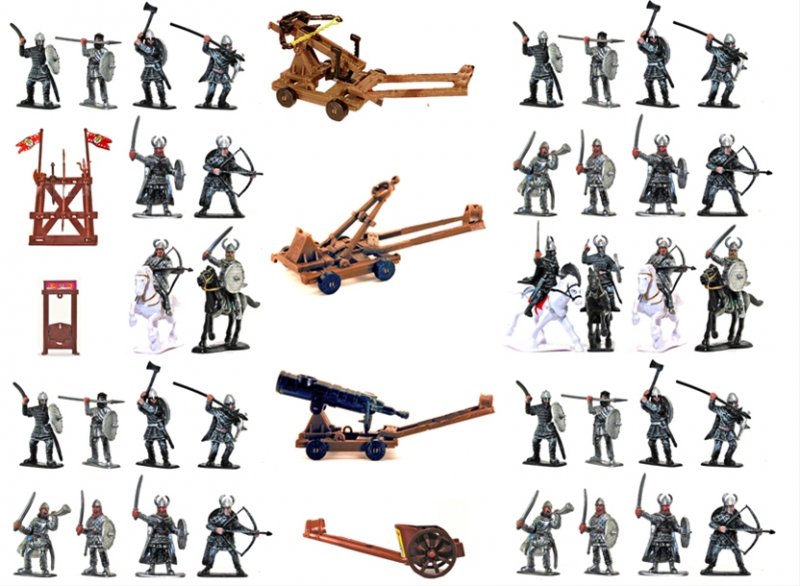
Rules for Medieval Toy Soldiers
Introduction
"Ringmail" was an improbable historical construct. So too these rules are an improbable match to anything historical. But they sure are fun!
Scale
Toy soldiers are 1:32 scale; that is 2&¼" or 54mm.
Field of Battle
Arrange a field of battle anywhere from 6' to 24' in dimensions. Determine battle line between opposing sides in roughly the middle of the field. Each side has a starting line set back from the battle line equivalent to that of their opponent's and no less than 24." Main stronghold, camp or pavilion of each side no more than 12" back from respective start-lines. Scale of play is such that terrain types and penalties make little sense. Distribute interesting obstacles for tactical use. Recommended: felt battle mat marked with 2" hexes; model trees, blue ribbon for rivers, etc.
Composition of Forces
Each side has one or two engines of war. Arrange each side with troop types falling roughly within the following ratio:
1 Archer : 3 Cavalry : 5 Infantry
Turn Sequence
- Engine
- Range
- Melee
- Move
All actions simultaneous. Alternatively, players determine initiative for movement by opposing check. First turn: move only. Second turn: move and melee (if any). Third turn adds range. Fourth and all subsequent turns: all four phases.
Movement
- Engine 3"
- Archers 6"
- Infantry 12"
- Cavalry 24"
Range & Melee
Range fire and melee resolved with modified rock-paper-scissors:
- Archer removes cavalry (24" range)
- Cavalry removes infantry
- Infantry removes archer
All other melee resolved on opposing check: loser removed; both remain on ties. Note the following exceptions:
- Cavalry and archer opposing check in melee
- Both archers remain when attacker losses opposing check against archer not returning fire
- Flank (side) or surprise (rear) attack of lesser to greater allows opposing check
- E.g., infantry flanking cavalry resolved by opposing check
Engine
- Redo misfires
- Remove any figure hit by projectile
- Remove engines hit by opposing engine fire
- Take engines with two or more troops of opposing side on successful opposing check
Morale
Check a force's morale at the top of every turn after reduced beyond half its original line-up: maintain morale on 2d6 = 7+ otherwise morale lost.
End
Battle ends when one or both sides:
- Losses morale
- Reduced to less than a third its original line-up
- Surrenders
Victory
Victory goes to the side that:
- Does not loose morale
- Is not reduced to less than a third its original line-up
- Does not surrender
Otherwise a draw. Alternatively, other end and victory conditions may be agreed upon; e.g., attaining some goal such as capturing an object or flag, etc.
Sieges
Make walls with gates and even some wall-portions that engine fire can topple. One additional engine to the defender but defender starts with one third the troops of the besieger. Imagine any foot soldier positions along a wall or upon a parapet as capable of range fire, whether depicted with range weapon or not.
Point Values
- Engine 5
- Cavalry 4
- Archer 3
- Infantry 2
Setting up a Medieval Toy Soldier Wargames Campaign
Each side starts with 50 points to acquire starting forces. Note guidelines to composition of force, above. After each battle, save for the return of removed troops on 2d6:
- Engine 6+
- Cavalry 6+
- Archer 7+
- Infantry 8+
Victor gets 20 points, looser 10. Capture of opposing "baggage" or some other such treasure, object or goal grants 5 points. Each side of a draw gets 15 points. Unused points accumulate. Use points to acquire new forces for subsequent battles.
Fantasy Supplement
For a fantasy scenario, use larger scales for large types (e.g., tall elves, trolls, ogres, etc.) and smaller scales for diminutive types (e.g., small elves, dwarves, hobbits, pixies, etc.).
Mark one or more figures per side to indicate special status as a hero, wizard, or knight (i.e., "Templar" or "cleric").
Hero = best of both cavalry and archer; removed by archery
Wizard = best of both archer and infantry; removed by infantry
Knight = best of both infantry and cavalry; removed by cavalry
Heroes melee and range monsters with equal opposing check; defeat monsters by flanking or surprise. Heroes and wizards range fire as archers (wizards by magic). In any given battle wizards may cast each of the following once per battle: fireball, lightning bolt, light (good wizard) or darkness (bad wizard) during the engine turn phase. Light spells cause fell and undead creatures to check morale with a penalty. Darkness spells cause normal troops to check morale with a penalty. Resolve fireball and lightning bolt as engine fire. Lobbing a colorful marble with the thumb usually does the trick. During the engine phase knights may do one of the following per battle: restore one removed figure upon a successful save (see above); cast light (Dark Knights cast darkness); dispel undead creature. Heroes, wizards and knights cost 10 points and those removed in battle save for the next on 2d6: 5+.
A Sort of Challenge
"How much better is the amiable miniature than the Real Thing! Here is a homeopathic remedy for the imaginative strategist. Here is the premeditation, the thrill, the strain of accumulating victory or disaster -- and no smashed nor sanguinary bodies, no shattered fine buildings nor devastated country sides, no petty cruelties, none of that awful universal boredom and embitterment, that tiresome delay or stoppage or embarrassment of every gracious, bold, sweet, charming thing, that we who . . . remember a real modern war know to be the reality of belligerence." H. G. Wells, Little Wars, 1913.
Fight on!
Saturday, September 10, 2016
Skeletons In The Closet
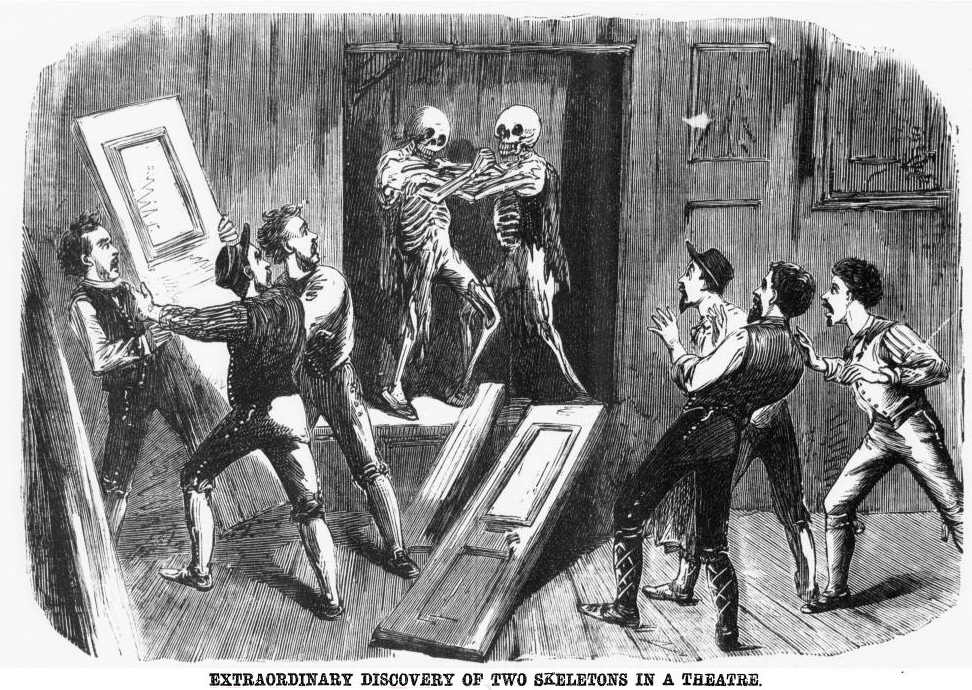
MM01
A Haunted House Mini-Module for Normal Characters (Levels 1-3)
Introduction
Use this mini-module for character levels 1-3; in conjunction with other mini-modules use to represent dungeon levels 1-4. For use with higher-level characters, see end notes.
Background
A powerful Lady, forlorn of her true love fell prey to a trickster medium. She became a Wight through repeated attempts to contact her dead lover. The medium traps the Wight of the Lady in her abandoned house.
Referee Notes
- Describe features and furnishings as a typical victorian mansion
- Characters looking through windows see a grey-blue twilight world of forlorn ghosts and shades (see "exit," below)
- Determine level-based treasure according to relative level of use
All Closets:
2d6 Skeletons: burn or pulverize to prevent magical reassembly in 3 rounds; silver coin in each mouth
AC7 MV6 HD1/2
Underneath all beds hide
Hobgoblin:
AC5 MV9 HD1+1
Link to Campaign NPC
The Wight is ancestor to a powerful Lord who keeps it secret. If PCs inform others, the powerful Lord will prosecute them and ban them from his territories. If PCs put the wight to rest, keep the secret and inform the Lord, he will reward them accordingly.
Rumor Table
- T Lord Campaign NPC Name don't want nobody knowing about that old place
- F Nothing in there but rats and roaches
- T There's a crazy old witch (medium) what lives in there
- F If you go in there, you'll turn into a ghost yourself!
- T Legend has it if you put to rest the old lady's Wight you'll get a share in her inheritance!
- F All the treasure belongs to wicked hobgoblins
Unique Monster
Haunted Rocking Chair
Rocks incessantly of its own; voices of crying baby and lullaby-singing mother
Attacks upon touch; folds in on itself if sat upon (2d6 damage)
All touched: Save vs. "Fear"
AC7 MV3 HD2
Unique Magic Item
Ouija Board of Speak with Dead: Chaotic in alignment: harms characters as per magic swords with each use. Use up to three times per day to ask single question of deceased familiar or for ESP
Entry
Characters who enter through either front or back porch areas see only a dilapidated house full of decaying furniture and cob-webs. Characters who enter from another mini-module enter directly through the chimney or to the stairwell of the second floor if going down to this mini-module from above, or into the fruit cellar beneath the kitchen if going up to this mini-module from below.
Time Element
If characters do not engage Medium in seance, wight appears above table to search for characters 1 turn from their departure from the chamber
Exit
Characters who exit through windows or doors find that the grey-blue twilight realm disappears and that they are in the setting where the referee has placed the house. Referee allows hatch in cellar and attic door when stacking further mini-modules above or below this mini module. Ignore otherwise.
Map
Ground Floor

Second Floor

Key
Ground Floor
Dining
Large dining table set with silver platters and candelabras; dining chairs move of their own
Blow out or snuff candles: save vs. curse
Clues: Guest book on stand has a reminder to the butler "it is rude to have unlighted candles at table;" mural on the wall depicts angels holding candles and demons with snuffers; snuffer on the table cannot be picked up until candles extinguished by other means
Treasure: 12 dining sets of silver and 2 silver candelabras: level treasure in value
Kitchen
2d6 Zombies preparing and serving "meal" of dust and ashes between kitchen and dining
Will eat brains of fallen victims, rendering them zombies
AC8 MV6 HD1
Morning
Room filled with flowers, wreaths and sprays of Lady's funeral: Touch turns to ash
Bathroom
Chanting "Bloody Mary" staring at the mirror in the dark will conjure the Wight through mirror
If Wight already dispatched, wraith appears
Utility
Sinks with ashen and charred remains of previously blasphemous seances
Parlor
Chimney may be used to move between stories; also between mini-modules at referee's discretion
Portrait of Lady above mantle; behind portrait: safe:
Treasure: per level + magic sword
Clues: Portrait slightly crooked; Lady pictured with jewels in her lap; folded note on mantle reads "true riches hide behind mere representations"
Monster: Haunted Rocking Chair (See Unique Monster, above)
Stairwell Up
Trap: Stairs turn to slide (d6: 1-2) per ascending character; may be stopped by jamming something between stairs
Clues: sign in magic above stairwell entry reads "some may not ascend;" marbles on floor in front of stairs; painting to the side depicting children on a slide
Hall
Gas lamps light hall with cool eerie blue: If characters address house, lamps answer yes/no questions dimming once or twice; also alphabet or morse code per referee ability
Skeletons in Hall Closet defend huge sapphire (1Kgp): rings like crystal glass upon touch
Second Floor
Bedroom Top Left
The Lady's Bedchamber: canopy bed
Vanity with chair and mirror flanked by candles that never burn out until removed
Lady appears in mirror when character sits in chair
Jewelry box, save vs. poison gas (clue: poison symbol on lid), inside:
Treasure: per level & 3 gems (large agate 500gp, medium diamond, 500gp and medium pearl 500gp)
One item of Jewelry: The Lady's Elegant Hairpin: (7Kgp) Solid gold with large agate that glows on touch; save vs. geas: character must wear hairpin and seek the admiration of others
Bathroom Top Middle
As per "bathroom," above
Also medicine cabinet contains 1d6 poisons and 1d3 potions, all unlabeled
Bedroom Top Right
The Lost Lord's Bedchamber
Portrait of Lady's lost love: Eyes follow characters movement
Skeletons in closet defend magic armor
Hall
As per "hall" on ground floor, above
Stairwell Down
Trick: Stairwell actually leads up (d6: 1-2) per descending character: Grants access to next mini-module upwards when used in connection with others; Otherwise leads to widow's peak surveying haunted lands
Clues: sign in magic above stairwell entry reads "sometimes you've got to get down to get up;" Picture in hallway of widow's peak above house; bird feathers on the floor
"Bedroom" Bottom Left: NOT BEDROOM but: Seance Chamber
Chimney may be used to move between stories
Round table in area shaped as partial octagon
Ouija Board of Speak with Dead (see Unique Magic Item, above) in middle of table
Chandelier above
Medium sits at table; greets characters; invites to seance
Seance conjures wight over table; Wight attacks
Medium charms characters who resist
If characters dispel or, upon defeat, pray the Wight to Rest in Peace: Wight disappears in exhausted sigh, full level treasure + magic weapon issues from chandalier onto seance table, covered in ectoplasm
Medium MU Lvl 1; Silver Dagger; Spell: Charm
AC9 MV12 HD1
Wight: impervious to normal range-fire: successful attack = 1 life-energy drain; renders killed victim wight
AC5 MV9 HD3
Bathroom Bottom Right
As per "bathroom," above. Also treasure:
Shiny Golden Toilet Seat (500gp) attached to wire triggering guillotine trap from ceiling
NOT DEPICTED
Large fruit cellar accessible through hatch in kitchen and down ladder
Used in connection with other mini-modules, characters find hatch to next level under treasure
Treasure by level
Monster: 1d6 Ghouls emerge from earthen floor
AC6 MV9 HD2
Tiny attic door with ladder above second floor hall grants access to next mini-module when used in connection with others
Modifications for Heroic Characters (Levels 4-7)
Haunted Rocking Chair: HD6 2d6 normal dmg., 3d6 folding bite
3d6 Skeletons in closets wield rusty shields (AC6)
1d6 Hobgoblins under beds
Zombies become ghouls
Ghouls become Wights
Wight becomes 1d3 Wraiths (sisters, perhaps?)
Medium becomes Witch (Warlock, Lvl 8)
Adjust all treasures per relative dungeon level
Modifications for Super-heroic Characters (Levels 8+)
Haunted Rocking Chair: HD12 2 attacks, 3d6 dmg., folding bite poisonous
4d6 Skeletons in closest wear rusty armor (AC3)
Troll under beds
Zombies become Wights
Ghouls become Wraiths
Wight becomes Spectre
Medium becomes Necromancer (Lvl 10)
Adjust all treasures per relative dungeon level
FIGHT ON!
Monday, September 5, 2016
Mini Module Project

An Idea
My idea of a "mini modules" project is linked to my desires to link the mythic underworld with demon haunted lands in the Perilous Realms. I love how TSR called them "modules," not "adventures." Use of the term "Adventures" seems like what I am getting is going to be self-contained and goal, if not narrative oriented. "Module," sounds, to my ears, well, modular. And here I mean not only something that could be dropped into a sandbox setting (their original implication, I think) but droppable in relationship to each other in terms of a multi-layered dungeon.
My idea of a "mini modules" project is linked to my desires to link the mythic underworld with demon haunted lands in the Perilous Realms. I love how TSR called them "modules," not "adventures." Use of the term "Adventures" seems like what I am getting is going to be self-contained and goal, if not narrative oriented. "Module," sounds, to my ears, well, modular. And here I mean not only something that could be dropped into a sandbox setting (their original implication, I think) but droppable in relationship to each other in terms of a multi-layered dungeon.
When the OSR came on-line, the word "megadungeon" entered our vocabulary. But I feel constricted by mega-dungeons in a different way. The idea that everything that adventurer's would need for an entire campaign is under one castle seems to constricting and too much like I'm playing Q*bert, or Pac-Man rather than exploring a real perilous realm.
Each mini module would be 1 to 3 levels (preferably 1) and the mini module would have stairs up and down, thus making the mini modules compatible with each other. If used as a "one off," the ref would ignore the stairs, teleports, etc., to other levels. If used in conjunction with other mini modules, those connecting points would be used.
But here is my other idea. What if each map was keyed three times: once for normal leveled characters, then for heroic and finally for super heroic and beyond. So, for example, a kobold lair for normals, a hobgoblin for heroic and a troll for super-heroic. Thus many birds are killed with one stone. Or, again, a wight borrow for normals, a mummy's tomb for heroes, a vampire's undercroft for super-heroes.
The mini modules would be fairly "vanilla" so that they could fit in anybody's setting with just minor tweaking. Next, there would be just enough standardization that the modules would be "modular," that is to say, mutually compatible.
Standards
Standards
Here could be some standard "design" elements, kind of like a template in a wiki:
Introduction
Background
Note(s) for the Referee
Unique Monster
Unique Magic Item (or Treasure)
Map(s)
Key(s)
*Link to Campaign NPCs
*Rumor Table
*Start (or Entry)
*Time Element
*End (or Exist, or Conclusion)
*Wandering Monster Table
So, again, the name is "Mini-Module," so we are going for minimalism and assuming a referee with familiarity with 0e or similar rules. We are going for the kind of sketch we actually make for ourselves, rather than some poetic full-description plush product. So, some general rules (of thumb?) might be:
- No more than three sentences per the above headings (excepting the key(s), of course), preferably one.
- And, as implicit, only one unique monster and one unique magic item or treasure per mini-module. NOTE: word choice is "unique," not "new." The idea being these are one-off freaks, not stuff to gather up in a "Monster Manual."
- Give basic stats for each monster.
- No more than a noun phrase description, or, at most, sentence for a room, and then only if truly necessary.
- Give rest of main treasure and other treasure by level or type only: assume the referee can use the books or a compatible on-line generator -- even at table if necessary.
- Preferable one map and one key.
General composition rules (of thumb):
- Focus is on retrieval of main focal treasure.
- Trick or wonder likely hides/guards/ or directs to this treasure, otherwise guarded by thematic BBEG or trapped.
- Trick or wonder has at least 3 clues.
- Main monster and theme of lair linked thematically to main treasure.
- Half rooms/spaces empty.
- Of the other half, ⅔ rooms/spaces treasure ½ guarded, rest ½ hidden, ½ trapped.
- Traps have 3 to 5 clues.
- 1/6 remaining rooms have monster(s).
- ½ thematically related to theme monster, the rest "random."
- If presented as print-ready, map and key lay flat side-by-side with one another.
The asterisked items are optional:
- The "Link to Campaign NPCs" would be a suggestion for how to hook the module not just to other modules or the campaign setting, but to major movers in the campaign world with a quick suggestion as to how the clearing of the lair would affect this NPC and, thereby, the PC party. How to do this generically? And in one sentence? Something like this: "An important Lord/Wizard/Patriarch (does not) want(s) the party to X the lair, if they succeed, NPC will Y."
- "Rumor Table" is always fun: d6 or at most d10, with T/F marked and at least half F.
- "Start/End," again, only if truly necessary.
- "Time element" allows for time pressure to enter. Keep to a one sentence description: "Once PCs do/perform/take/ cross/enter X, NPC NAME / MONSTER will Y in N turns."
- "Wandering Monster Table," only if both a.) deemed truly necessary and b.) a simple (d6, d10?) table.
Finally, if we go with the idea of keying each mini-module so that it could be compatible with different character level tiers, each mini-module would conclude with two of the following three headings, depending upon the original target level:
Constraints Aid Creativity
And here is a nice article about how constraints actually aid creativity:
Modifications for Normal Characters (Levels 1-3)
Modifications for Heroic Characters (Levels 4-7)
Modifications for Super-heroic Characters (Levels 8+)
Constraints Aid Creativity
And here is a nice article about how constraints actually aid creativity:
Mini Module Title Ideas
Here is a list of possible "mini-module" titles based upon the monster list and some magic items. Namely, those monsters that clearly constitute the mythic underworld (vs. wilderness) in my loose estimation and the misc. magic items (some, not all of them):
Here is a list of possible "mini-module" titles based upon the monster list and some magic items. Namely, those monsters that clearly constitute the mythic underworld (vs. wilderness) in my loose estimation and the misc. magic items (some, not all of them):
The Monsters:
The Bandit’s Lair
The Brigand’s Redoubt
Berserker’s Mountain
Revenge of the Mad Dervishes
Nomads of Wasteland
Pirate’s Cove
Buccaneer’s Bounty
Cavern’s of the Lost Cavemen
Mermen’s Hidden Mere
Tucker’s Kobolds
Night at Goblin Mound
The Minions of Orcus
The Gnoll Knoll
The Ogre’s Horrid Banquet
Cairn of the Troll Lord
Rebirth of the Nephalim
Jotunheim’s Anvil
Cloud Castle of the Giant King
Temple of the Titans
Cave of the Cyclopes
Skeletons in the Closet
Escape from Zombie Plantation
Graveyard of Ghouls
Barrow of Wights
Tomb of Wraiths
Curse of the Mummy King
The Spectre’s Haunted Mansion
The Vampire’s Undercroft
Lair of the White Wyrm
Black Dragon Swamp
Glade of the Green Dragon
Blue Dragon Dunes
The Red Dragon’s Deepest Delves
The Search for the Golden Dragon
The Halls of Hell (Demon / Balrog)
The Werewolf’s Dire Den
The Hidden Weretiger of the Mountain Monastery
The Ratcatcher’s Nightmare (Wererat)
Feast of the Boar’s Head (Wereboar)
The Skin-changer’s Longhouse (Werebear)
The Minotaur’s Labyrinth
Search for the Unicorn Maiden
The Nixies Netherkingdom
The Craggy Peaks of The Roc Eyrie
The Gate to the City of Brass
The Salamander’s Sea of Lava
Ruins of the Living Idol
The Golem’s Gold
The Android’s Secret Program
The Treasures:
The Search/Quest/Hunt for:
The Scrying Ball
The Medallion that Makes Minds Known
The Amulet of Mental Protection
The Scarab that Spells the Pagan Priests’ Repulsion
The Bottomless Bag
The Censer of Elemental Air
The Stone of Elemental Earth
The Brazier of Elemental Fire
The Bowl of Elemental Water
The Efreeti’s Bottle Chamber
The Djinni’s Lamp
The Elven Cloak of Old
The Boots of Speed / Levitation / Leaping
The Witch’s Flying Broom
The Flying Carpet of Old Araby
The Beating Drums of Panic
The Horn of Blasting
The Ogre’s Mighty Gauntlets
The Giant’s Strong Girdle
The Mirror that Traps Souls
The Teleportation Machine
The Crown, Orb and Scepter of the Ancient Kings / Priests / Magi
The Stone Crystallization Projector
I just went through the lists and tried to give a fun, youthful, pulpy adventurous title based upon each. So, a mini module on each classic monster. Or each classic treasure. And, come to think of it, starting with the treasures (the real "goal" of the game in 0e) may actually be best, linking the key treasures to key monster-types.
So, e.g., if orcs subsume elven ruins, then the elven cloak and boots may be hidden away in the lair of the Minions of Orcus! Then we would get: the Search for the Elven Cloak and Boots in the Lair of the Minions of Orcus! Now that sounds fun to me!
Background
Background
I love B1 and B2, but I kind of just wish they had made a module for each major monster. Likewise I love the Judges' Guild Wilderlands, but, for me in our current one session a month gaming style, I need something that fits a bit more nicely into a single session. Hence my "mini module" idea.
I think another thing that I love about 0e is that it is prior to the feed-back loop of D&D world-generation separate from the main western tradition. I play 0e because I want a set of simple rules in order to walk into (pre 1974) the fantasy land of our classical, western legendaria. Beholders and Liches are fine, I suppose, but, for me, as one-off unique monsters. I still want my plane jane vanilla standby monsters.
Here is another way to put it. If I were a Napoleonic war gamer, I would want my knowledge of actual Napoleonic warfare to contribute to my success at a given scenario.
Likewise, as a player of 0e, I want, for myself and for my players, to find reward in knowing the classical and romantic legends of our heritage.
Here is an example: I was thinking the other day of a high-level NPC vampire in one of my campaigns. I had decided he was going to surprise attack a PC at night in his own castle -- I mean, he has gaseous form and can be a bat and all that. But then I remembered: vampires cannot enter where they have not been invited. My knowledge of the monster, as our collective inheritance, guided my decision -- regardless of the fact that this is not in the description of vampires in the rules. Instead, I had the good count meet a high lvl CL just outside his camp pavilion one night. "Are you going to be rude, or are you going to invite me in?" The player knew to say "no"! So he was rewarded. His tent was a safety zone.
So, for example, the description of Ogres in 0e is pretty scant. You need to know that they are small giants who delight in eating human infants! Thus I named that mini-module "The Ogres Horrid Banquet." In it, I would try to imagine some way in which knowledge of the classic archetype of an ogre would be rewarding to the player's exploration and discovery. Etc.
Possibly a Shared Project
Now let's make it even crazier: What if we made a free, "share-ware" on-line resource for people by building a "setting" through multiple "mini-" modules. Perhaps a "wiki" would be better for this, I don't know. But I would love to hear ideas from folks who find this interesting or inspiring.
Now let's make it even crazier: What if we made a free, "share-ware" on-line resource for people by building a "setting" through multiple "mini-" modules. Perhaps a "wiki" would be better for this, I don't know. But I would love to hear ideas from folks who find this interesting or inspiring.
Monday, March 7, 2016
A Supplement for Perilous Realms
After many conversations over many fora my first old school project is finally available!

A Supplement for Perilous Realms: Suggestions for Pick-up Sessions and Otherwise Rollicking Fantastic Medieval Wargames Campaigns Playable with Original Edition Rules and their Various Simulacra
The Lulu version is currently $4.15
If you buy it you will help contribute to my becoming a hundredaire through old school self-publication!
Otherwise, a free PDF is also available
Share, enjoy, let me know what you think!
Thanks!

A Supplement for Perilous Realms: Suggestions for Pick-up Sessions and Otherwise Rollicking Fantastic Medieval Wargames Campaigns Playable with Original Edition Rules and their Various Simulacra
The Lulu version is currently $4.15
If you buy it you will help contribute to my becoming a hundredaire through old school self-publication!
Otherwise, a free PDF is also available
Share, enjoy, let me know what you think!
Thanks!
Subscribe to:
Posts (Atom)